You go down to the basement and notice something on the walls. White, chalky, sometimes crystalline deposits that weren’t there before — or maybe they’ve been building up so gradually you’re only now paying attention. Your first thought might be mold. Your second thought might be panic.
Take a breath. What you’re looking at is almost certainly efflorescence, and while it’s not dangerous in itself, it’s your foundation sending you a message. A message worth reading.
What Is White Powder on Basement Walls?
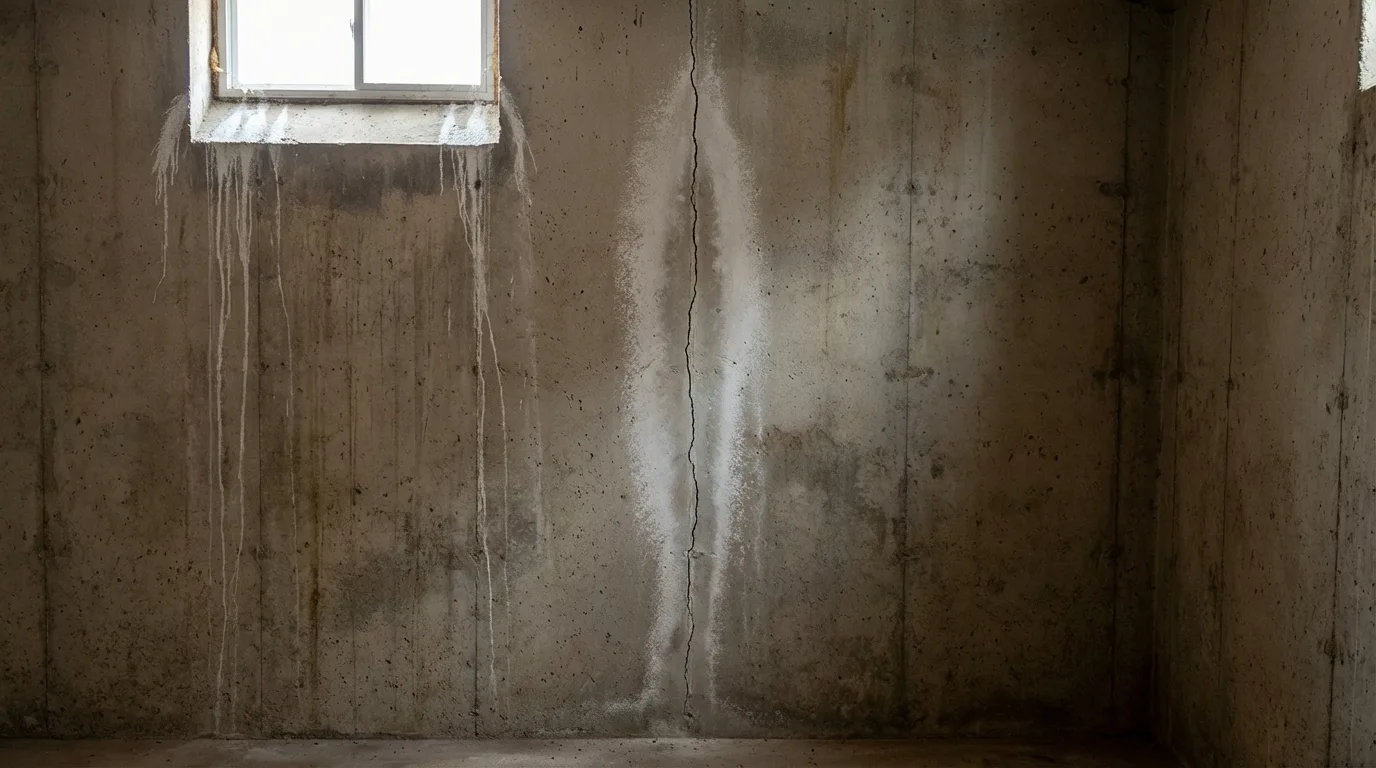
Efflorescence is a white, chalky, or crystalline deposit that forms on basement walls when water moves through concrete and evaporates on the interior surface, leaving dissolved mineral salts behind. It is not mold and is not harmful in itself, but it is a reliable indicator that moisture is actively migrating through your foundation — which can lead to mold growth, structural deterioration, and ongoing humidity problems if the source is not addressed.
Here’s the process in detail:
- Water enters your concrete wall from the outside — through the soil, through cracks, or through the concrete’s natural porosity.
- As the water moves through the concrete, it dissolves mineral salts (primarily calcium carbonate, sodium sulfate, and potassium sulfate) that are naturally present in concrete and morite.
- When the water reaches the interior surface and evaporates, it leaves those dissolved minerals behind as a white, powdery, or crystalline deposit.
That’s it. Efflorescence is mineral residue left behind by evaporating water. Think of it like a bathtub ring — the minerals were always there, hidden in the concrete. The water just brought them to the surface.
The word itself comes from the French “to flower out,” which is actually a pretty accurate description. The minerals bloom on the surface like frost flowers.
Is Efflorescence Dangerous?
No. Efflorescence itself is completely harmless. You can touch it, brush it off, even taste it if you’re particularly curious (it’s salty — we don’t recommend this as a hobby). It won’t damage your health, your belongings, or even your concrete.
But here’s the important part: efflorescence is a symptom, not a disease. The deposits themselves are harmless, but the moisture that creates them is potentially not. Chronic moisture movement through your foundation walls can lead to:
- Mold growth. The damp conditions that produce efflorescence are the same conditions mold loves.
- Structural deterioration. Persistent water movement through concrete can slowly erode the material, especially in older walls with high lime content.
- Rebar corrosion. If your poured concrete walls have steel reinforcement, moisture reaching the rebar can cause it to rust and expand, cracking the concrete from within.
- Indoor humidity problems. All that moisture evaporating into your basement raises humidity levels, which affects everything stored down there and can impact your whole house.
Treating efflorescence without addressing the moisture source is like wiping fog off a window without fixing the leak. You’ll be wiping again next week.
Efflorescence vs. Mold: How to Tell the Difference
This is the question that brings a lot of people to their search engine at midnight, and it’s a fair one. Both can appear as white or light-colored deposits on basement walls. Here’s how to tell them apart:
Efflorescence
- Texture: Crystalline, powdery, or crusty. Feels gritty if you rub it between your fingers.
- Color: Always white or off-white. Occasionally yellowish if iron minerals are present.
- Location: Typically appears on concrete, block, or masonry surfaces — the wall itself.
- Behavior: Brushes off easily in a dry, powdery form. Dissolves in water (try touching a damp finger to it — it will dissolve).
- Smell: None.
Mold
- Texture: Fuzzy, slimy, or velvety. Feels soft or damp.
- Color: Can be white, but also green, black, gray, or spotted.
- Location: Can grow on any surface including wood, drywall, and stored items — not just masonry.
- Behavior: Does not dissolve in water. May smear if wiped but doesn’t powder.
- Smell: Often musty or earthy.
The Water Test
Still not sure? Put a few drops of water on the deposit. If it dissolves and the surface looks clean, it’s efflorescence. If it stays put, you might be dealing with mold, and you should get it tested.
If you find actual mold in your basement, that’s a different situation requiring different expertise. But the underlying cause — moisture intrusion — is something we can absolutely help with.
What Efflorescence Tells You About Your Foundation
Here’s where efflorescence gets genuinely useful. Think of it as a diagnostic map. Where you see efflorescence is where water is moving through your wall. And the pattern tells a story.
Along a Crack
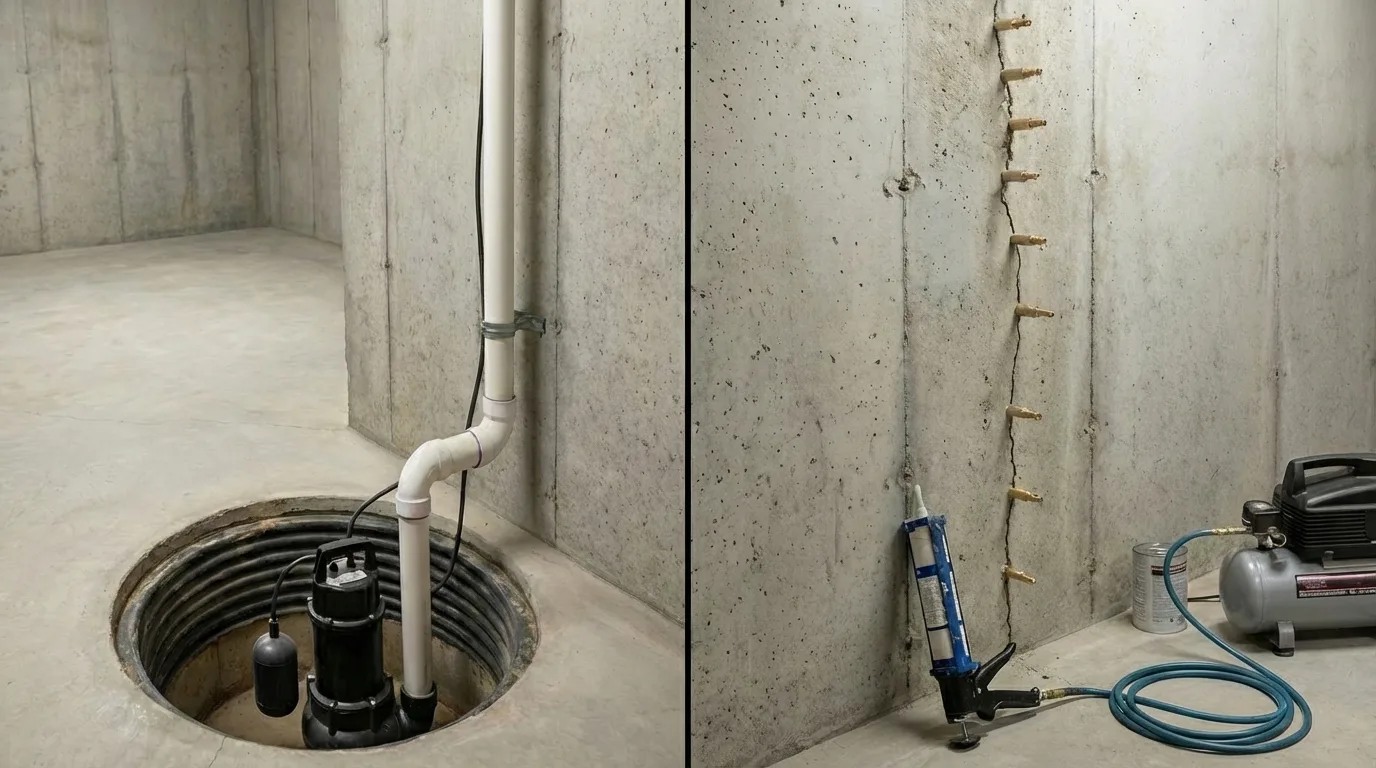
Efflorescence concentrated along a visible crack means water is actively entering through that crack. This is the most straightforward scenario: seal the crack, stop the water, no more efflorescence. Foundation crack injection is typically the solution here.
Along Mortar Joints
In cinderblock or brick foundations, efflorescence following the mortar joints tells you the mortar is deteriorating and allowing water passage. This is common in foundations built before the 1970s. See our cinderblock foundation repair guide for approaches to this problem.
Across a Large Area
Widespread efflorescence across a broad section of wall — not following any particular crack or joint — indicates that water is moving through the concrete itself. This usually means significant hydrostatic pressure is forcing water through the wall’s natural porosity. This is a more serious situation that may require exterior waterproofing or drainage improvements in addition to any crack repairs.
At the Floor-Wall Joint
Efflorescence concentrated where the wall meets the floor is extremely common. This joint — called the cove joint — is a natural weak point where the wall sits on the footing. Water under hydrostatic pressure finds this gap readily. Interior drainage systems can address this, though sealing any nearby cracks with injection helps reduce the overall water load.
High on the Wall
Efflorescence near the top of the wall might indicate surface water issues — gutters overflowing, grading sloping toward the foundation, or window wells collecting water. Before you invest in foundation repair, check the simple stuff. Sometimes re-grading or fixing a downspout solves the problem.
Cleaning Efflorescence
You can clean efflorescence, and here’s how. Just understand that cleaning is cosmetic maintenance — if the moisture source remains, the deposits will return.
Dry Brushing
For light deposits, a stiff nylon brush is all you need. Brush the deposits off the dry wall and sweep or vacuum them up. Don’t use a wire brush on concrete — it can damage the surface and create new pathways for water.
Vinegar Solution
For heavier deposits, a solution of one part white vinegar to three parts water works well. Apply with a spray bottle, let it sit for a few minutes, then scrub with a nylon brush and rinse. The mild acid dissolves the mineral deposits effectively.
Muriatic Acid
For severe, thick efflorescence that vinegar won’t touch, a diluted muriatic acid solution (about 1:10 ratio with water) is the heavy-duty option. Use extreme caution: work in a well-ventilated area, wear rubber gloves and eye protection, and never mix muriatic acid with any other cleaning products. Rinse thoroughly afterward. Most homeowners don’t need to go this route — if your efflorescence is this severe, the moisture problem is significant enough to warrant professional attention anyway.
Fixing the Underlying Problem
This is the part that actually matters. Cleaning is temporary. Stopping the water is permanent.
Step 1: Check the Easy Stuff
Before calling anyone, walk around the outside of your house after a rain and check:
- Gutters and downspouts. Are they clear? Do downspouts discharge at least 4-6 feet from the foundation?
- Grading. Does the soil slope away from the foundation? It should drop about 6 inches over the first 10 feet.
- Window wells. Are they draining properly, or holding water against the wall?
- Irrigation. Are any sprinklers watering your foundation?
You’d be amazed how often we visit a home with basement moisture problems and find a disconnected downspout dumping roof water right against the foundation. Free fix.
Step 2: Seal Foundation Cracks ($800-$1,300 Per Crack)
If efflorescence is following a crack, that crack needs to be sealed from the inside out. Our foundation crack injection process injects material at approximately 100 PSI, filling the crack through the full 8-10 inches of wall thickness, stopping water at its source. For cracks showing structural movement, we may combine injection with carbon fiber reinforcement (also called carbon fiber staples) at $200-$300 per stitch.
For a full understanding of when professional repair makes sense versus when you can handle it yourself, see our guide on DIY vs. professional foundation repair.
Step 3: Address Systemic Moisture
If your efflorescence is widespread — covering large areas without following specific cracks — you may need more comprehensive moisture management:
- Interior drainage systems to collect water at the cove joint and direct it to a sump pump
- Exterior waterproofing membrane applied to the outside of the foundation wall
- French drain installation to redirect groundwater away from the foundation
These are bigger projects, but they solve the problem permanently rather than chasing individual symptoms.
When NOT to Ignore Efflorescence
Most efflorescence is a minor nuisance pointing to a manageable moisture issue. But sometimes it’s waving a red flag:
- Efflorescence accompanied by crumbling concrete. If the wall surface is deteriorating where the deposits appear, the moisture may be causing chemical breakdown of the concrete itself.
- Increasing efflorescence over time. If the deposits are getting heavier year over year, the moisture problem is getting worse, not better.
- Efflorescence with structural cracking. If you see mineral deposits along a crack that’s also showing displacement or widening, you’ve got both a moisture and a structural problem that needs professional assessment.
- New efflorescence after heavy rain. If deposits appear rapidly after rain events, the water path is direct and significant.
The Bottom Line
Efflorescence is your foundation talking to you. It’s saying: “Water is coming through here.” Whether that’s a minor issue you can fix with a gutter repair or a significant problem requiring professional crack injection depends on the pattern, the severity, and the source.
If you’re seeing white powder on basement walls and want to know what it means for your specific situation, we’re happy to take a look. Our free foundation consultations include a thorough assessment of moisture indicators like efflorescence, crack patterns, and drainage conditions. Text us a photo for a quick assessment — we’ll help you decode what your basement is trying to tell you. After 50+ combined years of foundation work, there is no efflorescence pattern we have not diagnosed. 860-573-8760 (CT) | 617-668-1677 (MA)If you’re seeing white powder on basement walls and want to know what it means for your specific situation, we’re happy to take a look. Our free foundation consultations include a thorough assessment of moisture indicators like efflorescence, crack patterns, and drainage conditions. Text us a photo for a quick assessment — we’ll help you decode what your basement is trying to tell you. After 50+ combined years of foundation work, there is no efflorescence pattern we have not diagnosed. 860-573-8760 (CT)If you’re seeing white powder on basement walls and want to know what it means for your specific situation, we’re happy to take a look. Our free foundation consultations include a thorough assessment of moisture indicators like efflorescence, crack patterns, and drainage conditions. Text us a photo for a quick assessment — we’ll help you decode what your basement is trying to tell you. After 50+ combined years of foundation work, there is no efflorescence pattern we have not diagnosed. 617-668-1677 (MA)