The Question We Hear Every Week
“Do I need a sump pump or crack injection?” It is one of the most common questions homeowners ask us, and it is the wrong question. Not because it is a bad question, but because it assumes these two solutions compete with each other. They do not. A sump pump and crack injection solve fundamentally different problems, and understanding that difference is the key to spending your money on the right fix.
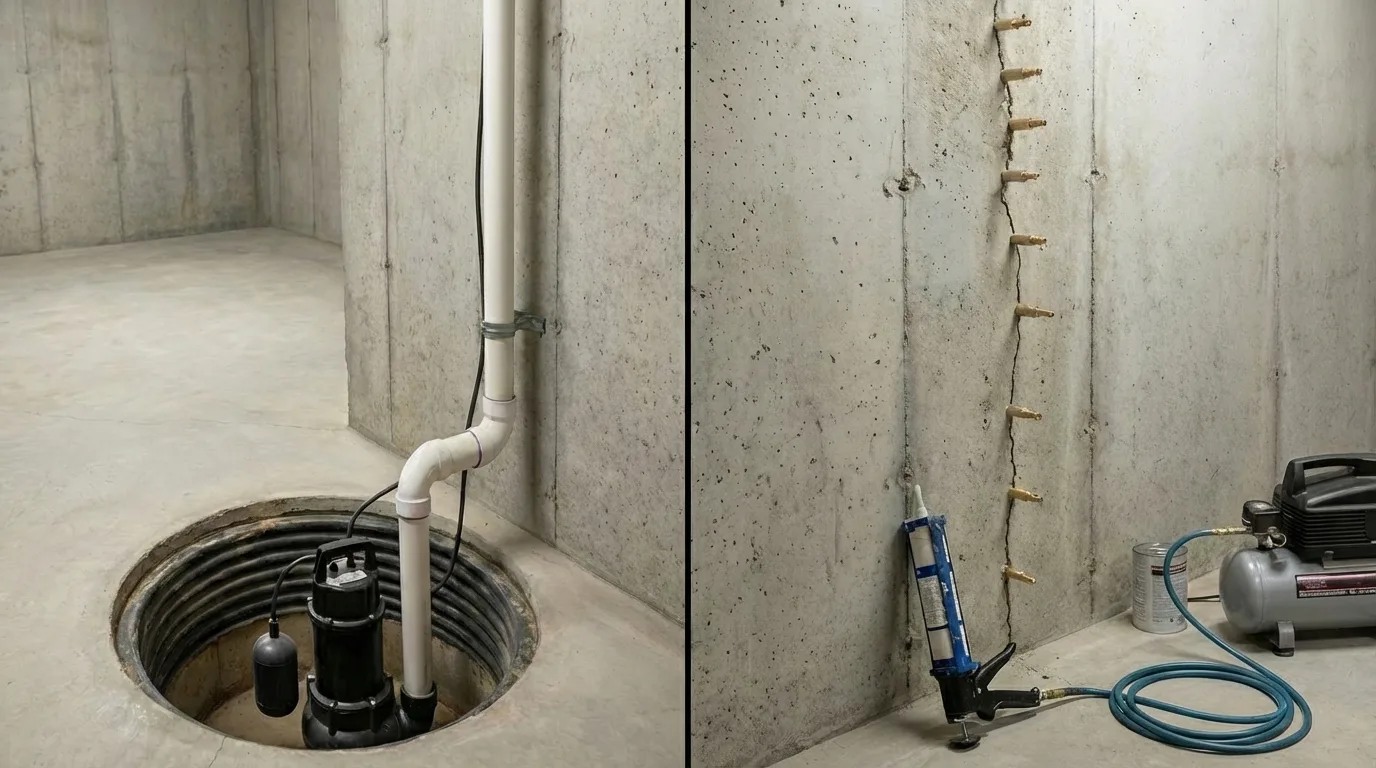
Here is the short version: crack injection stops water from entering. A sump pump manages water that has already entered. One is a seal. The other is a pump. They work at different points in the water’s journey, and the right choice depends entirely on where your water problem originates.
How Crack Injection Works
When a foundation wall develops a crack, that crack extends through the full 8-10 inches of concrete. Groundwater under hydrostatic pressure — especially in areas with glacial till or clay-heavy soil common across New England — pushes through this crack and into your basement. The crack is the pathway. The fix is to seal the pathway.
Foundation crack injection works by injecting expanding polyurethane or structural epoxy directly into the crack. Injection ports are installed along the crack’s interior surface, and material is injected under pressure until it fills the entire crack from the inside face to the outside face and sometimes beyond. The material bonds to the concrete, flexes with minor movement, and creates a permanent waterproof seal.
The result: water hits the outside of your foundation wall, encounters a sealed crack, and goes elsewhere. It never enters your basement. Problem solved at the source.
When Crack Injection Is the Right Answer
- Water appears at a specific, identifiable crack in the wall
- Moisture staining or efflorescence follows a visible crack line
- Water entry correlates with rain events or snowmelt
- The leak can be traced to one or a few specific locations
- The foundation is poured concrete (the most common scenario in New England)
For a typical wall crack, injection takes a few hours, costs $800-$1,300 per crack (significantly less than waterproofing system installation), and comes with a lifetime warranty. It is, in our professional and admittedly biased opinion, one of the best values in home repair.
How Sump Pumps Work
A sump pump sits in a pit (the sump) dug below the level of your basement floor, usually in a low corner. Water that enters the basement through various pathways, the floor-wall joint, floor cracks, or an interior drain system, flows by gravity into the sump pit. When the water level reaches a trigger point, the pump activates and pushes the water through a discharge pipe to the exterior, away from the foundation.
A sump pump is a water management system. It accepts that water will enter the basement and removes it before it causes damage. It does not stop water from entering. It just makes sure water does not stay.
When a Sump Pump Is the Right Answer
- Water seepage is widespread across the floor or floor-wall joint, not from a single crack
- The water table is high enough to push water up through the floor slab
- Hydrostatic pressure is creating general seepage across a large area
- The home has an interior perimeter drain system (French drain) that needs an outlet
- Seasonal groundwater rise causes basement flooding regardless of wall condition
Sump pump installations are typically more involved and more expensive than crack injection. They require cutting into the basement floor, installing the pit, and routing the discharge pipe. The pump also requires electricity and ongoing maintenance, and it will eventually need replacement (typical lifespan is 7 to 10 years for a quality unit).
Why Sump Pumps Are Often Over-Prescribed
Here is where we are going to be uncomfortably honest, even though it might annoy some people in our broader industry.
Many waterproofing companies default to selling interior drainage systems with sump pumps. It is a bigger job. It costs more. And it is a legitimate solution for certain problems. But we regularly see homeowners who spent $8,000 to $15,000 on a full interior drain system when their actual problem was a single wall crack that could have been fixed with injection for a fraction of that cost.
Why does this happen? A few reasons:
Business model. Some companies specialize in drainage system installation and do not offer injection. When your only tool is a hammer, everything looks like a nail.
Misdiagnosis. Identifying the specific source of water entry requires experience and careful inspection. It is easier to propose a system that addresses every possible entry point than to pinpoint the one that matters.
Conservative approach. There is a defensible argument that a comprehensive system is more thorough. And sometimes that is genuinely true. But “more thorough” should not mean spending ten times more when the problem is localized.
We have written about a similar comparison in our French drain vs. crack injection guide, which covers the indoor drainage system question in more detail.
When You Need Both
There are situations where both solutions genuinely make sense together. Here is what that looks like.
High water table plus wall cracks. If the water table in your area rises seasonally above your floor slab level AND you have wall cracks letting water in during rain events, you have two separate problems. Injection seals the cracks. A sump pump handles the rising water table. Neither solution alone addresses both issues.
Multiple entry points including floor seepage. If water enters through wall cracks and also seeps up through the floor or floor-wall joint, injection handles the wall cracks while a sump system manages the floor-level water.
Older foundations with widespread deterioration. A foundation that is generally porous (old, thin concrete or deteriorated block) may benefit from an interior drain system to manage water that migrates through the walls broadly, combined with injection on specific cracks that are actively leaking.
In these combined scenarios, injecting the cracks first actually makes the sump pump more effective because it reduces the total volume of water the pump needs to handle.
The Cost Comparison
Let us put real numbers on this.
Crack injection for a typical wall crack: $800-$1,300 per crack, with multi-crack jobs running $800-$2,500. One-time cost. Lifetime warranty. No electricity or maintenance required.
Sump pump installation (pump, pit, basic connection to existing drain): $1,000 to $3,000 for a quality setup. Add ongoing electricity costs of $5 to $15 per month. Pump replacement every 7 to 10 years ($200 to $500). Battery backup recommended ($200 to $500 installed).
Full interior drainage system with sump pump: $5,000 to $15,000 depending on basement size and soil conditions. Plus ongoing pump maintenance and electricity.
The cost difference is significant, which is why getting the diagnosis right matters so much. You do not want to spend $10,000 on a drainage system for a problem that $1,500 would have solved.
How We Assess Your Situation
When you call us for a free consultation, here is what we do:
- Visual inspection. We examine every visible crack, stain, and moisture indicator in your basement.
- Source identification. We determine where water is entering and whether the sources are localized (crack injection candidate) or widespread (drainage system candidate).
- Honest recommendation. If your problem is a cracked wall, we say so and recommend injection. If your problem requires a sump pump, we say so, and in many cases we refer you to a waterproofing company that specializes in drainage systems. We do not install drainage systems or sump pumps because that is not our expertise. We would rather send you to someone who does it right than do it ourselves and do it poorly.
That last point is worth emphasizing. We turn away work that is not right for us. If you need a sump pump and not injection, we will tell you. We would rather earn your trust by being honest than earn a fee by selling you the wrong solution.
When NOT to Get a Sump Pump
Do not let a contractor sell you a sump pump system if your only problem is water in your basement after rain at a specific, identifiable crack. That is a crack injection problem, not a pump problem. Similarly, if you see white powder on basement walls (efflorescence) along a crack line, the solution is sealing the crack — not managing the water after it enters.
The Decision Framework
Ask yourself these questions:
Can you (or a professional) identify a specific crack where water enters? If yes, start with crack injection. It is the targeted, cost-effective fix.
Does water appear across the floor or at the floor-wall joint generally? If yes, a sump pump or drainage system may be necessary.
Does water appear only after heavy rain or snowmelt? This usually points to a specific entry point that injection can seal.
Does water appear even during dry periods? This suggests groundwater or water table issues that require a pump-based solution.
Does your basement smell damp but you never see standing water? This could be vapor transmission through concrete, which neither injection nor a sump pump solves. A dehumidifier and moisture management approach may be more appropriate.
The Bottom Line
A sump pump is not better than crack injection. Crack injection is not better than a sump pump. They are different tools for different problems, and the right choice depends entirely on an accurate diagnosis of your specific situation.
If you are unsure which solution fits your situation, text us a photo for assessment or call for a free consultation. We will identify the source, recommend the right fix, and if that fix is not something we do, we will point you to someone who does. 860-573-8760 (CT) | 617-668-1677 (MA)If you are unsure which solution fits your situation, text us a photo for assessment or call for a free consultation. We will identify the source, recommend the right fix, and if that fix is not something we do, we will point you to someone who does. 860-573-8760 (CT)If you are unsure which solution fits your situation, text us a photo for assessment or call for a free consultation. We will identify the source, recommend the right fix, and if that fix is not something we do, we will point you to someone who does. 617-668-1677 (MA)