Why South Shore Foundations Face Unique Challenges
If you own a home on Massachusetts’ South Shore, your foundation lives a harder life than most. The combination of coastal soil conditions, high water tables, older housing stock, and the relentless New England climate creates a set of challenges that homeowners in Worcester or Springfield simply do not face.
We say this from 50+ years of combined experience. Our Massachusetts headquarters is in Quincy, right in the heart of the South Shore. We have been repairing foundations in these communities for over two decades, and we have developed a deep understanding of what makes this stretch of coast different. This is not a generic foundation repair article. This is specific to your area, your soil, and your homes.
Not sure if what you are seeing is a problem? Text us a photo for assessment at 617-668-1677 — we can often tell you what you are dealing with from a photo alone.
The Geology Under Your South Shore House
The South Shore’s landscape was shaped by glaciers that retreated roughly 15,000 years ago. What they left behind determines everything about how your foundation behaves today.
Glacial Till and Marine Clay
Much of the South Shore sits on glacial deposits: a mix of clay, sand, gravel, and boulders called glacial till. The composition varies block by block, sometimes even within a single property. In low-lying areas and near the coast, marine clay deposits are common. This clay is particularly problematic for foundations because it expands when wet and contracts when dry, creating cyclical pressure against foundation walls.
In Hingham and Cohasset, the clay content tends to be especially high in areas near the Back River and tidal marshes. Braintree and Weymouth have patches of dense glacial till interspersed with sandy outwash deposits. This variability means two houses on the same street can have completely different soil conditions, which is why your neighbor’s foundation may be fine while yours has cracks.
High Coastal Water Table
Proximity to the ocean and the many tidal rivers, estuaries, and wetlands along the South Shore means the coastal water table is naturally high across much of the area. In towns like Scituate, Marshfield, and Hull, the water table can be just a few feet below ground level, especially during spring and early winter.
A high water table creates persistent hydrostatic pressure against your foundation walls and floor. This is the slow, constant push of groundwater against the concrete, forcing water through any crack, joint, or porous spot. It is why South Shore basements tend to be wetter than those inland, even in the absence of obvious defects.
Sandy Coastal Soils
Closer to the actual coastline, particularly in areas like Duxbury, Plymouth, and parts of Scituate, the soil becomes sandier. Sandy soil drains quickly, which sounds like good news. But sand provides less lateral support for foundation walls, and the rapid drainage can also lead to soil erosion around the foundation, undermining support over time.
Common Foundation Types on the South Shore
The South Shore’s housing stock spans three centuries, and each era brought different foundation construction.
Fieldstone and Rubble Foundations (Pre-1900)
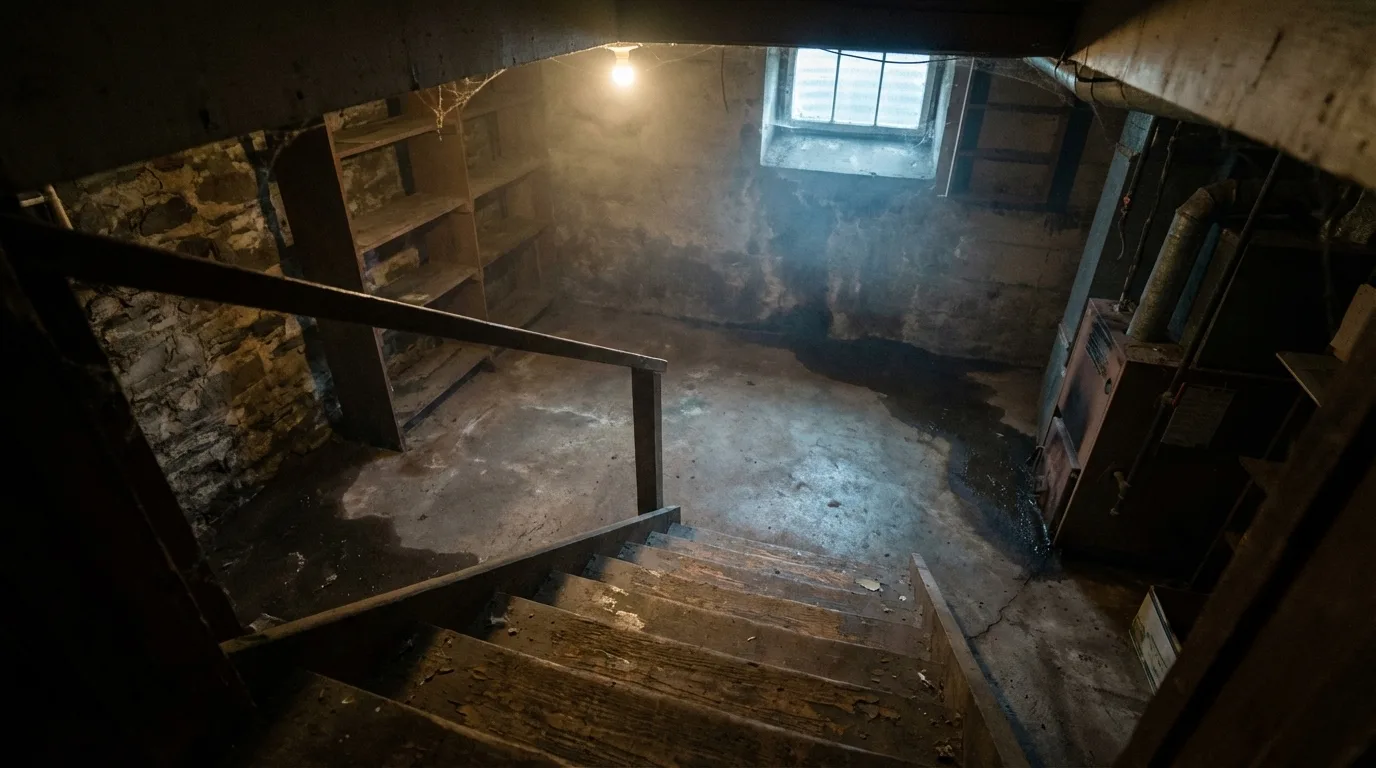
The oldest homes in Quincy, Hingham, Weymouth, and Braintree often sit on foundations built from locally gathered fieldstone or quarried granite (Quincy granite was a major industry). These foundations have no mortar or use lime-based mortar that deteriorates over time. They are inherently porous and flexible, which means they handle some settling well but are essentially open invitations for water. Fieldstone foundation repair requires specialized techniques to address these unique challenges.
Early Poured Concrete and Block (1920s-1960s)
The post-war building boom filled the South Shore suburbs with Cape Cod and ranch-style homes sitting on poured concrete or concrete block foundations. These foundations were typically adequate for their era but are now 60 to 100 years old. The concrete has endured decades of freeze-thaw cycles, and many of these foundations have developed cracks that allow water entry. Block foundations in this age range are particularly susceptible to horizontal cracking from lateral soil pressure.
Modern Poured Concrete (1970s-Present)
Newer construction across the South Shore uses poured concrete foundations with waterproofing membranes and drainage systems. These foundations are more robust, but they are not immune to problems. Even modern poured concrete develops cracks as it cures, and the waterproofing membrane has a finite lifespan, typically 15 to 25 years. Homes from the 1970s and 1980s are entering the age where original waterproofing is failing.
The Salt Air Factor
This one does not get enough attention. Homes within a mile or two of the coast are exposed to salt-laden air that accelerates the deterioration of both concrete and the steel reinforcement (rebar) inside it. Salt penetrates the porous surface of concrete, reaches the rebar, and causes it to corrode. Corroding rebar expands, creating internal pressure that causes spalling, the condition where the surface of the concrete flakes and chips away.
We see accelerated spalling on coastal homes in Hull, Scituate, Cohasset, and the Quincy coastline neighborhoods more frequently than in homes just a few miles inland. It is not just cosmetic. As the concrete surface deteriorates, it exposes more rebar to further corrosion, creating a cycle that accelerates over time.
Neighborhood-Specific Patterns
After decades of work on the South Shore, we have observed patterns that are specific to individual communities.
Quincy
As our home base, we know Quincy foundations intimately. The older neighborhoods near Quincy Center and Adams Shore have some of the most challenging conditions: aging housing stock, proximity to the coast, and variable soil.
Braintree and Weymouth
The interior neighborhoods of these towns sit on relatively stable glacial till, but areas near the Fore River, Back River, and coastal edges face higher water tables and more clay content. Post-war Capes and ranches from the 1950s and 1960s make up a large portion of the housing stock, and these homes are hitting the age where foundation maintenance becomes critical.
Hingham and Cohasset
Higher property values in these towns sometimes mask foundation neglect. Homeowners invest in kitchens and bathrooms while ignoring the basement. The topography varies significantly, with some homes on ledge (which provides excellent foundation support but makes drainage unpredictable) and others on clay-rich lowlands.
Scituate and Marshfield
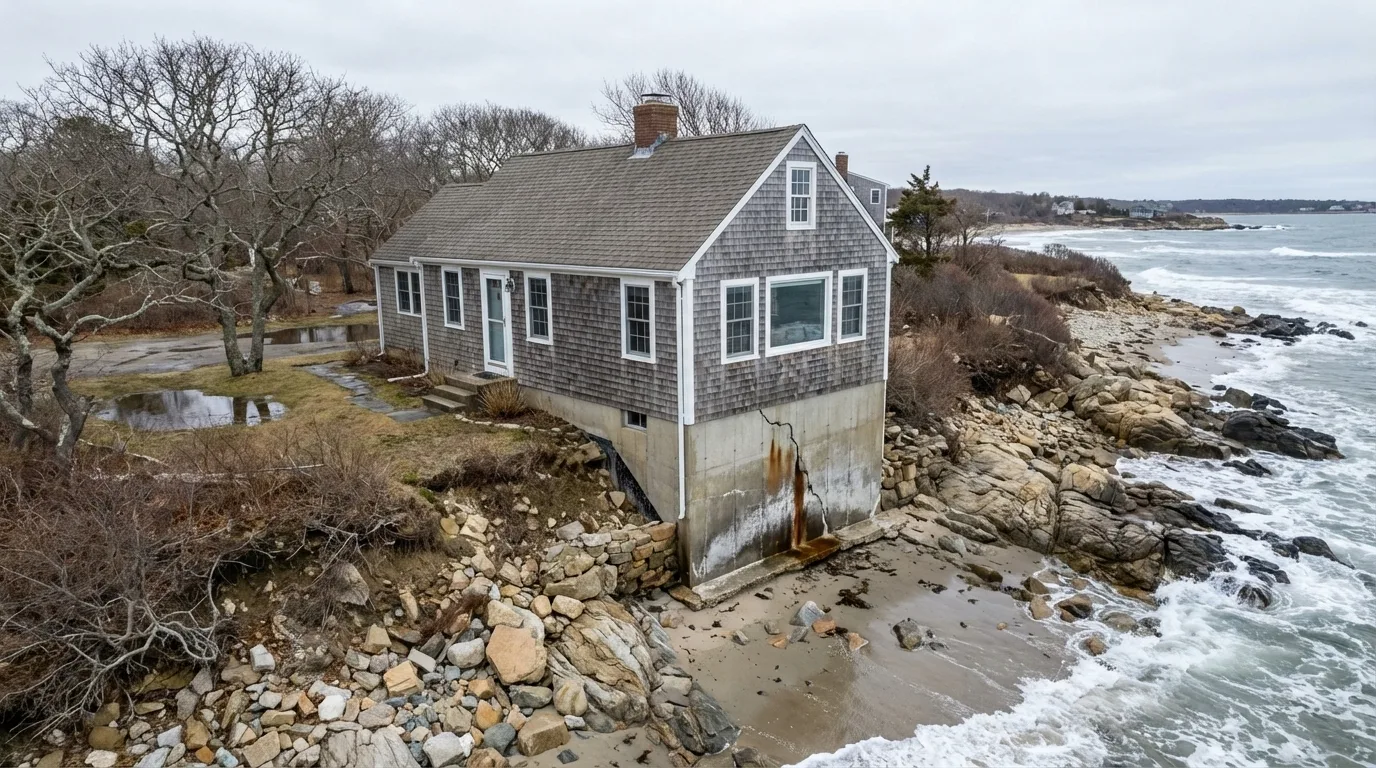
Flood zone homes in these towns face the most extreme water challenges on the South Shore. Foundation problems here are often compounded by periodic flooding, which can saturate the soil around the foundation for extended periods. If your home is in a FEMA flood zone, foundation monitoring should be part of your annual routine.
Plymouth and Duxbury
Sandy soils dominate here, and the foundation challenges tend to be more about erosion and settling than hydrostatic pressure. Homes near Plymouth Harbor and Kingston Bay can see water table fluctuations tied to tidal cycles, which creates an unusual push-pull effect on foundation walls.
What South Shore Homeowners Should Watch For
Given the specific conditions on the South Shore, here is what to pay attention to.
After rain or snowmelt, check your basement for new moisture, damp spots, or active seepage. If you notice water in your basement after rain, the timing and location of water appearance tells us a lot about the source. A musty smell in your basement is another early warning sign, even without visible water.
Each spring, walk the exterior of your foundation and look for new cracks, spalling concrete, or changes in grading. Winter freeze-thaw is when most new damage occurs, and spring is when you will first see it.
Watch your basement humidity with a digital hygrometer, especially from April through September. If humidity consistently exceeds 60%, moisture is entering from somewhere.
Monitor existing cracks. If you know about cracks, mark them with a pencil line at each end and note the date. If the crack grows past the marks, it is active and should be evaluated.
What to Do About It
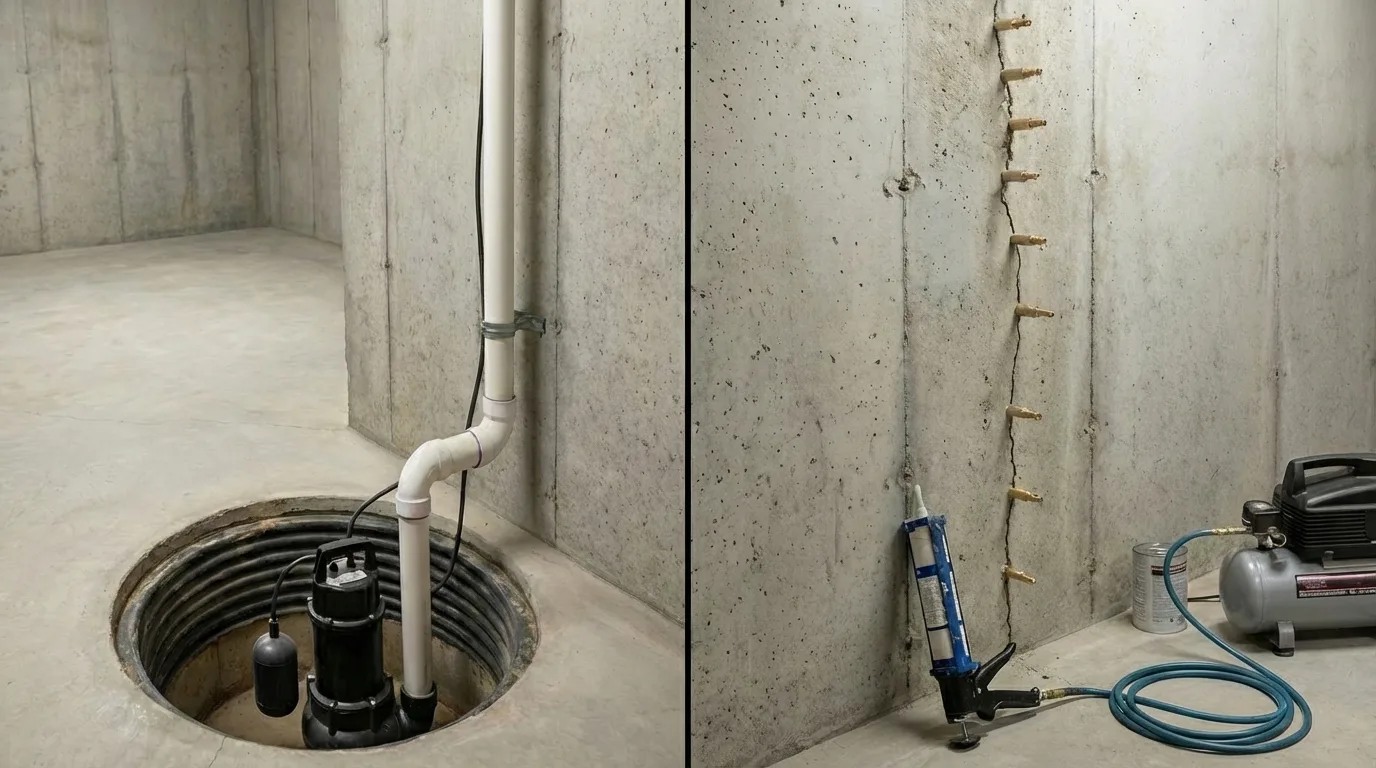
Most South Shore foundation problems fall into the fixable category. Foundation crack injection at $800-$1,300 per crack solves the majority of water intrusion issues we see. For walls showing structural stress, carbon fiber staples (also called carbon fiber stitches) at $200-$300 per stitch prevent further movement. Wall crack repair addresses more significant structural concerns. And a proper assessment identifies exactly what you are dealing with before any money changes hands.
When NOT to Panic About South Shore Cracks
Not every crack on the South Shore is an emergency. Hairline vertical cracks in poured concrete are normal shrinkage — they happen in every foundation. If the crack is stable, not leaking, and not wider than 1/16 inch, monitoring it quarterly is a reasonable approach. The cracks that warrant prompt attention are horizontal cracks (indicating lateral soil pressure), cracks that are widening, or any crack admitting water.
The key is not to wait. South Shore conditions are not getting milder, the housing stock is not getting younger, and small problems left alone tend to become larger problems. A free consultation from a team that knows your specific area is the smartest first step.
Call our Massachusetts office at 617-668-1677. We are local, we are here, and we have probably already repaired a foundation on your street.