Understanding Cinderblock Foundations
Cinderblock foundations—technically called Concrete Masonry Unit (CMU) foundations—were popular in residential construction from the 1940s through 1970s. While durable and cost-effective when new, these foundations develop characteristic problems as they age.
What Is a Cinderblock Foundation?
CMU foundations are built from standardized concrete blocks stacked and mortared together. The blocks are hollow, with two or three open cores running vertically through each unit.
Characteristics:
- Era: Most common 1940s-1970s
- Material: Concrete masonry units (CMU), 8” or 12” thick
- Structure: Hollow cores, steel reinforcement in some
- Mortar: Portland cement-based
- Appearance: Regular grid pattern of blocks and mortar joints
How Cinderblock Differs from Poured Concrete
Understanding the difference helps explain why block foundations fail differently:
| Feature | Cinderblock (CMU) | Poured Concrete |
|---|---|---|
| Structure | Hollow with cores | Solid throughout |
| Weak points | Mortar joints | Fewer joints |
| Water paths | Multiple (blocks + joints) | Primarily cracks |
| Reinforcement | Steel in some cores | Steel throughout |
| Crack patterns | Step cracks, horizontal | Diagonal, vertical |
Common Cinderblock Foundation Problems
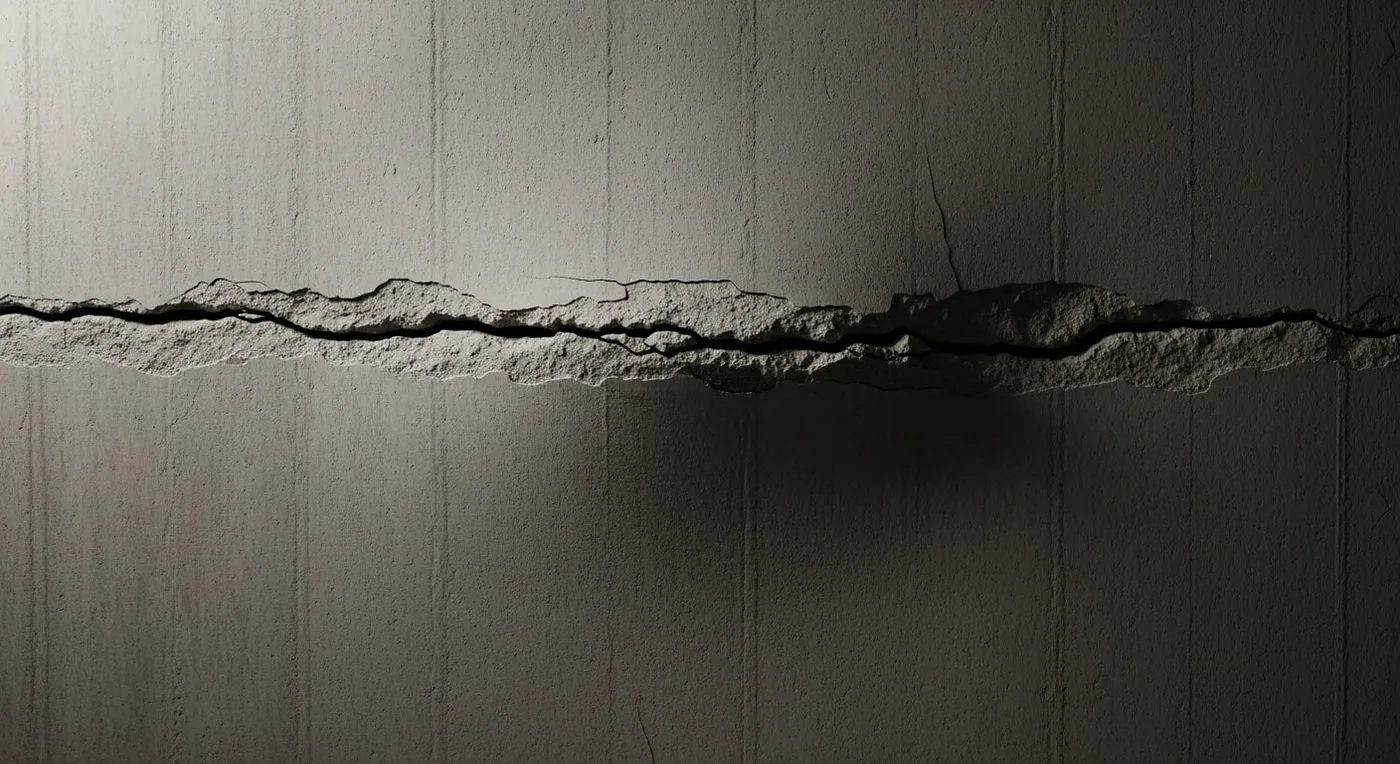
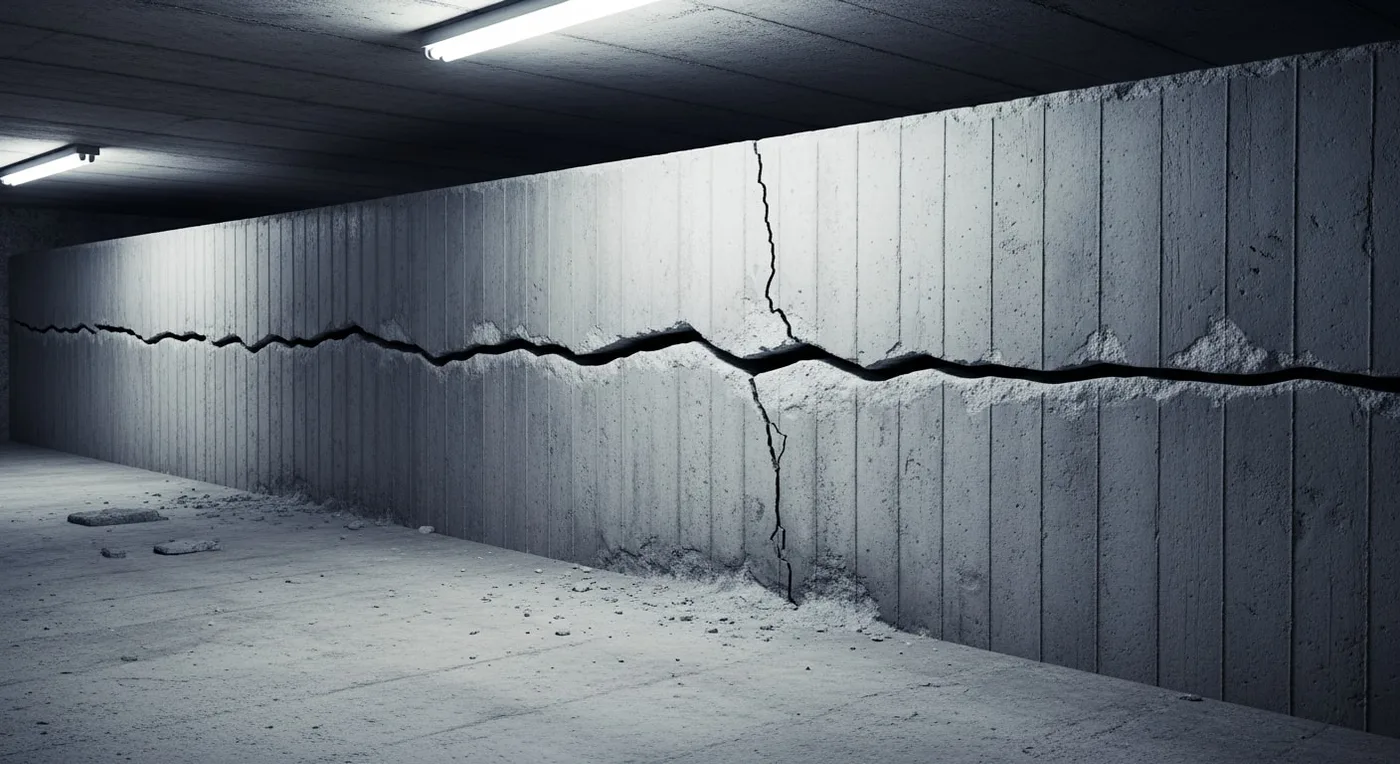
Horizontal Cracking
The most concerning issue in block foundations. Horizontal cracks indicate:
- Soil pressure exceeding wall capacity
- Freeze-thaw cycle expansion pushing inward (especially in clay-heavy soil and glacial till)
- Potential for progressive failure if untreated
Location matters: Cracks near the middle of the wall are most serious, as this is where bending stress peaks.
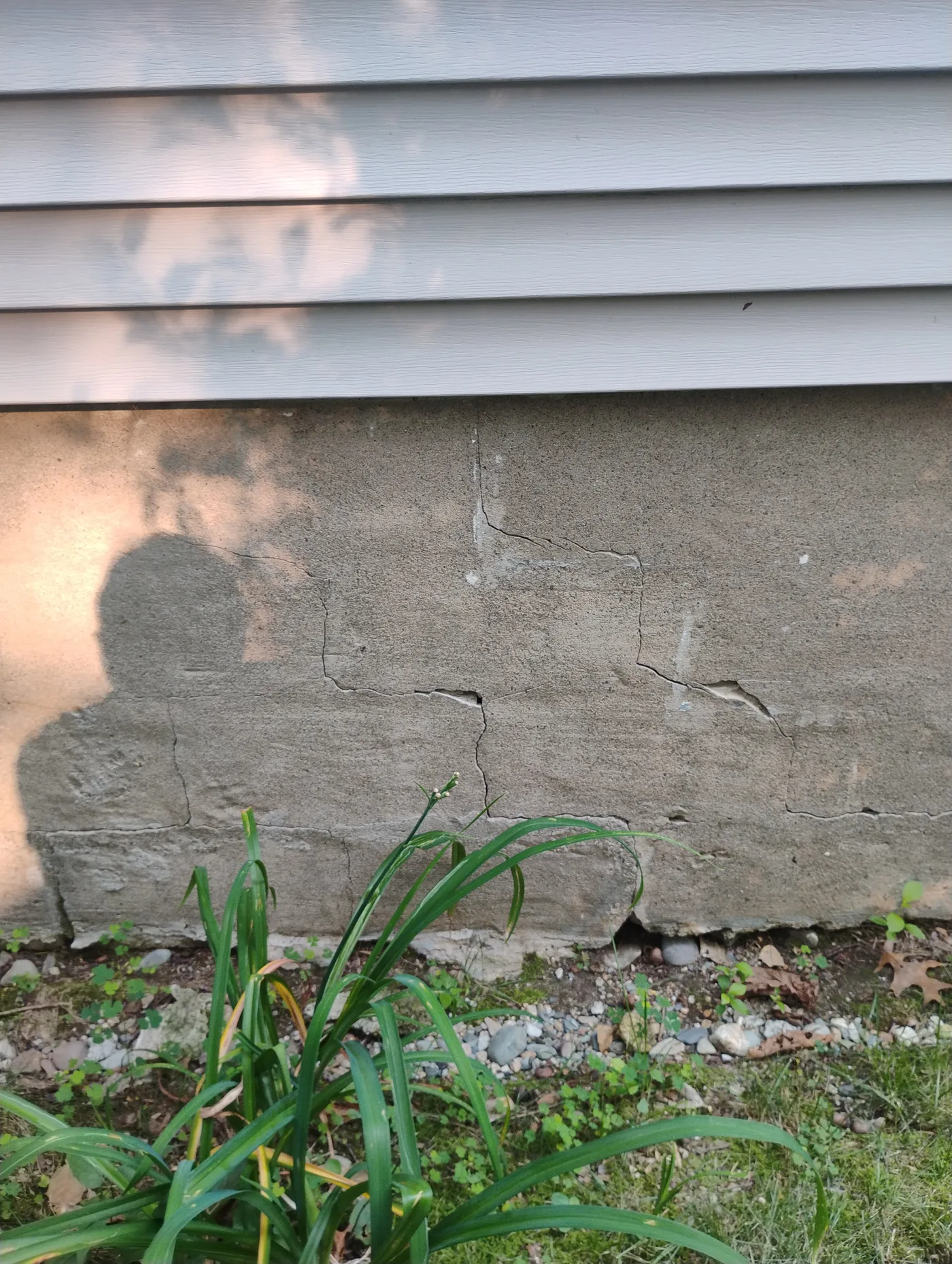
Step Cracks
Diagonal cracks following the mortar joints in a stair-step pattern. These usually indicate:
- Foundation settling
- Soil movement
- Thermal expansion/contraction
Step cracks are common and often less severe than horizontal cracks, but should still be evaluated.
Bowing and Leaning
When soil pressure exceeds what the wall can resist, the wall begins to move inward. You may notice:
- Visible curve in the wall surface
- Gaps at the top where wall meets floor framing
- Windows or doors that don’t operate properly
- Cracks at wall corners
Water Infiltration
Block foundations are particularly susceptible to water problems because:
- Hollow cores collect and channel water
- Multiple mortar joints provide entry points
- Block surfaces are porous
- Age causes mortar deterioration
Repairs We Perform
Carbon Fiber Staples (Stitches) for Block Wall Reinforcement
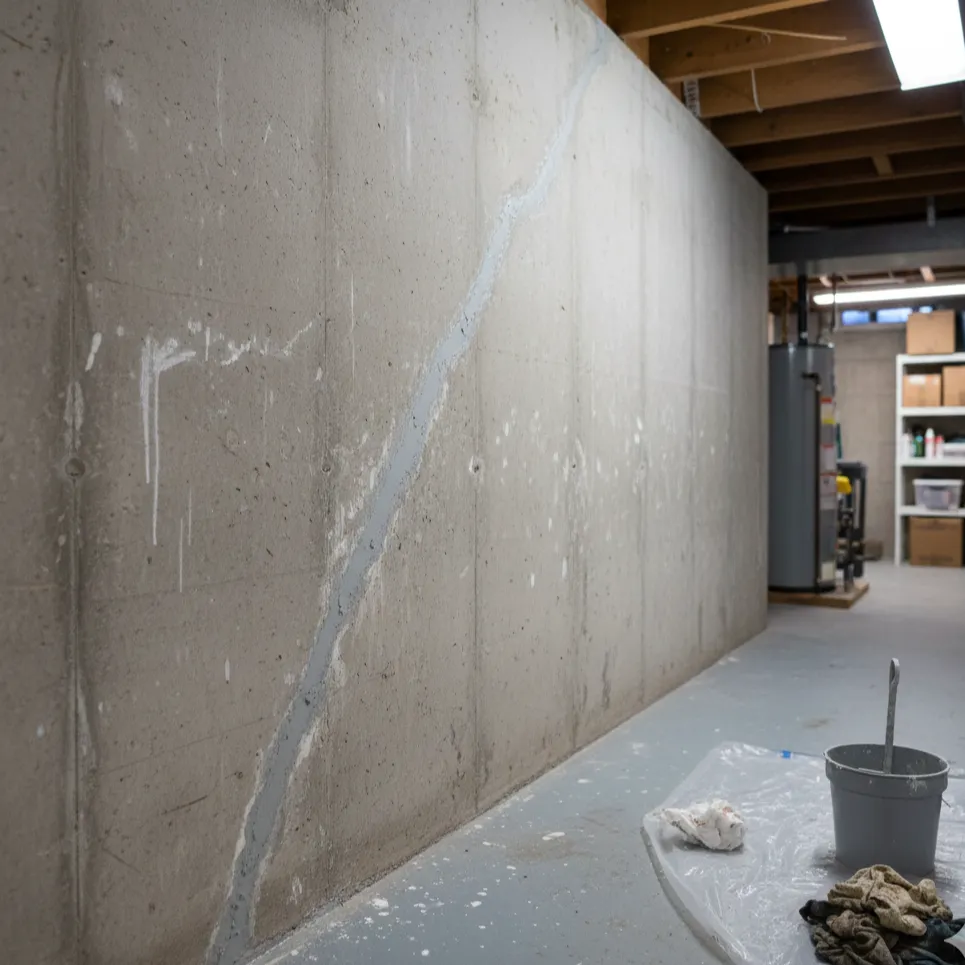
Our primary cinderblock repair method. For walls with cracking but minimal bowing (under 2”):
- Carbon fiber staples (straps) bonded to wall surface at $200-$300 per stitch
- Extremely high tensile strength — 10x stronger than steel by weight
- Low profile — doesn’t reduce basement space
- Prevents further movement permanently
- Lifetime transferable warranty available
Important note about block injection: Unlike poured concrete walls, cinderblock walls usually cannot be injected effectively. The hollow cores and mortar joints create too many pathways for material to dissipate. Carbon fiber reinforcement is typically the right approach for structural cracks in block foundations.
Repairs We May Recommend
The following are not services we perform, but depending on the severity of your situation, we may recommend a specialist who does.
Steel I-Beam Systems — For walls with moderate to severe bowing where carbon fiber isn’t sufficient. Steel beams installed vertically against the wall provide industrial-strength stabilization.
Wall Anchor Systems — For bowing walls with accessible exterior yard space. Steel rods extend through soil to anchor plates, and can often restore a wall to near-vertical over time.
Interior Waterproofing/Drainage — For water infiltration through block walls (water in your basement after rain, white powder on walls, musty smell), interior drainage systems may be needed for high water table conditions.
When to Act
Cinderblock foundation problems tend to worsen over time. Early signs that warrant assessment:
- Cracks wider than 1/4” – Indicates significant movement
- Horizontal cracks at any width – Structural concern
- Step cracks following mortar joints – Settlement or soil pressure
- Visible wall bowing – Progressive failure risk
- Water entering basement – Ongoing damage to foundation
Don’t wait for obvious failure. The cost of stabilization is far less than the cost of replacement, and early repairs are simpler than late-stage interventions.
Service Area
We repair cinderblock foundations throughout New England, including areas where block construction was most common:
- Post-war suburban developments in Hartford County, Middlesex County
- Mid-century homes on Boston’s South Shore and North Shore
- Ranch and Cape-style homes from the 1950s-60s
Schedule Your Assessment
If your cinderblock foundation shows signs of stress, contact us for a free evaluation:
860-573-8760 (CT) | 617-668-1677 (MA)860-573-8760 (CT)617-668-1677 (MA)
Text us a photo for a quick preliminary assessment, or call to schedule. With 50+ years of combined experience and thousands of projects across New England, we’ll assess the severity, explain your options, and provide honest recommendations. See our foundation repair cost guide for complete pricing details.