The Dehumidifier Trap
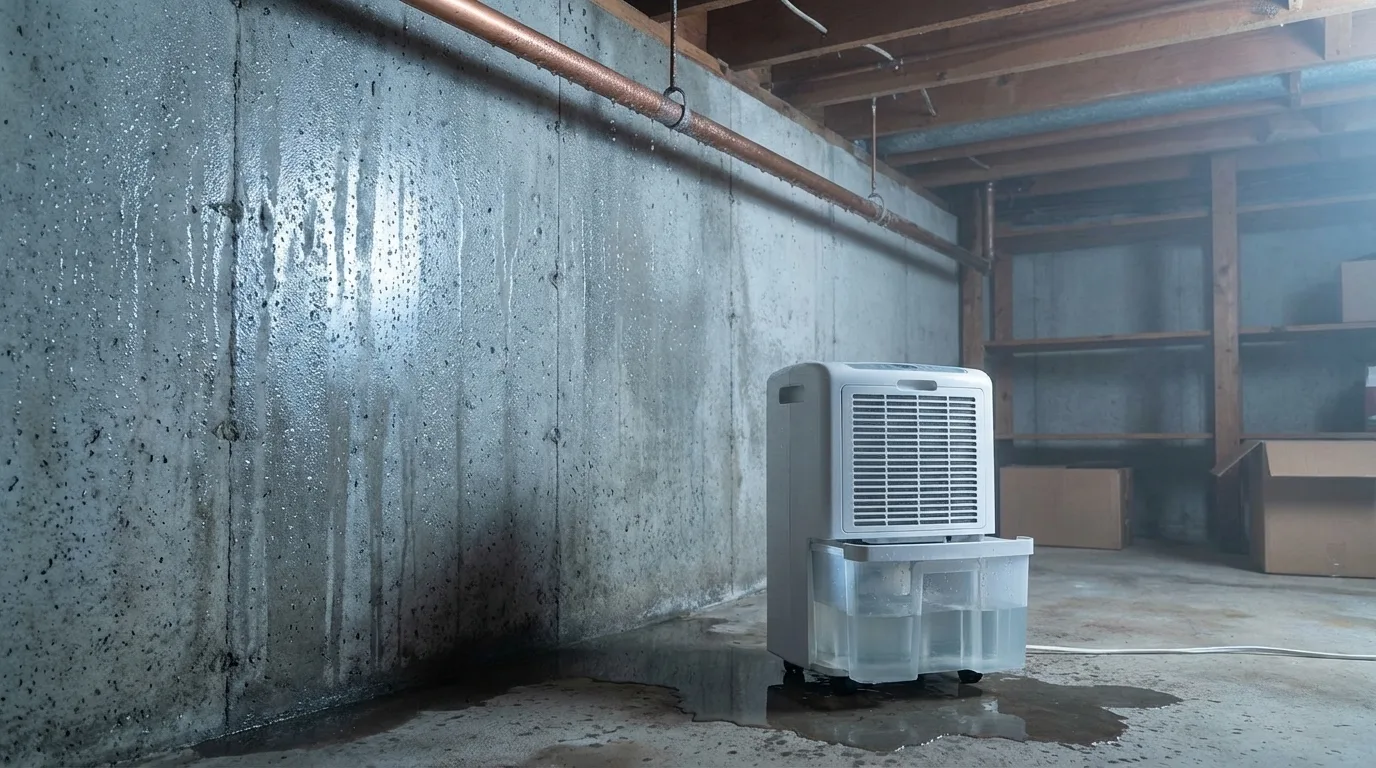
Here is a scenario we see constantly across New England: a homeowner buys a dehumidifier for a damp basement, empties the bucket religiously (or hooks up the drain hose), and watches the unit run around the clock. The electricity bill creeps up. The basement smells a little better, but never quite right. And every spring, the humidity comes roaring back.
The dehumidifier is doing its job. It is pulling moisture out of the air. But it is fighting a battle it cannot win, because new moisture keeps entering faster than the machine can remove it.
Think of it this way: if your kitchen faucet is running, you do not solve the problem by mopping faster. You turn off the faucet. Your basement works the same way.
Where Basement Moisture Actually Comes From: Water in Basement After Rain
In New England homes, basement moisture enters through a handful of predictable paths. Understanding which one is your problem changes everything about the solution.
Foundation Wall Cracks
This is the most common source we see across Connecticut and Massachusetts. Poured concrete foundations develop cracks as they cure and settle, and those cracks become direct channels for groundwater. A single hairline crack in a wall can let in a surprising amount of moisture, especially during spring snowmelt or heavy rain.
The crack does not need to be visibly leaking to be a problem. Even cracks that appear dry can wick moisture through capillary action, raising your basement humidity without ever producing a puddle.
The Floor-Wall Joint (Cove Joint)
Where your basement floor meets the wall, there is a natural seam called the cove joint. This joint is not sealed during construction because the floor and walls are poured separately. Hydrostatic pressure from groundwater pushes moisture up through this gap, sometimes as visible seepage, sometimes as invisible vapor.
Bulkheads and Hatchways
If you have a basement bulkhead, you have a potential moisture entry point. Aging bulkhead doors, deteriorating seals, and cracked bulkhead walls are among the most common problems we repair. Water pools on bulkhead stairs during rain and finds its way inside. Learn more about leaky bulkhead causes and repair options.
Bare Concrete Vapor Transmission
Even perfectly intact concrete is not waterproof. Concrete is porous, and moisture from the surrounding soil migrates through the walls and floor as water vapor. This is called vapor transmission, and it is a constant, low-level source of humidity that is especially noticeable in older homes with thinner foundation walls.
Window Wells and Penetrations
Basement windows, utility penetrations (where pipes and wires enter), and any other opening in the foundation can allow moisture in. Window wells that lack proper drainage are particularly problematic in areas with heavy clay soil, which is common in parts of Connecticut.
Why Your Dehumidifier Cannot Keep Up
A standard residential dehumidifier removes 30 to 70 pints of moisture per day. That sounds like a lot until you consider that a single foundation wall crack during a rainy week can introduce far more moisture than that. And vapor transmission through a full basement’s worth of concrete walls adds a steady baseline of humidity that never stops.
Running a dehumidifier in a basement with active moisture intrusion is like running the air conditioning with the windows open. The machine works harder, your electricity bill climbs (expect $30 to $60 per month for a constantly running unit), and you never actually solve the problem.
There is also a health angle. That musty smell in your basement? Persistent humidity above 60% relative humidity creates conditions for mold growth, dust mite proliferation, and musty odors. If your dehumidifier cannot get your basement below 60% RH consistently, you have an active moisture source that needs to be addressed at the point of entry.
How to Find the Real Source
Before you can fix the problem, you need to identify where moisture is entering. Here are some diagnostic steps you can take yourself.
The Foil Test
Tape a 12-inch square of aluminum foil flat against your basement wall. Press the edges down firmly. Leave it for 24 to 48 hours, then check both sides. If moisture is on the outer surface (between the foil and the wall), water is migrating through the concrete. If moisture is on the inner surface (the room side), you have a condensation issue from humid air.
Visual Inspection After Rain: Look for White Powder on Basement Walls
Walk your basement 12 to 24 hours after a heavy rain. Look for damp spots, water stains, efflorescence (that white powder on basement walls is mineral deposits), and active drips. Pay special attention to corners, the floor-wall joint, and any visible cracks. If you see white powder on your basement walls, that is a telltale sign of moisture moving through concrete.
Track Humidity Over Time
Use a digital hygrometer (under $20 at any hardware store) to track humidity levels over several weeks. Note how readings change after rain, during snowmelt, and in different seasons. If humidity spikes correlate with weather events, you have active water intrusion. If humidity is constant regardless of weather, vapor transmission or indoor sources are more likely.
Permanent Solutions That Actually Work
Once you know where moisture is entering, the fix is usually straightforward.
Foundation Crack Injection
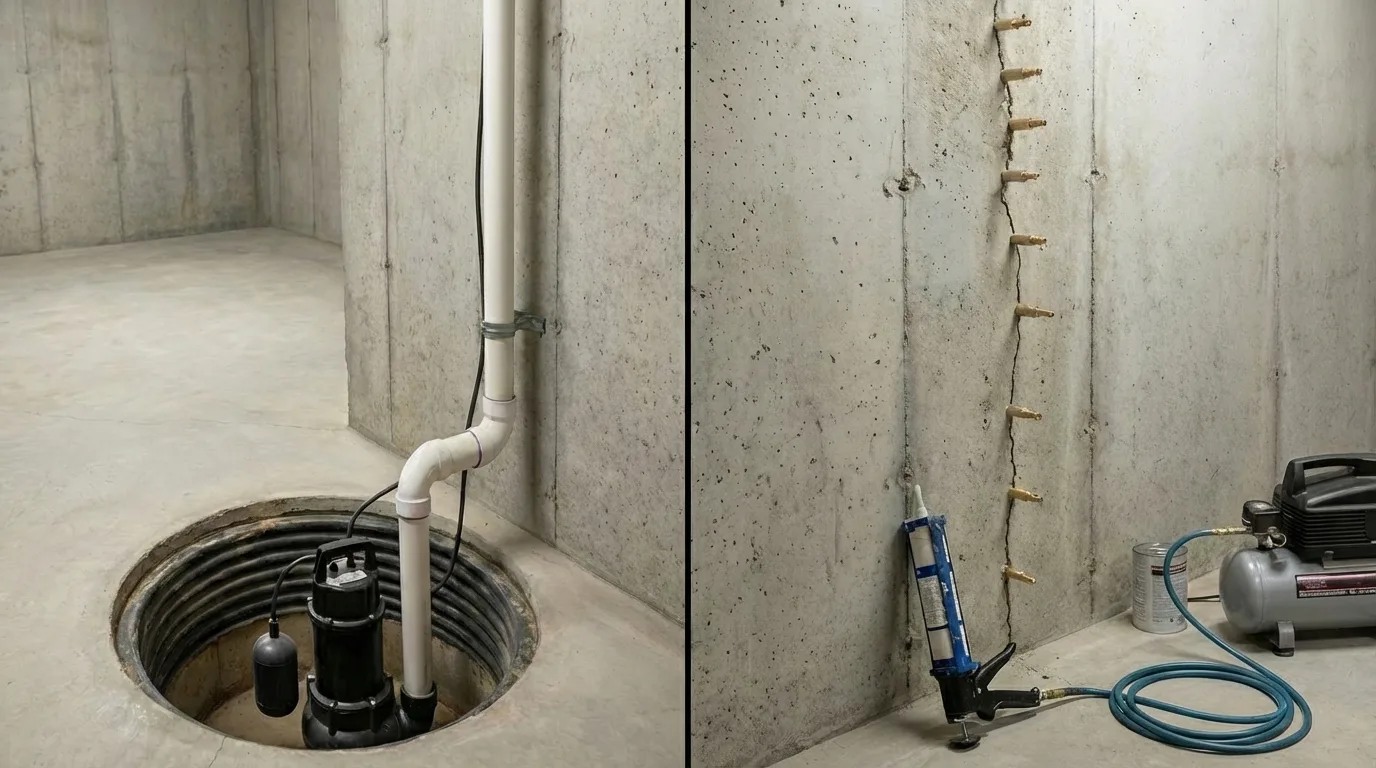
For cracks in poured concrete walls, foundation crack injection is the gold standard. We inject expanding polyurethane or epoxy at up to 100 PSI directly into the crack, sealing it from the inside out through the full 8-10 inches of concrete wall thickness. At $800-$1,300 per crack, the repair stops water at the source and comes with a lifetime warranty. Most crack injections take a few hours and cost a fraction of what you will spend on dehumidifier electricity over the years.
Bulkhead Repair and Bulkhead Sealant
Leaking bulkheads need targeted repair with professional bulkhead sealant that addresses the actual failure point: cracked walls, deteriorated doors, failed waterproof coatings, or drainage problems on the stairs. At $1,800-$2,500 for most bulkhead repairs, a properly sealed bulkhead eliminates one of the biggest moisture sources in New England basements.
Exterior Drainage Improvements
Sometimes the moisture source is not a foundation defect but poor grading or drainage around the home. If the ground slopes toward your foundation, or if your gutters discharge right next to the wall, fixing those issues can dramatically reduce the water load on your foundation.
Vapor Barriers
For moisture migrating through bare concrete, a vapor barrier on the interior wall surface can reduce transmission significantly. This is not always necessary if other moisture sources are addressed, but in older homes with thin foundation walls, it can be the difference between a dry basement and a perpetually damp one.
When a Dehumidifier IS the Right Answer
We are not anti-dehumidifier. There are situations where a dehumidifier is exactly the right tool.
If you have addressed all active moisture sources (cracks sealed, bulkhead repaired, drainage corrected) and your basement still runs a bit humid during the peak of a New England summer, a dehumidifier makes sense. Ambient humidity in July and August across Connecticut and Massachusetts routinely hits 80% or higher outdoors. Some of that humidity will find its way into any basement, and a dehumidifier keeps things comfortable.
The target range is 30% to 50% relative humidity year-round. Below 30% and you will get static electricity and dry skin. Above 60% and you are creating conditions for mold. If your dehumidifier can maintain 45% to 50% RH without running constantly, you are in good shape.
The key question is whether your dehumidifier is supplementing a dry basement or compensating for an active leak. One is a sensible comfort measure. The other is an expensive band-aid.
The Cost Comparison That Matters
A quality dehumidifier costs $250 to $400 upfront. Running it year-round costs $300 to $700 annually in electricity. Over ten years, that is $3,000 to $7,000 in operating costs alone, plus one or two replacement units.
A typical foundation crack injection costs $800-$1,300 — significantly less than that lifetime dehumidifier expense — and comes with a warranty that lasts as long as you own the home. The math is not close.
Not sure where your moisture is coming from? Text us a photo for assessment — we can often identify the source from a photo alone. 860-573-8760 (CT) | 617-668-1677 (MA)Not sure where your moisture is coming from? Text us a photo for assessment — we can often identify the source from a photo alone. 860-573-8760 (CT)Not sure where your moisture is coming from? Text us a photo for assessment — we can often identify the source from a photo alone. 617-668-1677 (MA)
What to Do Next
If your basement humidity stays above 60% despite running a dehumidifier, or if you see any signs of active water intrusion, the smartest move is a free foundation consultation. We will identify the moisture source, tell you honestly whether it is something we fix or something outside our scope, and give you a clear path forward.
No one should spend years emptying a dehumidifier bucket when the actual fix might take an afternoon.