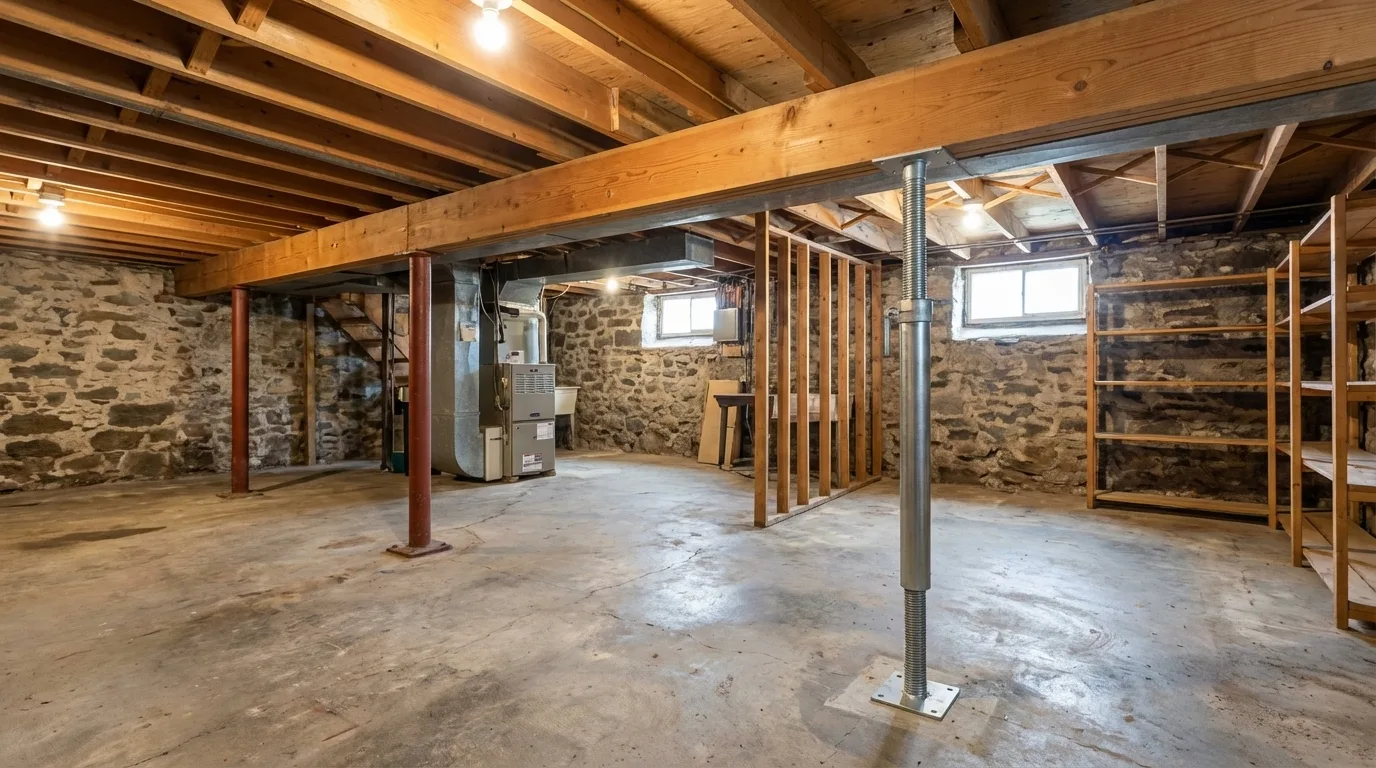
Walk into the basement of almost any New England home built before 1970 and you will see them: steel columns running from the concrete floor to the main carrying beam above. These are lally columns, and they are holding up your house.
Most homeowners never think about them until something goes wrong — a sagging floor upstairs, a door that will not close, or visible rust eating through the steel. By then, the problem has been developing for years.
What Are Lally Columns?
Lally columns are vertical steel support posts that transfer the weight of your home’s main beam (and everything above it) down to the foundation floor or footings. The name comes from John Lally, who patented the design in 1898 in Waltham, Massachusetts — motivated by a wave of building collapses and fires in the late 1800s that revealed how inadequate existing structural supports were.
In most New England homes, the main carrying beam — usually a steel I-beam or engineered lumber (LVL beam) — spans the full length of the basement. Lally columns support this beam at intervals of 6 to 10 feet, preventing it from sagging under the weight of the floors, walls, and roof above.
Types of Lally Columns
Permanent (code-compliant):
- Concrete-filled steel columns — the original standard. A steel pipe filled with concrete, set on a reinforced footing pad. These are permanent structural members that also provide fire resistance — the concrete core continues to carry load even if the steel shell is compromised by heat.
Temporary only:
- Adjustable steel columns (screw-jacks) — can be raised or lowered. Designed as temporary supports during construction or renovation. Most building codes in Massachusetts and Connecticut limit their use to 180 days and do not allow them as permanent structural members.
What we find in older New England basements:
- Hollow steel columns — unfilled steel pipe, weaker and more corrosion-prone than concrete-filled. Common in homes built before modern building codes.
- Brick or block columns — stacked masonry, sometimes with no mortar between courses. Found in pre-1940s homes.
- Wood posts and tree trunks — yes, actual tree trunks with bark still on, sometimes set on flat stones instead of footings. Extremely common in historic New England basements.
- Improvised supports — contractors and homeowners have reported finding vehicle axles, cast iron sewer pipe, stacked cinder blocks, and even dimensional lumber (2x4s) used as makeshift supports. If you find anything like this in your basement, it needs immediate professional evaluation.
Signs Your Lally Columns Are Failing
Lally column problems develop slowly, which is why they are easy to miss. Watch for these warning signs:
Visible Column Damage
- Rust or corrosion — especially at the base where the column meets the damp basement floor
- Bulging or buckling — the column bows outward under load
- Leaning — the column is no longer plumb (vertical)
- Concrete crumbling inside the pipe (visible through rust holes)
- Gap at the top or bottom — the column has settled or shifted and is no longer fully bearing weight
Symptoms in Your Living Space
- Sagging or bouncy floors on the first floor
- Doors that stick or will not latch — frames have shifted as the beam sags
- Cracks in drywall or plaster — especially near the center of the house
- Visible sag in the main beam — look along its length from one end
If you see any of these, do not wait. A failing lally column is a structural issue that gets worse over time — the more the beam sags, the more stress shifts to the remaining columns, accelerating the problem.
Why Lally Columns Fail
New England basements are tough on steel. A rusted or deteriorating column can lose 30-60% of its design strength before you notice visible symptoms upstairs. The most common causes of failure:
- Moisture and corrosion — basement humidity, condensation, and occasional flooding corrode unprotected steel from the outside in. The base of the column, sitting on the damp concrete floor, is the most vulnerable point. Road salt tracked into garages and basements from winter driving accelerates corrosion significantly.
- Inadequate footings — homes built before roughly 1970 often have columns sitting on a thin slab with no dedicated footing pad, or set on loose stones. The floor cracks and the column settles. Modern code requires a minimum 24”x24”x12” reinforced concrete footing extending below the slab.
- Frost heave — in unheated basements or crawl spaces, frost can push footings upward, putting lateral stress on the column.
- Original undersizing — homes that have been remodeled with added weight (second stories, heavy tile, stone countertops) may exceed the original column’s load rating.
- Missing or damaged top plates — the steel cap plate at the top of the column distributes load across the beam. If the plate is missing, undersized, or not properly attached, the column creates a point load that can damage the beam above.
- Age — a column installed in 1940 has endured 85 years of load and moisture. Even properly installed columns have a service life.
The Replacement Process
Lally column replacement is a structural job that requires careful load management. Here is how it works:
- Engineering assessment — a structural engineer determines the current load, required column capacity, and footing requirements. A building permit is required in both Massachusetts and Connecticut.
- Temporary shoring — temporary supports (called cribbing — typically 4x4 pressure-treated posts) are installed adjacent to the failing column to carry the load during replacement.
- Old column removal — the failed column is cut out.
- Footing inspection or installation — if the existing footing is inadequate, the slab is cut, a hole is excavated, and a new reinforced concrete footing is poured (minimum 24”x24”x12”, with rebar reinforcement, extending 12-14 inches below the slab). The footing must cure for at least a week before the column is installed.
- New column installation — a properly sized, concrete-filled steel lally column is set on the footing with a thick steel cap plate at the top, welded or bolted to the beam to distribute the load evenly.
- Load transfer — temporary supports are carefully removed, transferring the load to the new column. In some cases, the beam can be lifted slightly to correct sagging floors that developed while the old column was failing.
- Final inspection — beam deflection is checked, the installation is verified, and a building inspector signs off on the work.
The entire process typically takes 1 to 2 days per column, depending on footing work.
Lally Columns and Home Inspections
If you are buying or selling a home in New England, lally columns will be on the inspector’s checklist. Here is what they look for:
- Rust or corrosion — especially at the base where steel meets concrete
- Column splitting — vertical cracks in the steel shell
- Hollow construction — unfilled steel pipe is a code violation in most jurisdictions
- Wood or tree trunk columns — always flagged, always need replacement
- Deteriorating brick or block — crumbling masonry supports
- Missing cap plates on the main beam — load is not properly distributed
- Adjustable/temporary columns — flagged as non-permanent supports
Any of these findings can affect your home sale. Buyers may request column replacement as a condition of closing, and lenders may require it. If you are selling, getting a structural evaluation ahead of time avoids surprises during the inspection.
Can I Move or Remove a Lally Column?
This comes up often when homeowners want to open up their basement for a recreation room or home gym. The short answer: never remove a lally column without a structural engineer’s assessment. The column is carrying load from every floor above it.
In some cases, a structural engineer can redesign the support system using a larger LVL (laminated veneer lumber) beam that spans a greater distance, allowing columns to be repositioned or reduced in number. This is legitimate structural work that requires engineering, permits, and proper installation — not a weekend project.
Why Adjustable Columns Are Not a Permanent Fix
This is one of the most common mistakes in New England basements: a homeowner or contractor installs an adjustable screw-jack column as a “permanent” replacement. Hardware stores sell them, and they seem like a quick, affordable fix.
The problem is that adjustable columns are rated as temporary supports only. Most building codes in Massachusetts and Connecticut do not allow them as permanent structural members because:
- The screw mechanism can loosen over time from vibration and settling
- They are not rated for the same loads as concrete-filled columns
- They corrode faster — thinner steel with more exposed joints
- Home inspectors flag them — if you sell your home, adjustable columns will appear on the inspection report and may affect your sale
If you have adjustable columns in your basement, they should be evaluated by a structural engineer and replaced with permanent concrete-filled columns.
What Lally Column Replacement Costs
Column replacement costs vary based on the scope of work:
- Single column replacement (existing footing adequate): $1,500-$3,000
- Column replacement with new footing: $2,500-$5,000
- Multiple column replacement: $2,000-$4,000 per column (economies of scale)
- Beam repair or replacement (if the beam has also been damaged): $5,000-$15,000+
These costs include engineering, permits, materials, and labor. Compared to the alternative — a sagging first floor, cracked walls, and potential structural failure — column replacement is a sound investment.
When to Call a Professional
If you notice any signs of lally column failure, start with a professional assessment. A structural engineer can evaluate whether the column needs immediate replacement or can be monitored.
Do not attempt to jack up a sagging beam yourself. Improper jacking can crack the beam, damage the framing above, or cause the column to kick out — all of which turn a manageable repair into a much larger project.
A Note from Attack A Crack
Lally column replacement is not a service we offer. This guide is provided for educational purposes — we want New England homeowners to understand what is holding up their house and when to take action.
If you need lally column work, we are happy to refer you to a qualified structural contractor. Just give us a call and we will point you in the right direction.
What we do specialize in is the foundation work that often accompanies column issues. If your lally columns are failing because of foundation movement, cracking, or settling, that is where we come in. We can address the root cause with crack injection, wall crack repair, or carbon fiber reinforcement — so the problem does not come back after your columns are replaced.