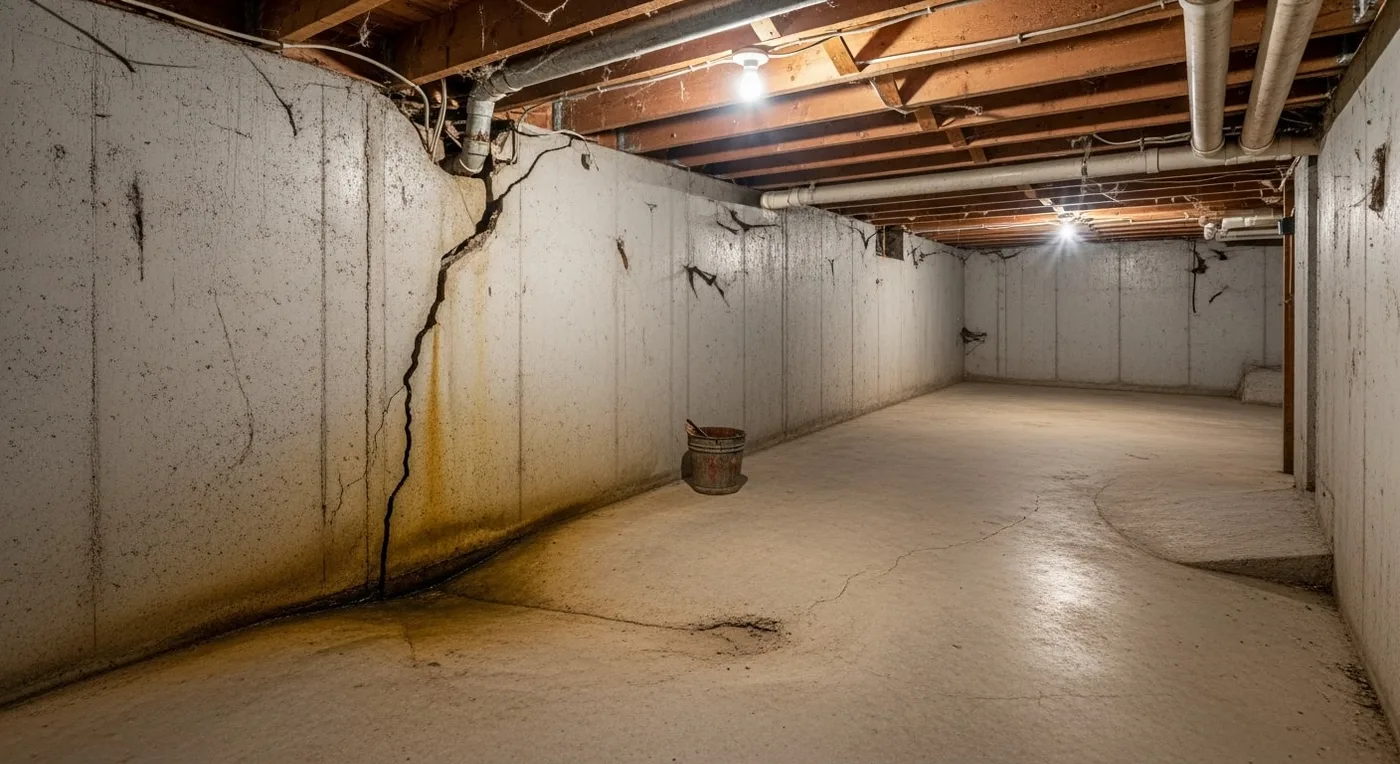
When a basement wall starts bowing inward, it gets your attention. Unlike a hairline crack you might debate ignoring for another year, a wall that is visibly curving inward feels urgent. And your instincts are right — bowing walls are a legitimate structural concern that gets more expensive to fix the longer you wait.
But here is the good news: most bowing walls do not mean your house is about to collapse. They mean your house needs attention. There is a significant difference, and understanding it will save you from both panic and procrastination.
What Causes Basement Walls to Bow
Basement walls bow for one fundamental reason: something outside is pushing harder than the wall can resist. The specific source of that pressure varies.
Hydrostatic Pressure
The most common culprit in New England. When soil around your foundation becomes saturated with water, it exerts enormous pressure against your walls. Think of it this way — a cubic foot of saturated soil weighs about 120 pounds. Multiply that by the square footage of your basement wall surface area, and you are looking at tons of force.
Poor drainage, high water tables, and heavy rain seasons all increase hydrostatic pressure. This is why bowing often appears or worsens during spring thaw and heavy rain periods.
Frost Expansion
New England’s signature contribution to foundation problems. When water in saturated soil freezes, it expands by approximately 9%. Frozen soil pushes against your basement walls with tremendous force. When it thaws, the wall does not spring back — it stays in its new position. Next freeze cycle, the soil pushes it a little further.
This ratcheting effect, called frost heave, is why bowing walls in our region often show incremental worsening from year to year.
Poor Backfill
When your home was built, the excavated area around the foundation was backfilled with soil. If that backfill was not properly compacted, it settles over time, creating a trough around your foundation that collects water. That collected water saturates the soil right against your wall — exactly where you do not want it.
Homes built quickly (looking at you, mid-century housing booms) are particularly susceptible to poor backfill compaction.
Tree Root Pressure
Large trees growing near foundations can exert root pressure against walls. More commonly, tree roots dry out soil unevenly, causing the soil to shrink and swell in ways that stress the wall.
Expansive Clay Soil and Glacial Till
While less common in New England than in the Midwest, some areas — particularly the Connecticut River Valley — do have clay-heavy soil and glacial till deposits that swell significantly when wet and shrink when dry. This cyclical expansion and contraction is brutal on foundation walls.
Assessing Severity: How Bad Is It?
Not all bowing is equal. Here is how to gauge where you stand.
Monitoring Stage (Less Than 1 Inch of Deflection)
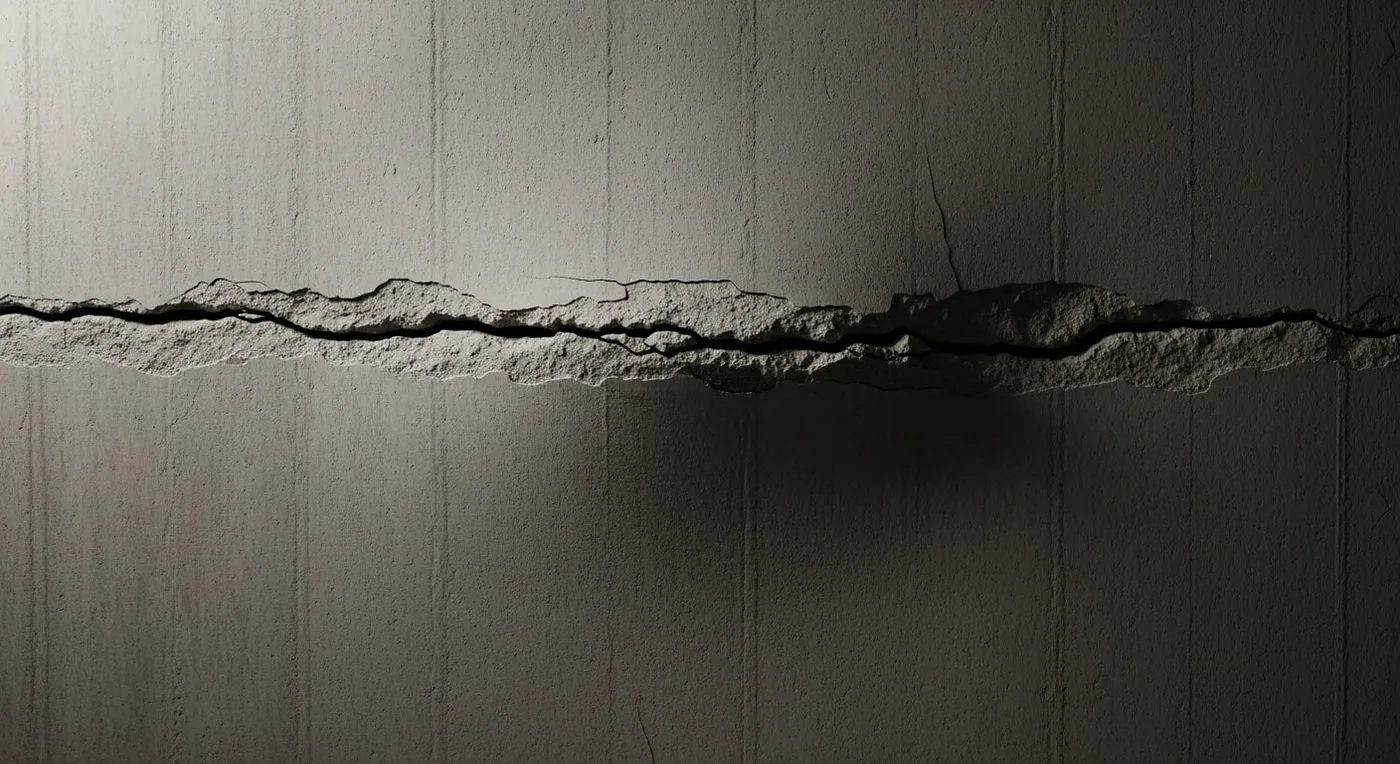
What you see: A slight inward curve visible when you sight along the wall. Possible horizontal crack at the mid-height of the wall. The bow may not be obvious without a straightedge or level.
What it means: The wall is under pressure but has not moved significantly. This is the ideal time to intervene — repairs are simpler, less invasive, and less expensive.
What to do: Get a professional assessment. Install monitoring markers to track movement. Address drainage issues contributing to soil pressure.
Action Stage (1-2 Inches of Deflection)
What you see: Visible bow without needing a straightedge. Horizontal crack likely present, possibly with stair-stepping at the ends. Possible water intrusion through the crack.
What it means: The wall has moved enough to need structural reinforcement. It will continue moving without intervention.
What to do: Repair should not be delayed. Carbon fiber reinforcement or wall anchors are typically appropriate at this stage. The wall crack repair page describes our approach to these situations.
Urgent Stage (More Than 2 Inches of Deflection)
What you see: Obvious inward lean. Multiple cracks. Possible separation at the top of the wall from the sill plate. Water intrusion likely.
What it means: The wall is approaching the limits of its structural integrity. Further movement could lead to partial collapse.
What to do: Professional assessment immediately. Steel beams, wall replacement, or a combination of approaches may be needed. Do not use the basement as a living space until the wall is evaluated.
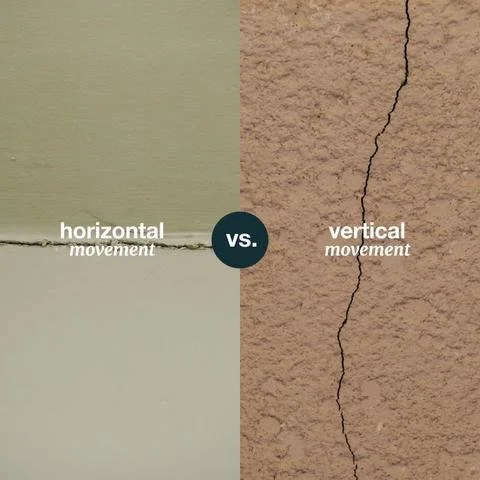
For help identifying crack patterns associated with bowing, our guide on vertical vs. horizontal foundation cracks explains what different patterns mean.
Repair Options by Severity
Carbon Fiber Reinforcement Straps — What We Do
Best for: Early to moderate bowing (up to approximately 2 inches)
How it works: High-strength carbon fiber staples (straps) are bonded vertically to the wall using structural epoxy. Carbon fiber has a tensile strength of 800,000 PSI — roughly 10x stronger than steel — and permanently arrests further inward movement.
Pros:
- Minimal disruption (installed from inside the basement)
- No excavation required
- Completed in one day
- Thin profile — does not significantly reduce basement space
- No ongoing maintenance
Cons:
- Stabilizes but does not straighten the wall
- Not suitable for severe bowing (greater than 2 inches)
Cost range: $3,000 - $8,000 depending on the number of straps and wall size. Our foundation repair cost guide has more detail.
Carbon fiber reinforcement is our specialty and covers the majority of bowing wall situations we encounter. For a detailed breakdown of costs and how straps work, see our carbon fiber straps guide. For cases requiring other methods, we can recommend trusted contractors who specialize in those approaches.
Other Repair Methods We May Recommend
The following methods are not services we perform, but depending on the severity of your situation, we may recommend a specialist who does.
Wall Anchors
Best for moderate bowing with potential to gradually straighten over time. Steel rods are driven through the basement wall and extended through the soil to anchor plates placed in stable earth. Interior plates are tightened against the wall, and periodic tightening can slowly push the wall back toward its original position. Typical cost: $5,000 - $12,000 depending on the number of anchors needed.
Steel I-Beams
Best for severe bowing or walls with significant structural compromise. Vertical steel beams are placed against the wall, bolted to the basement floor slab and sill plate. They provide direct structural support but take up about 4 inches of basement space per beam. Typical cost: $7,000 - $15,000.
Wall Replacement
Best for catastrophic failure or walls beyond practical repair. The failed wall section is removed and rebuilt, requiring temporary structural support, excavation, and new construction. Typical cost: $20,000 - $50,000+. This is rarely necessary — the vast majority of bowing walls can be stabilized with less invasive methods.
Prevention: Reducing the Pressure
Whether you repair now or are watching early signs, reducing the forces acting on your walls is always smart.
Drainage is everything:
- Grade soil away from the foundation (6 inches of drop over 10 feet)
- Keep gutters clean and functioning
- Extend downspouts at least 4 feet from the foundation
- Ensure window wells have proper drainage
Manage soil moisture:
- Avoid planting heavy-water-demand plants against the foundation
- Consider a French drain system if you have persistent drainage problems
- Keep large trees at a reasonable distance from the foundation
Monitor the wall:
- Mark the current bow with a pencil line and date
- Measure deflection every 3-6 months with a straightedge
- Photograph the wall from the same position for comparison
- Document any new cracking
Do Not Wait for It to Get Worse
Here is the uncomfortable truth about bowing walls: they do not get better on their own. The forces causing the bow do not stop. Freeze-thaw cycles keep happening. Rain keeps falling. Soil pressure keeps building.
The difference between repairing a wall with 1 inch of bow (a $5,000 carbon fiber job) and repairing a wall with 3 inches of bow (a $15,000 steel beam installation — or worse) is often just a few years of inaction.
If your basement wall is bowing, call us for a free consultation. We will talk you through measuring the deflection, assess the cause, and recommend the most appropriate and cost-effective repair. Our lifetime warranty covers the work, and the sooner you act, the more options you have. 860-573-8760 (CT) | 617-668-1677 (MA)If your basement wall is bowing, call us for a free consultation. We will talk you through measuring the deflection, assess the cause, and recommend the most appropriate and cost-effective repair. Our lifetime warranty covers the work, and the sooner you act, the more options you have. 860-573-8760 (CT)If your basement wall is bowing, call us for a free consultation. We will talk you through measuring the deflection, assess the cause, and recommend the most appropriate and cost-effective repair. Our lifetime warranty covers the work, and the sooner you act, the more options you have. 617-668-1677 (MA)