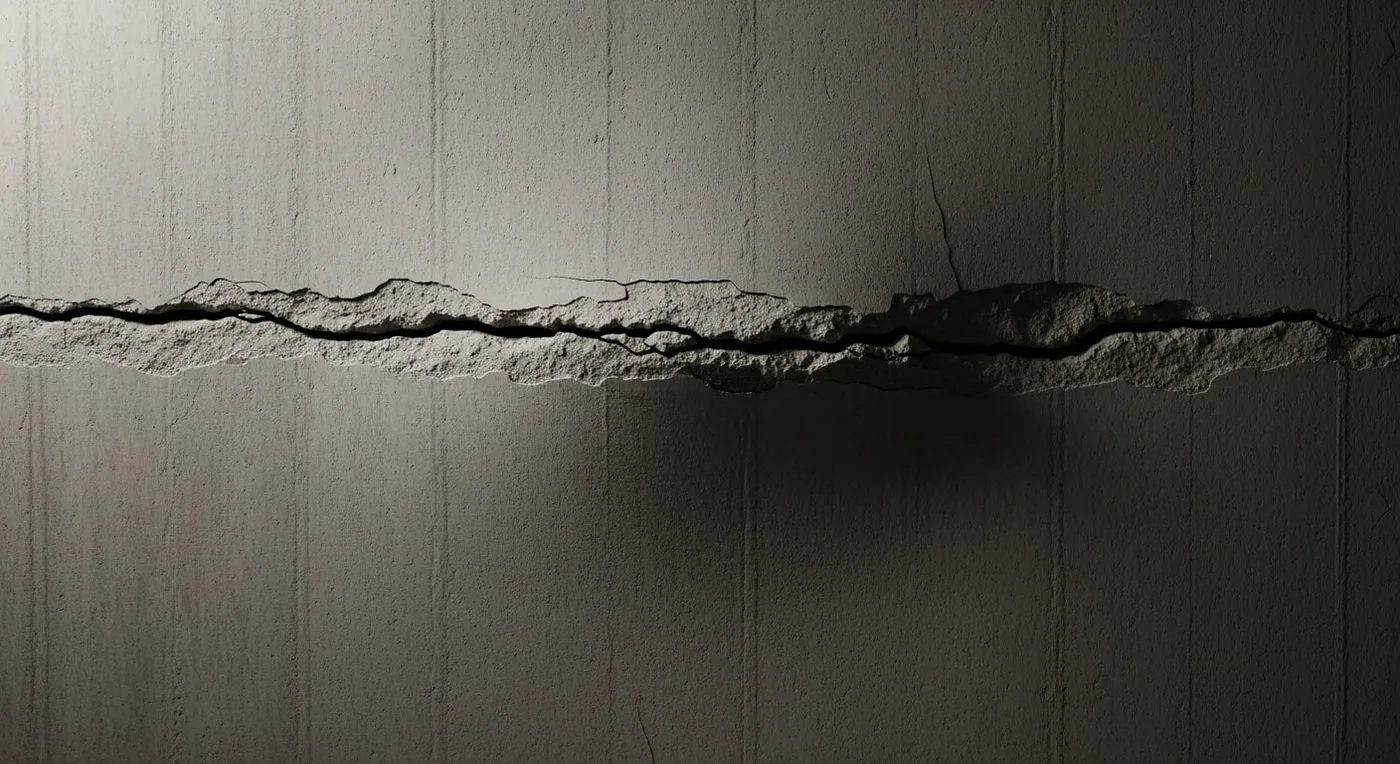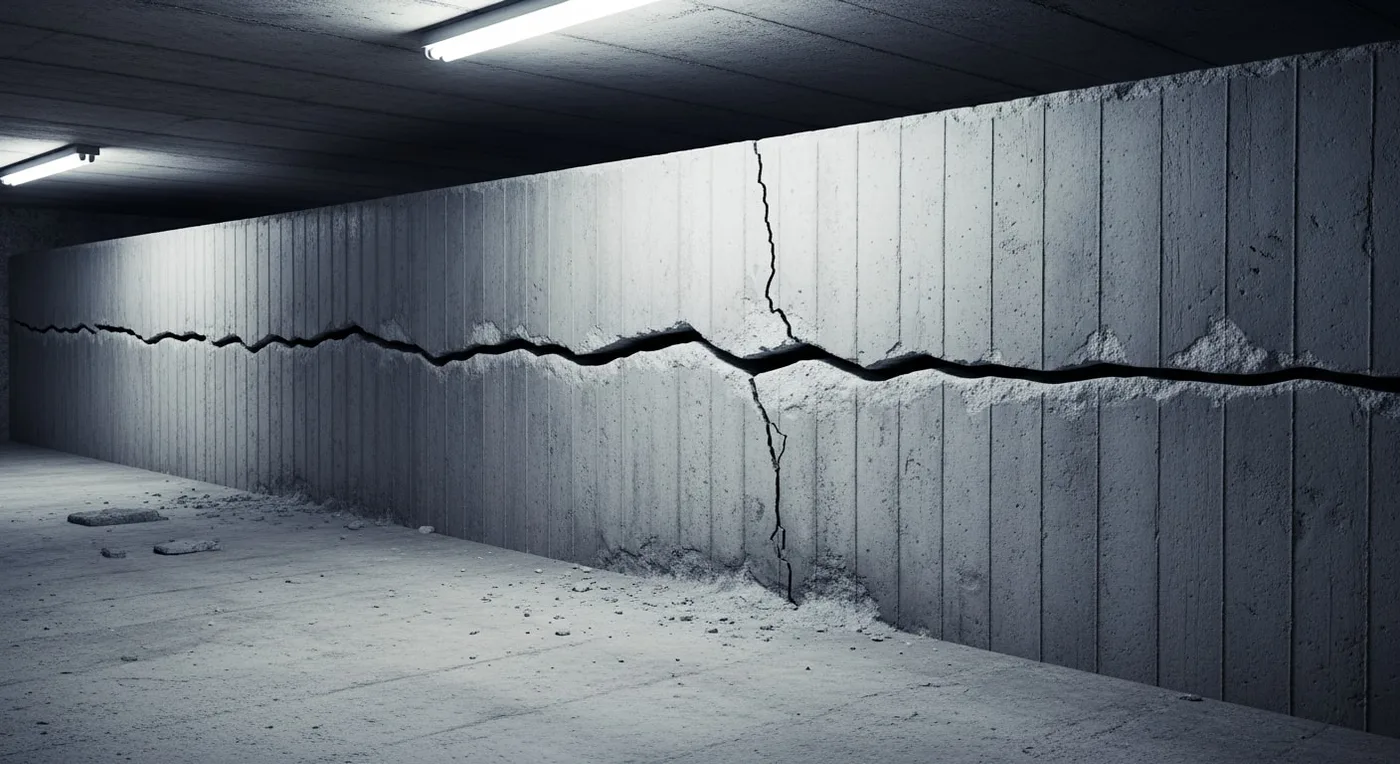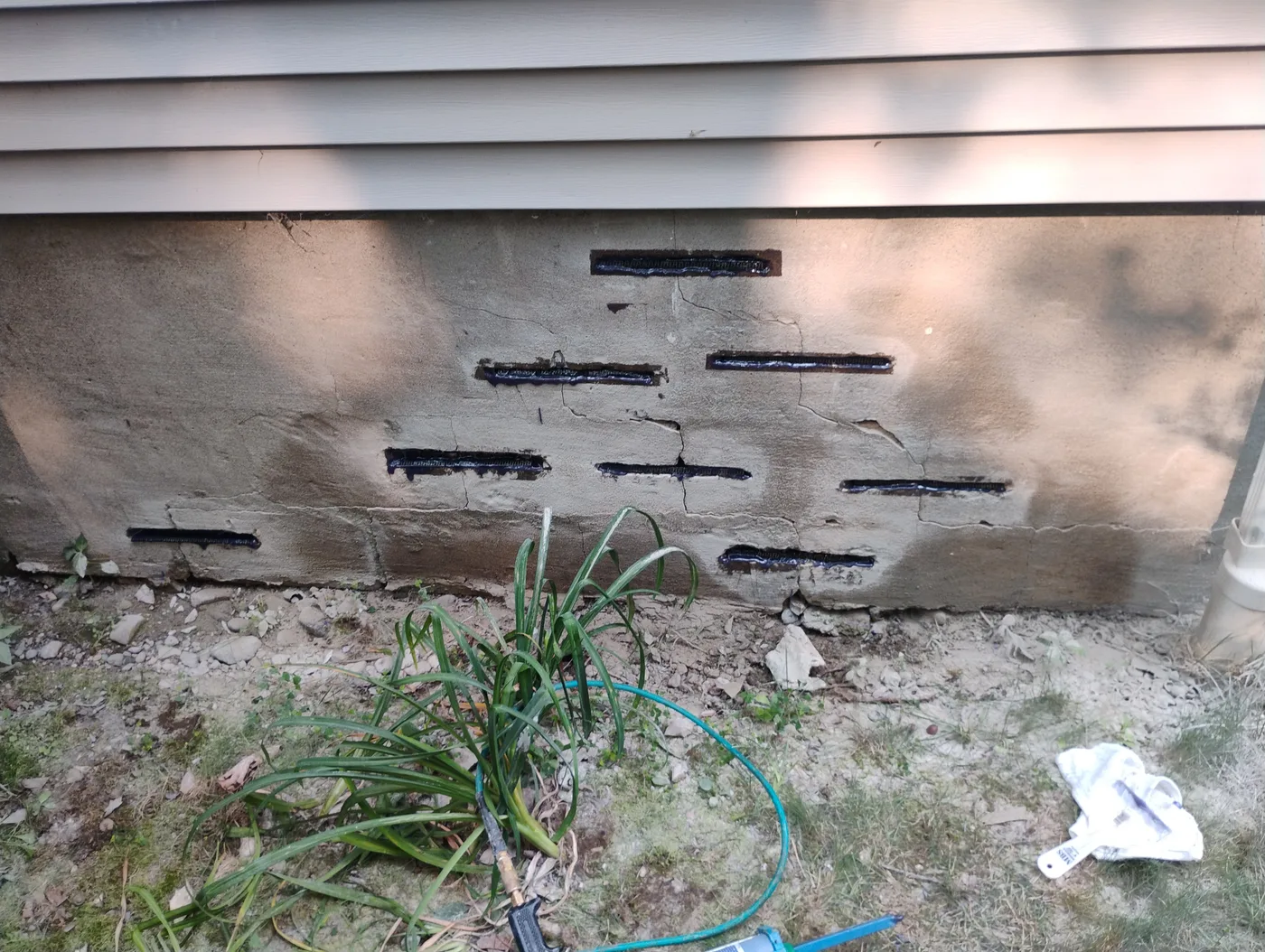
Most foundation cracks in New England are straightforward. Water finds a way in through a shrinkage crack, we inject it, it stops leaking, and everyone goes home happy. But some cracks need more than a seal — they need structural reinforcement. That’s where carbon fiber stitches come in.
After 50+ combined years of repairing foundations across Connecticut, Massachusetts, Rhode Island, New Hampshire, and Maine, we’ve seen every type of crack imaginable. And we can tell you this: knowing when injection is enough and when you need carbon fiber is the difference between a repair that lasts and one that fails in two years.
When Injection Is Not Enough
Crack injection — whether polyurethane or epoxy — does an excellent job of sealing cracks against water intrusion. Our foundation crack injection process fills the crack from the inside out, bonding the concrete and stopping leaks permanently.
But injection has a limitation. It seals the crack and restores some rigidity, but it doesn’t add tensile strength to the wall. If the forces that caused the crack are still active — soil pressure pushing inward, ongoing settlement, or structural loading — the repair can eventually re-crack.
Here’s how to tell if your crack needs more than injection:
Signs of Structural Movement
- Displacement. Put your finger across the crack. If one side is higher or further out than the other, the wall sections have shifted. That’s structural.
- Width over 1/4 inch. Wider cracks often indicate forces beyond normal shrinkage. Check our guide on vertical vs. horizontal foundation cracks for more on reading crack patterns.
- Horizontal cracking. Horizontal cracks, especially in block foundations, usually mean lateral soil pressure is pushing the wall inward. This is a structural concern every time.
- Diagonal stair-step patterns. In block or brick foundations, stair-step cracks following mortar joints indicate differential settlement.
- Bowing or leaning walls. If a tape measure shows the wall is no longer plumb, you’ve got active movement that injection alone won’t stop.
If you see any of these, you need reinforcement. And carbon fiber is often the smartest way to get it.
How Carbon Fiber Reinforcement Works
Carbon fiber is the same material used in aerospace, Formula 1 cars, and military applications. It’s not a gimmick — it’s genuinely one of the strongest materials on the planet relative to its weight. A carbon fiber strap has 800,000 PSI tensile strength — roughly ten times that of steel. Carbon fiber staples (also called carbon fiber stitches) create a permanent bond that will never rust, corrode, or degrade.
The Installation Process
Here’s how we install carbon fiber stitches on a foundation wall:
-
Surface preparation. We grind the concrete surface smooth along the crack path and at each stitch location. The concrete needs to be clean and slightly rough for proper adhesion.
-
Crack injection first (typically). In most cases, we inject the crack with polyurethane or epoxy before applying carbon fiber. The injection seals against water; the carbon fiber handles structural loads. They’re complementary, not redundant. In some cases — like block foundations where injection isn’t practical — we may proceed directly to carbon fiber installation without a full crack injection.
-
Epoxy application. We apply a structural-grade, two-part epoxy to the prepared concrete surface. This is not hardware-store epoxy — it’s engineered specifically for carbon fiber bonding to concrete.
-
Carbon fiber placement. Pre-cut carbon fiber fabric strips are laid across the crack in an X-pattern or perpendicular orientation, depending on the crack direction and structural requirements.
-
Saturation and curing. Additional epoxy is worked into the carbon fiber fabric to fully saturate the fibers. The assembly cures to form a rigid composite that’s permanently bonded to the wall.
-
Finishing. Once cured, the repair can be painted or covered. It adds minimal thickness to the wall — typically less than 1/8 inch — so it won’t interfere with finishing or framing.
The entire process for a typical crack takes a few hours. No excavation, no heavy equipment, no weeks-long disruption to your life.
Carbon Fiber vs. Other Structural Repairs
Carbon fiber isn’t the only structural repair option. Here’s how it compares to the alternatives:
Steel I-Beams
Steel I-beams are the traditional approach to bowing walls. Vertical steel columns are placed against the wall and anchored to the footing and floor framing above. (Not to be confused with lally columns, which are the support posts holding up your main beam.)
Pros: Proven technology, can handle severe bowing, adjustable over time.
Cons: They stick out 4-6 inches from the wall (goodbye, finished basement layout), they’re heavy, installation is disruptive, and they can cost $800-$1,500 per beam. A typical wall might need 4-6 beams ($4,000-$10,000 per wall).
Wall Anchors
Wall anchors use steel plates on the interior wall connected by rods to anchor plates buried in the yard. Tightening the rods pulls the wall back toward plumb over time.
Pros: Can actively straighten a bowed wall (not just stabilize it), relatively affordable per anchor point. Cons: Requires exterior excavation, yard disruption, and enough setback from property lines. Not suitable for every property.
Carbon Fiber
Pros: No loss of interior space, no excavation, fast installation, incredibly strong, won’t rust or corrode, maintenance-free, barely visible once painted. Cons: Stabilizes the wall in its current position — it doesn’t actively push it back. If bowing is severe (more than 2 inches), you may need beams or anchors first, then carbon fiber to maintain the correction.
When Each Makes Sense
- Carbon fiber: Best for cracks with minor displacement, early-stage bowing (under 2 inches), and walls that need reinforcement but not repositioning. It’s also ideal for poured concrete walls where you want minimal visual impact.
- Steel I-beams: Best for moderate to severe bowing where the wall needs active resistance and you don’t mind the space intrusion.
- Wall anchors: Best when you want to gradually straighten a wall over time and have the exterior space for anchor placement.
We’ll tell you honestly which approach your wall needs. Sometimes carbon fiber is overkill for a simple crack. Sometimes it’s not enough for severe bowing. Getting the diagnosis right matters more than the repair method. That’s why we offer free foundation consultations — so you know exactly what you’re dealing with before spending a dollar.
The Combined Approach: Injection + Carbon Fiber
This is actually our most common structural repair approach, and it’s worth understanding why.
Injection and carbon fiber solve different problems:
- Injection fills the void inside the crack, bonds the faces together, and creates a waterproof seal. It’s your moisture barrier.
- Carbon fiber bridges the crack on the surface and prevents it from reopening under load. It’s your structural reinforcement.
Together, they create a repair that’s both watertight and structurally sound. We inject first, let it cure, then apply the carbon fiber over the sealed crack. The result is a wall that’s stronger than it was before it cracked — and that’s not an exaggeration. The carbon fiber composite actually adds tensile strength that plain concrete doesn’t have.
If you’re curious about how this fits into the bigger picture of foundation repair options, our guide on DIY vs. professional foundation repair covers when you need professional-grade solutions versus when simpler approaches work.
Cost and Warranty
Let’s talk numbers. Carbon fiber stitches typically run $200-$300 per stitch, with most cracks needing 3-8 stitches depending on length and severity. Combined with injection, a typical structural crack repair runs $2,000-$4,000.
Compare that to steel I-beams at $4,000-$10,000 per wall or wall anchor systems at similar price points, and carbon fiber starts looking like a pretty smart investment — especially when the engineering says it’s the right solution.
For a more complete picture of repair pricing, see our foundation repair cost guide for 2026.
What About the Warranty?
Every carbon fiber repair we perform comes with a lifetime transferable warranty. That covers both the injection seal and the carbon fiber reinforcement. If the repair ever fails — and in 50+ combined years, we’ve seen vanishingly few failures with properly diagnosed carbon fiber applications — we come back and fix it at no charge.
The warranty transfers to new owners if you sell the home, which actually becomes a selling point rather than a liability. Real estate agents love seeing a professional structural repair with a lifetime warranty in the disclosure documents.
Is Carbon Fiber Right for Your Foundation?
Here’s the honest answer: maybe. It depends entirely on what your crack is doing and why.
Carbon fiber is an outstanding solution for the right problems. But diagnosing those problems correctly requires experience — not a Google search and not a guess. We’ve looked at tens of thousands of foundation cracks across New England, and that pattern recognition is what ensures you get the right repair the first time.
If you’ve got a crack that concerns you — especially one that’s wider than a quarter inch, showing displacement, or in a wall that looks like it might be moving — give us a call. The consultation is free, the diagnosis is honest, and if you don’t need carbon fiber, we’ll tell you that too. 860-573-8760 (CT) | 617-668-1677 (MA)If you’ve got a crack that concerns you — especially one that’s wider than a quarter inch, showing displacement, or in a wall that looks like it might be moving — give us a call. The consultation is free, the diagnosis is honest, and if you don’t need carbon fiber, we’ll tell you that too. 860-573-8760 (CT)If you’ve got a crack that concerns you — especially one that’s wider than a quarter inch, showing displacement, or in a wall that looks like it might be moving — give us a call. The consultation is free, the diagnosis is honest, and if you don’t need carbon fiber, we’ll tell you that too. 617-668-1677 (MA)