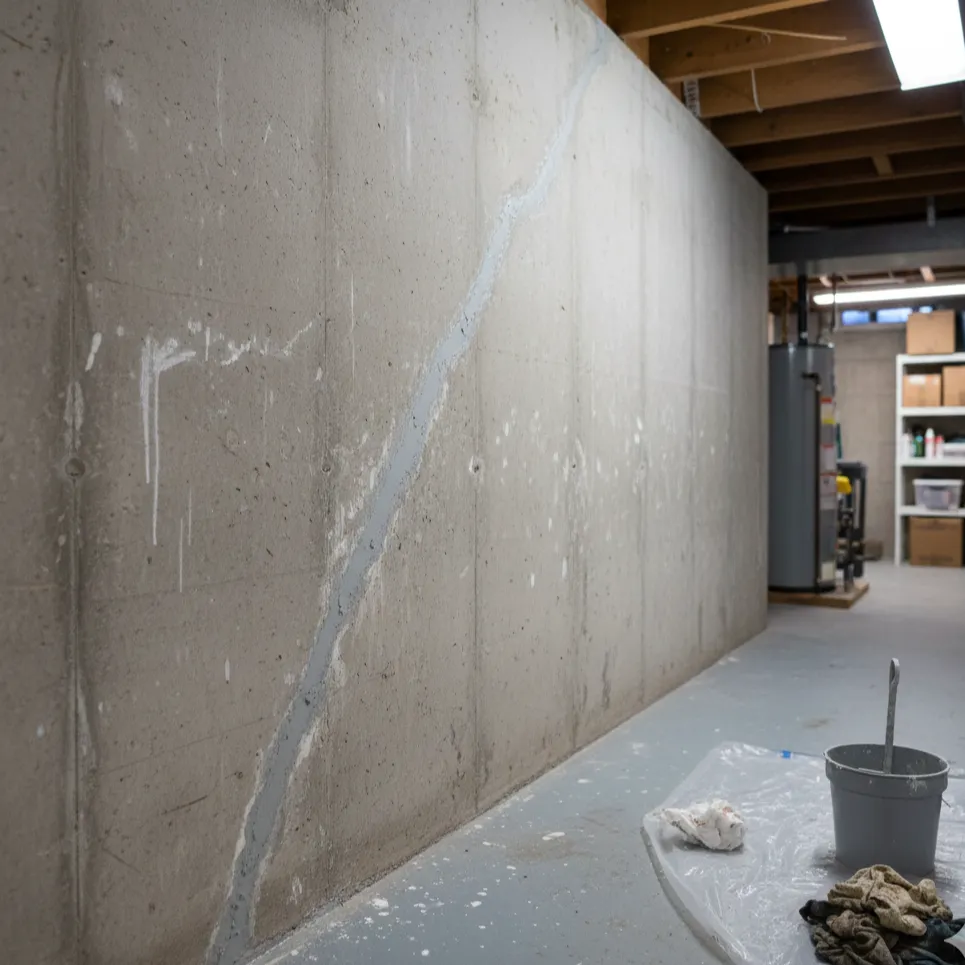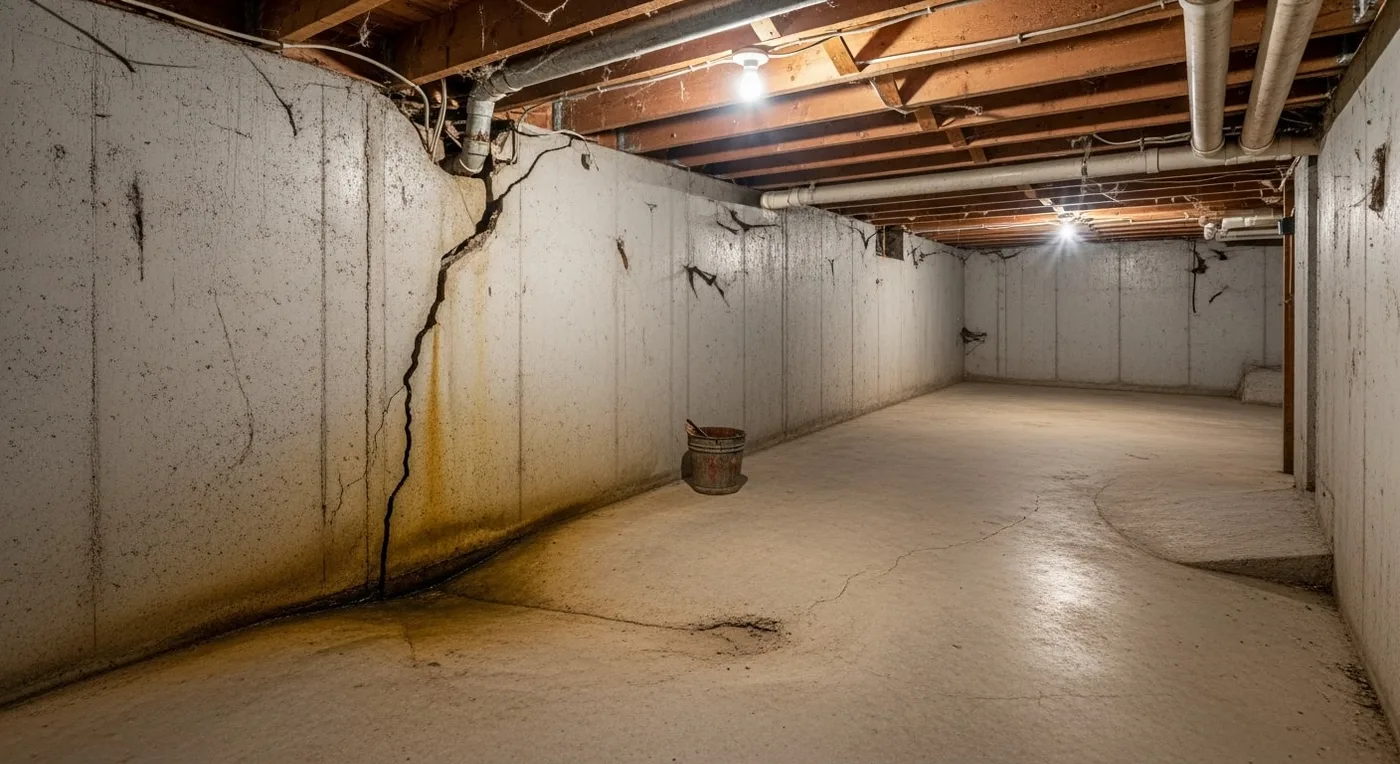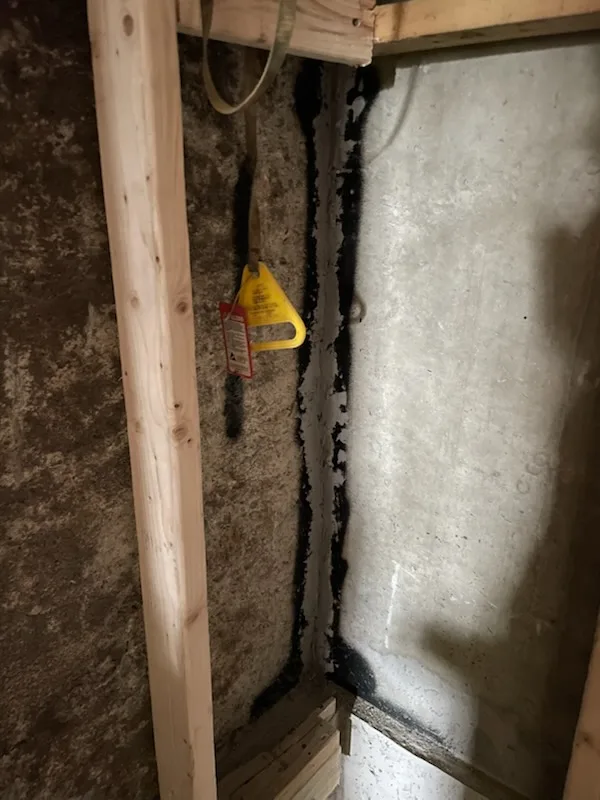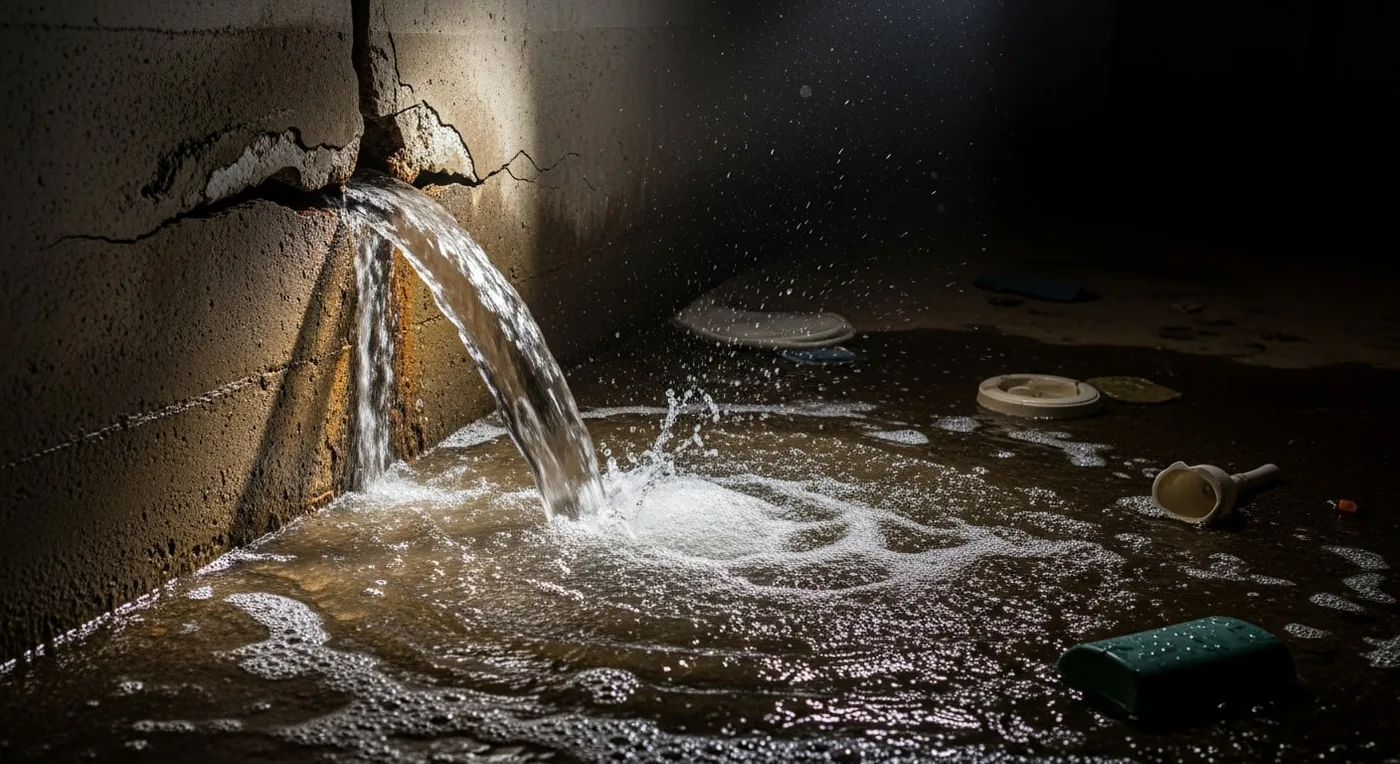
We are going to assume something bad is happening in your basement right now. Water through a crack, a wet floor with no explanation, a sound from downstairs that no homeowner wants to hear.
Take a breath. After 50+ combined years of foundation repair across New England, we can tell you this: the vast majority of foundation emergencies are very fixable. Alarming, yes. The end of your house, no.
Emergency Basement Flooding: Your First 15 Minutes
1. Check for Electrical Hazards
Before you step into standing water, look at the situation from the stairs. If water is near your electrical panel, outlets, or any appliances that are plugged in, do not enter the area. Call an electrician first or shut off power to the basement at the main breaker — but only if you can reach the breaker panel without stepping in water.
This is not us being overly cautious. This is the one part of a foundation emergency that can actually be dangerous.
2. Identify the Source
Once it is safe, figure out where the water is coming from. Different sources need different responses:
- Wall crack leak: Water through a visible crack. The most common foundation emergency.
- Floor-wall joint (cove joint): Water where the floor meets the wall, often in a line along the base.
- Bulkhead or hatchway: Water entering around the bulkhead frame. Very common in older New England homes.
- Floor crack: Water coming up through the slab — basement floor cracks leaking water mean hydrostatic pressure from below, often driven by a high water table or clay-heavy soil. Note: what looks like a floor crack leak is often water entering through a wall crack higher up and running down to the lowest point. Check the walls first.
- Window well: Water pooling in a window well and coming through the basement window.
- Pipe penetration: Water entering around sewer, water, or conduit lines that pass through the wall ($650-$1,000 to seal professionally).
Take a photo and a short video of the source — you can text us a photo for a quick assessment. This will be helpful whether you are calling us, filing insurance, or documenting the timeline.
3. Contain What You Can
If the source is a wall crack and the flow is manageable, you can slow things down:
- Place towels or rags at the base of the wall to direct water toward a floor drain if you have one.
- If you have a wet/dry shop vacuum, use it. They are worth their weight in gold during a basement water event.
- If you have a sump pump, make sure it is running. Test it by pouring water into the pit. If it does not kick on, check the power and the float switch.
Do not try to plug an actively leaking crack with hydraulic cement, caulk, or expanding foam. These products cannot bond to wet concrete under pressure and will fail almost immediately. You will waste time and money, potentially make a professional repair more expensive (we often have to clean out DIY attempts before injecting), and the water will just find another path.
What Constitutes a Real Foundation Emergency
Not every water event in a basement is an emergency. Here is how to tell the difference:
Call a Professional Immediately If:
- A wall is visibly bowing or leaning inward. This is structural and goes beyond water management.
- A crack is growing while you watch. Active widening indicates movement, not just water pressure.
- Water flow is increasing rapidly. A trickle becoming a stream in minutes means a worsening situation.
- You see soil or sediment in the water. Material being carried through the wall means a larger opening than a typical crack.
- Multiple new cracks appear suddenly. Three new cracks in one storm is a bigger concern than one.
Alarming but Probably Not an Emergency:
- A single crack is seeping or dripping. Needs fixing, but your house is not in danger tonight — unless you have a finished basement or valuables that cannot be moved, in which case urgency increases.
- The floor is damp with no obvious source. Could be condensation or a slow seep. Worth investigating, not panicking. Again, a finished basement changes the calculus.
- Water around the bulkhead during heavy rain. Extremely common in New England. Annoying, fixable, rarely urgent.
- Efflorescence on walls. White powder on basement walls is a historical indicator of water movement, not an active emergency.
What NOT to Do
We have seen well-intentioned homeowners make things worse. Avoid these:
Do not dig around your foundation during an active water event. Excavating saturated soil next to a wall already under pressure can cause more harm than good.
Do not use interior waterproof paint as a fix. These coatings trap water inside the wall. The pressure builds and eventually the coating delaminates — sometimes spectacularly.
Do not ignore it because the water stops. The crack is still there, and it will leak again — probably worse, because freeze-thaw cycles in New England’s glacial till and clay-heavy soil will widen it every winter. If you notice water in your basement after rain, that pattern will only intensify.
Do not run a dehumidifier as your long-term solution. A dehumidifier manages symptoms. The water is still entering your wall and creating conditions for mold.
When to Evacuate (Rare, but Important)
In decades of work, we can count on one hand the times we have told someone to leave. But if you see a wall actively shifting, the floor heaving upward, smell gas, or standing water has reached electrical systems you cannot shut off — get everyone out, call 911, then call us. In that order.
What Emergency Foundation Repair Looks Like
When you call Attack A Crack for an urgent situation, here is what happens:
Assessment first. We figure out exactly what is going on before we touch anything. This usually takes 15-30 minutes and involves examining the crack, the water flow, the exterior conditions, and the overall wall condition. With thousands of projects across New England, we have seen virtually every scenario.
For actively leaking cracks, we use foundation crack injection — injecting polyurethane resin at 100 PSI directly into the crack through the full 8-10 inches of concrete, which reacts with water to form a flexible, permanent waterproof seal. Most crack injection repairs cost $800-$1,300 per crack with a lifetime guarantee.
For structural concerns like bowing walls, the solution may involve carbon fiber staples (stitches) at $200-$300 per stitch or steel reinforcement. We will be straight with you about what it requires — we do not upsell structural work when injection will do, and we do not downplay structural issues to make a cheaper sale.
For bulkhead leaks, that involves repairing the bulkhead with professional bulkhead sealant injection ($1,800-$2,500), repairing the frame, and improving drainage around it.
After the Immediate Crisis
Once the active water is managed, take these steps:
-
Document everything. Photos, videos, dates, weather conditions. If you file a homeowner’s insurance claim, this documentation is essential. (Note: most standard policies do not cover groundwater intrusion, but they may cover sudden events. Check your policy.)
-
Get a professional assessment. Even if the water stopped on its own, you need to understand why it started. Text us photos for a free assessment and we will give you a clear picture.
-
Plan the permanent repair. Temporary fixes buy time. Permanent repairs buy peace of mind. We will give you an honest timeline and cost so you can plan accordingly. Our foundation repair cost guide covers all pricing details.
-
Address the exterior causes. Grading, downspouts, gutter maintenance — these are the upstream factors that put pressure on your foundation in the first place.
We Pick Up the Phone
If you are dealing with a foundation emergency, call us. We serve all of New England — CT, MA, RI, NH, and ME. 860-573-8760 (CT) | 617-668-1677 (MA)If you are dealing with a foundation emergency, call us. We serve all of New England — CT, MA, RI, NH, and ME. 860-573-8760 (CT)If you are dealing with a foundation emergency, call us. We serve all of New England — CT, MA, RI, NH, and ME. 617-668-1677 (MA)
We have been the “something is happening in my basement and I do not know what to do” call for thousands of homeowners across the region. We will give you an honest answer, even if that answer is “put a towel down and call us Monday.”
Your foundation is not giving up on your house. Neither should you.