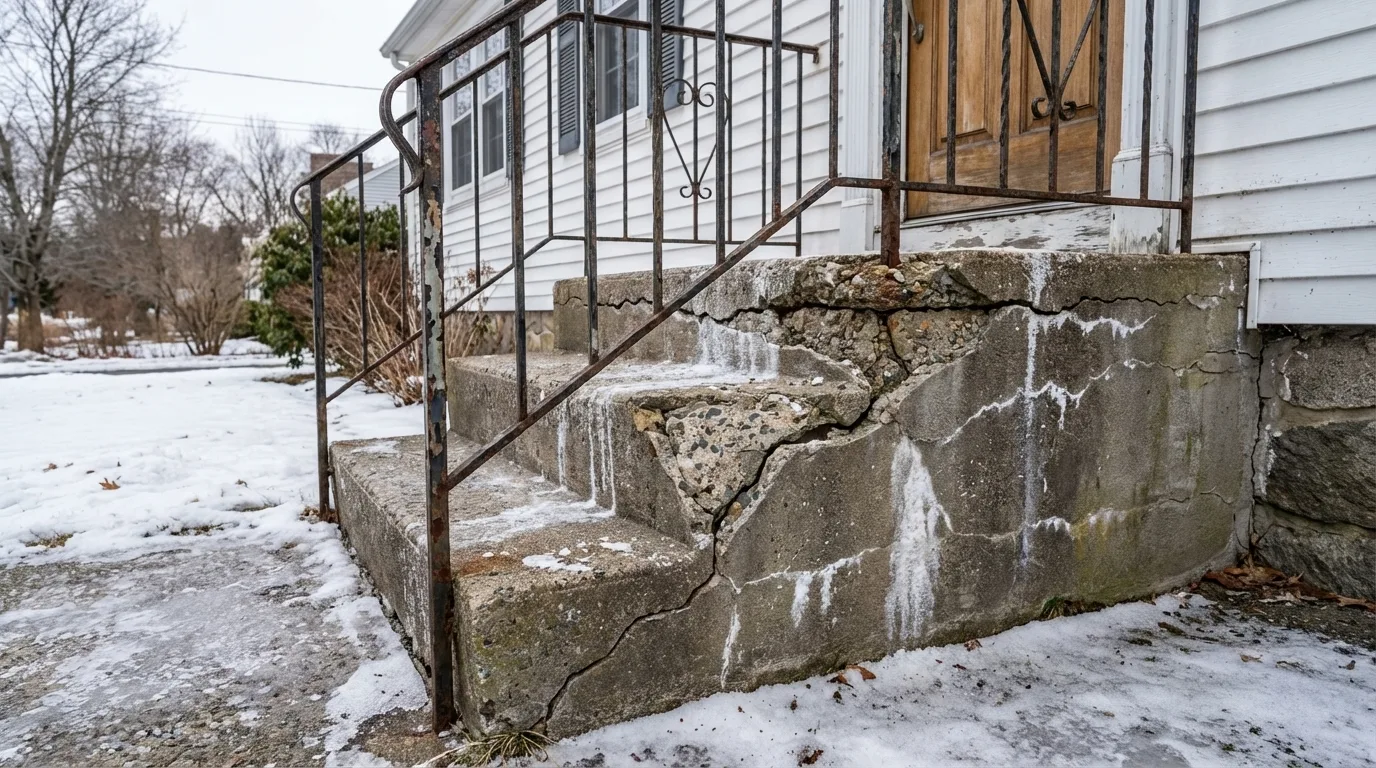
Crumbling concrete stairs are one of those problems that starts small and becomes urgent fast. A chipped edge becomes a crumbling corner, which becomes a missing chunk, which becomes the thing your mail carrier trips over before you get a letter from their lawyer. We’re only half kidding — concrete stair damage is a genuine safety and liability issue, and in Massachusetts, it’s everywhere.
The combination of brutal freeze-thaw cycles (50 to 80 per winter), decades of de-icing salt, and concrete that was often poured without air entrainment (a mix additive that improves freeze-thaw resistance) means that stair damage is one of the most common concrete repair problems we see across the Commonwealth. The good news? Most concrete stair repairs are affordable, and understanding your options helps you make the right call.
Concrete Stair Repair Cost Breakdown (2026 Prices)
Let’s start with the numbers. Here’s what concrete stair repair typically costs in Massachusetts in 2026:
| Repair Type | Cost Range | Best For |
|---|---|---|
| Edge/corner patching | $150-$400 | Minor chips, small broken corners |
| Full step resurfacing | $300-$800 per step | Surface deterioration across the tread |
| Single step replacement | $500-$1,200 | One badly damaged step |
| Partial rebuild (2-3 steps) | $1,000-$3,000 | Multiple damaged steps in a run |
| Complete stair replacement | $2,500-$6,000+ | Widespread structural failure |
| Landing replacement | $1,500-$4,000 | Top or bottom landing deterioration |
These are 2026 estimates for the Massachusetts market, which runs slightly above national averages due to higher labor costs and the shorter construction season. Your actual cost will depend on the specific factors below.
For context on how stair repair fits into the broader picture of concrete work, see our concrete repair services.
What Affects the Price
Concrete stair repair isn’t one-size-fits-all. Here’s what drives costs up or down:
Number and Severity of Damaged Steps
This is the obvious one. A single chipped edge on one step is a quick repair. Five crumbling steps with structural cracks running through them is a different project entirely. We assess each step individually and recommend the most cost-effective approach for the overall stairway.
Access and Location
Front entry stairs with clear access from the driveway? Straightforward. Basement bulkhead stairs with narrow access? More labor-intensive. Side-entry stairs against a retaining wall? That wall needs to be protected during the work. Access affects labor time, and labor is the biggest component of most stair repairs.
Speaking of bulkhead stairs, if your bulkhead itself is also showing problems, our bulkhead repair cost guide covers that related topic.
Stair Configuration
Simple straight runs are the easiest to repair. L-shaped stairs, curved stairs, stairs with integrated walls or railings, and stairs wider than the standard 36-48 inches all add complexity and cost. Wraparound front stoops — common on triple-deckers in Boston, Worcester, and Springfield — are among the more complex configurations.
Railing Integration
If your stairs have metal railings set into the concrete (as opposed to surface-mounted), any stair repair needs to account for the railing posts. Sometimes posts need to be temporarily removed and reset, or new post anchors need to be installed. This may add $100-$300 per post to the project.
Code Requirements
Massachusetts building code requires specific dimensions for stairs serving as a means of egress (which includes your front and back entry stairs):
- Rise: Maximum 7-3/4 inches per step
- Run: Minimum 10 inches per tread
- Width: Minimum 36 inches
- Handrails: Required when four or more risers
If your existing stairs don’t meet current code and you’re doing a substantial repair or replacement, you may need to bring them into compliance. This can change the scope and cost of the project significantly. A two-step patch job won’t trigger code review, but a full replacement will.
Safety Considerations
We want to be direct about this: damaged concrete stairs are a serious safety hazard. Here’s why urgency matters:
Trip and Fall Risk
Uneven step edges, crumbling treads, and broken corners create trip hazards for everyone who uses the stairs — your family, guests, delivery drivers, and emergency responders. The elderly and children are at highest risk, but anyone can catch a toe on a crumbling edge.
Liability Exposure
As a Massachusetts property owner, you have a duty to maintain safe conditions on your premises. If someone is injured on your deteriorating stairs, you can be held liable. Homeowner’s insurance may cover the claim, but it won’t cover the premium increase — or the possibility that your insurer drops you after a claim.
Code Violations
Severely deteriorated stairs can be cited by building inspectors, particularly during property transfers or if a complaint is filed. In some Massachusetts municipalities, a code violation on stairs can require immediate repair or temporary closure of that entrance.
Progressive Deterioration
Concrete stair damage doesn’t stabilize — it gets worse. Every freeze-thaw cycle wedges cracks wider, every rain drives more water deeper into the concrete, and every use applies load to a weakening structure. A $300 patch job today can prevent a $4,000 replacement next year.
Types of Concrete Stair Repair
There are several approaches to fixing concrete stairs, depending on the type and severity of the damage. Here’s what’s available:
Patching and Resurfacing (What We Do)
What it is: Applying a bonded cementitious overlay to damaged areas, restoring the step profile and surface. This is our specialty at Attack A Crack.
When it’s appropriate: Surface deterioration, small chips and spalls, cosmetic damage without structural compromise. The underlying concrete needs to be sound — patching over crumbling concrete is throwing money away.
Process: We clean the damaged area down to sound concrete, apply a bonding agent, build up the repair with polymer-modified concrete or mortar, and finish the surface to match. Repairs need 24 to 48 hours of cure time for full use.
Durability: 5-15 years depending on exposure and maintenance.
If your stairs need more than resurfacing, we’ll tell you honestly and help guide you to the right solution — including referring you to a trusted partner if the job calls for one of the methods below.
Mudjacking / Foam Leveling
What it is: Lifting sunken stair sections back to level by injecting material under the slab.
When it’s appropriate: When stair sections or landings have settled but the concrete surface is still in good condition. The problem is underneath, not on top.
Process: Small holes are drilled through the concrete, and cementitious grout (mudjacking) or expanding polyurethane foam is pumped underneath to fill voids and raise the slab. The holes are patched.
Durability: 10-20 years for mudjacking, potentially longer for foam, depending on the underlying soil conditions.
Partial Replacement
What it is: Removing and repouring individual steps or a section of the stairway while keeping the intact portions.
When it’s appropriate: When specific steps have structural damage but the rest of the stairway is sound. Commonly used when the top two or three steps are failing (they get the most weather exposure) but the lower steps are fine.
Process: The damaged section is carefully demolished, new formwork is set, rebar is tied into the existing structure, and fresh concrete is poured. Proper bonding between old and new concrete is critical.
Durability: 20+ years with proper installation and maintenance.
Complete Replacement
What it is: Demolishing the entire stairway and pouring new.
When it’s appropriate: When damage is widespread, when the stairs don’t meet code and need reconfiguration, or when repair costs exceed 50-60% of replacement costs.
Process: Full demolition, new formwork, footings (if required), rebar, pour, and finish. Typically includes bringing stairs up to current code requirements.
Durability: 30-50+ years with proper mix design, air entrainment, and maintenance.
When to Repair vs. When to Replace Concrete Stairs
Here’s the decision framework we use after decades of concrete work:
Repair when:
- Damage is limited to 1-2 steps
- The underlying structure is sound (tap it with a hammer — solid concrete rings, crumbling concrete thuds)
- The stairs meet basic code requirements
- Repair cost is under 40% of replacement cost
Replace when:
- More than half the steps are damaged
- You can push a screwdriver into the concrete (it’s that deteriorated)
- The stairs don’t meet code and reconfiguration is needed
- The footing is compromised or undermined
- Previous patch repairs have failed
When NOT to repair stairs: If the concrete crumbles when you chip at it with a hammer, or if rebar is visibly corroded and expanding, surface patching will not hold. The underlying concrete has lost its structural integrity and needs replacement, not cosmetic repair. Spending $500 on a patch over deteriorated concrete is $500 wasted.
For the broader repair-vs-replace decision for other concrete surfaces, our driveway crack repair guide and pool deck crack repair guide apply similar logic.
Timeline Expectations
Here’s what the typical concrete stair resurfacing project looks like from text to completion:
- Quote: Text us photos and we can typically get you a quote the same day.
- Scheduling: Once approved, we get you on the schedule right away. Depending on the season, we book out one to three weeks.
- The work: Most resurfacing repairs are a half-day or single-day job.
- Cure time: 24-48 hours for foot traffic, 7 days for full strength, 28 days for complete cure.
- Sealant: We use a premium mix that doesn’t require a separate sealant. For an optional premium sealant coating, that would be applied after a full cure.
Seasonal Considerations
Concrete work in Massachusetts has a real season. Temperatures need to be consistently above 40 degrees Fahrenheit for proper curing, with ideal conditions between 50-80 degrees. That gives us roughly April through November, with the sweet spot being May through October.
If your stairs are a safety hazard during winter months, temporary measures (non-slip treads, caution tape for severely damaged areas) can bridge the gap until spring repairs. But don’t let a full season pass without addressing the problem.
Getting a Quote
The fastest way to get started is to text us a few photos of your stairs. We can usually give you an honest assessment and a quote the same day — no on-site visit needed for most resurfacing jobs. Just snap a few shots showing the damage from different angles.
We’ll tell you straight: if it’s a simple resurfacing, we’ll handle it. If your stairs need more than what we do — partial replacement, full rebuild — we’ll let you know and point you to a trusted partner who can help.
No pressure, no upselling. If your stairs just need a $20 bag of patching compound and some elbow grease, we’ll tell you that.
Text photos to 617-668-1677. Concrete stair repair is available through our Massachusetts operations — we serve the greater Boston area, South Shore, MetroWest, Worcester area, and throughout the Commonwealth. Your stairs have been crumbling long enough — let’s fix them before someone gets hurt.