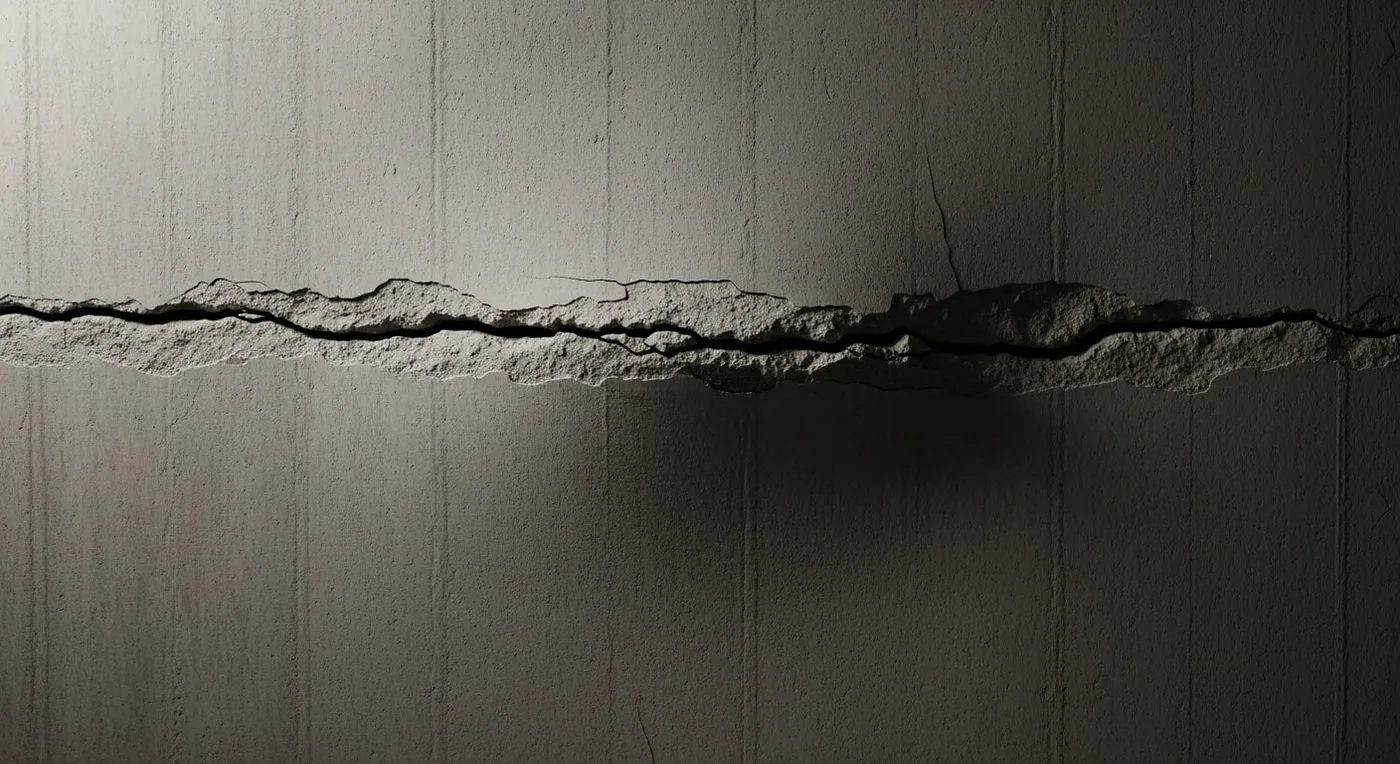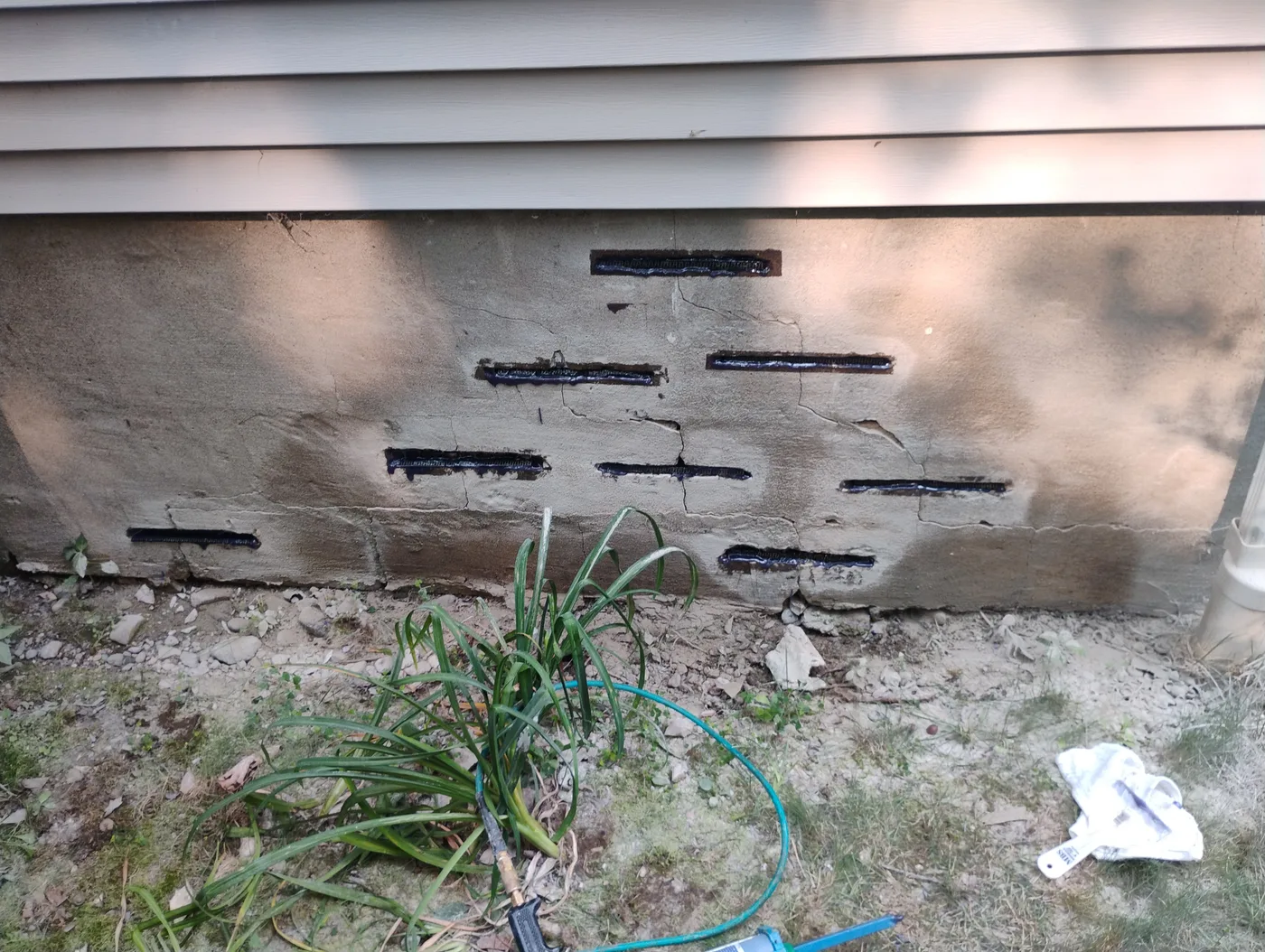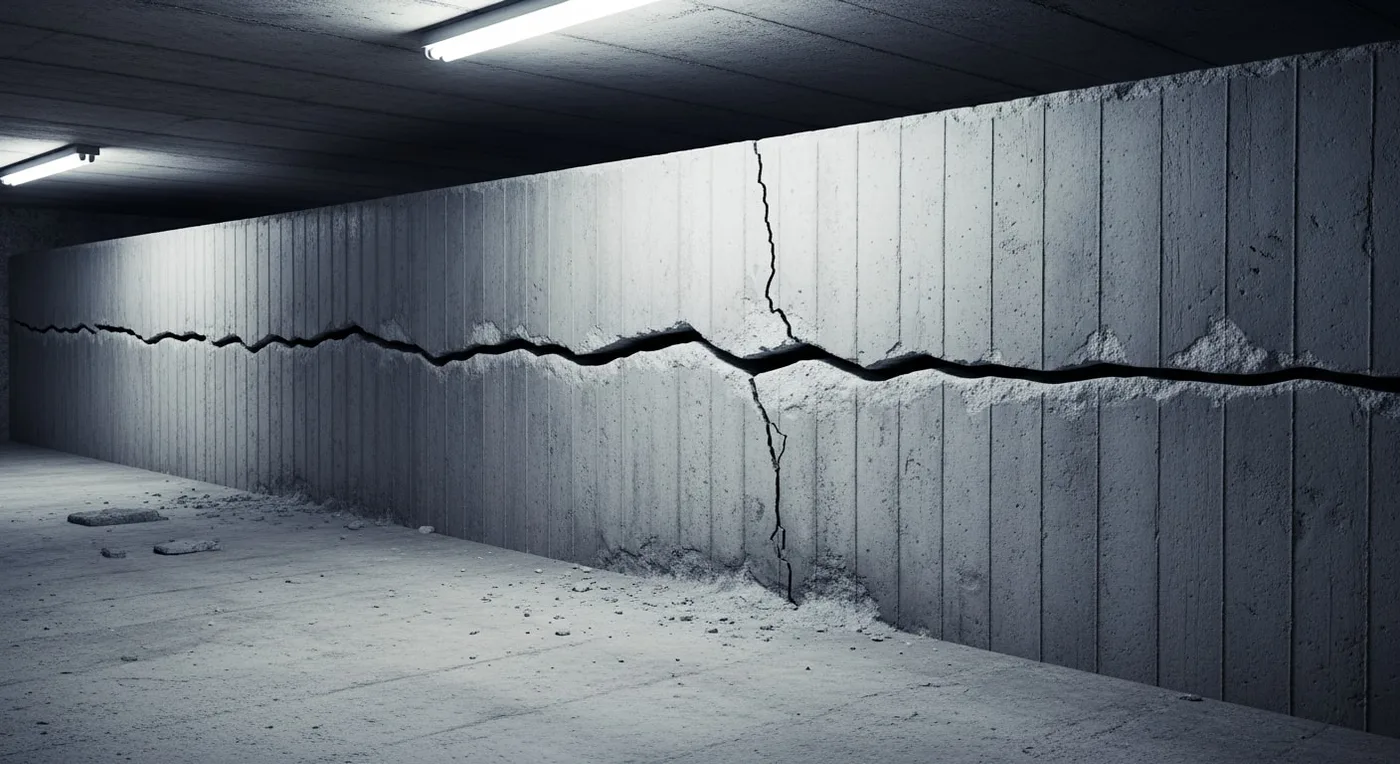
Your basement wall is bowing inward. You can see it — a horizontal crack runs across the middle of the wall, and below that line, the blocks are pushing into the basement. The soil outside is winning.
This is not a crack problem. This is a wall problem. And the fix in many cases is carbon fiber straps.
What Causes Basement Walls to Bow
Bowing happens when the soil outside your foundation pushes harder than the wall can resist. In New England, several forces can be at work — often in combination:
Hydrostatic pressure. Water-saturated soil exerts enormous force against your wall. After heavy rain or during spring thaw, this pressure spikes. Poor drainage and high water tables make it worse.
Freeze-thaw cycles. Wet soil freezes and expands in winter, then contracts in spring. Each cycle nudges the wall a fraction of an inch further inward. Over years, those fractions add up — a ratcheting effect called frost heave.
Clay expansion. The glacial till common across Connecticut and Massachusetts is dense, clay-heavy soil that swells when wet and contracts when dry. This seasonal cycle creates relentless lateral pressure.
Tree root pressure. Large trees growing near foundations can push roots directly against walls. More commonly, tree roots dry out soil unevenly, causing it to shrink and swell in ways that stress the wall over time.
Poor drainage and grading. When the ground slopes toward the foundation instead of away from it, water concentrates against the wall. Combined with any of the forces above, bad grading accelerates bowing.
The result is a wall that develops a horizontal crack (usually at the mortar joint closest to ground level) and begins to deflect inward below that crack line. For a deeper look at what causes this and how to assess severity, see our guide on bowing basement walls.
What Carbon Fiber Straps Are (and What They Are Not)
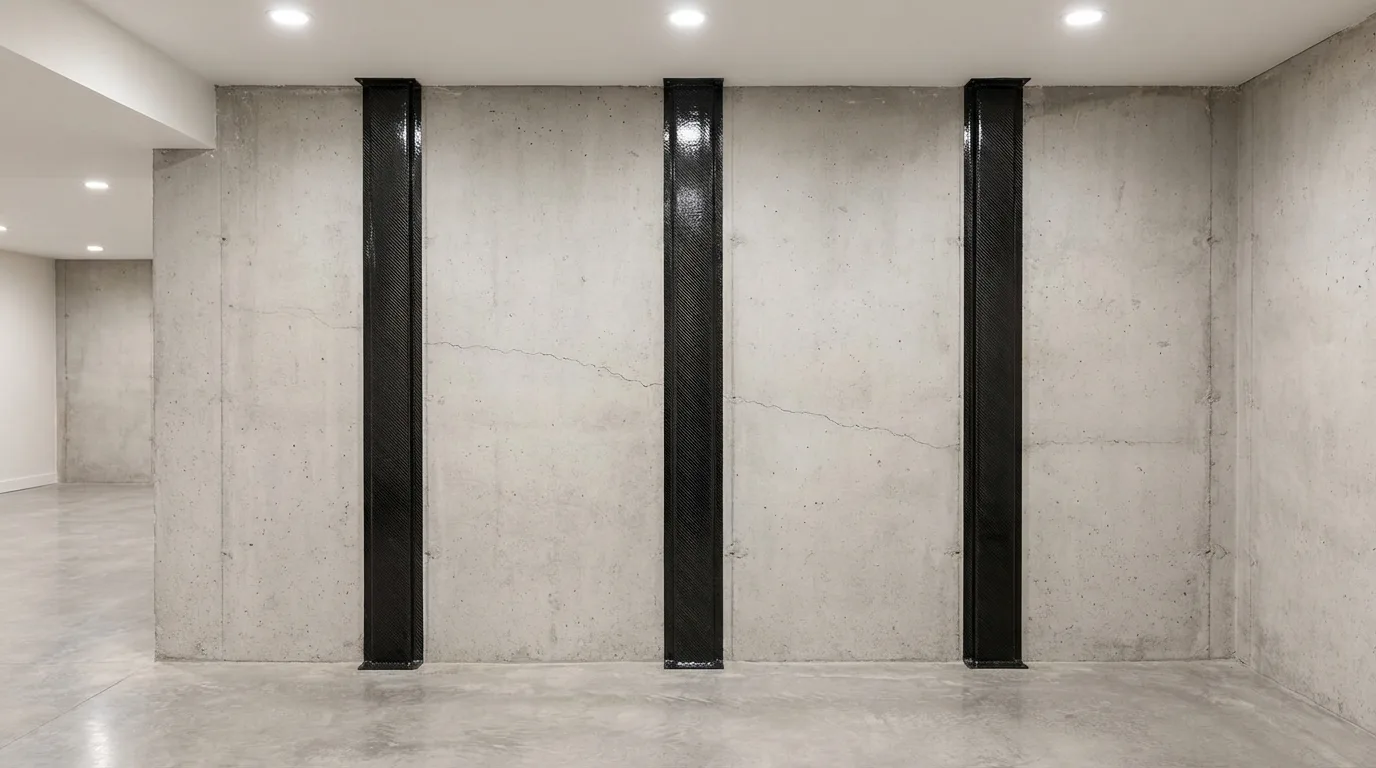
A carbon fiber strap is a sheet of unidirectional carbon fiber fabric, typically 12 inches wide, bonded vertically to the interior face of a basement wall from the footing to the sill plate. It is saturated with structural epoxy that creates a permanent, rigid bond to the wall surface.
What straps do: They arrest lateral movement. Once bonded, the strap resists the inward force of the soil and prevents the wall from bowing further. Carbon fiber has a tensile strength of approximately 195,000 PSI — roughly ten times stronger than steel by weight.
What straps do not do: They do not push the wall back. If your wall has bowed 1.5 inches inward, the straps will stop it at 1.5 inches. The bow stays, but it stops getting worse. For most homeowners, this is exactly the right outcome — the wall is stabilized, the structural risk is eliminated, and the repair is invisible once painted.
Straps vs. Staples: Two Different Fixes
There is real confusion around carbon fiber terminology. Here is the simple version:
-
Carbon fiber staples (also called stitches): Small reinforcements, about 12 inches long, that bridge an individual crack. They hold the two sides of a crack together. Cost: $200–$300 each. Use case: a single crack that needs to stop widening.
-
Carbon fiber straps: Full-height reinforcements that run from the footing to the sill plate. They stabilize the entire wall against lateral soil pressure. Cost: $800–$1,500 each. Use case: a wall that is bowing inward.
Staples fix cracks. Straps fix walls. They are different tools for different problems. For more on staples, see our carbon fiber staples guide.
When Carbon Fiber Straps Are the Right Fix
Straps are the standard repair for walls with less than 2 inches of inward deflection. Here is the decision framework:
| Wall Condition | Deflection | Recommended Repair |
|---|---|---|
| Horizontal crack, no visible bowing | 0–0.5” | Monitor, or staples at the crack |
| Early bowing visible below crack line | 0.5–1” | Carbon fiber straps |
| Moderate bowing, crack widening | 1–2” | Carbon fiber straps |
| Severe bowing, wall visibly displaced | 2–3” | Wall anchors or steel I-beams |
| Wall buckling or separating from sill | 3”+ | Structural engineering assessment first |
The 2-inch threshold is critical. Below 2 inches, straps provide more than enough resistance to arrest the movement. Above 2 inches, the wall may need to be actively straightened over time, which requires wall anchors that can be tightened incrementally or steel I-beams that brace the wall mechanically.
How Carbon Fiber Straps Are Installed
The installation is completed from inside the basement — no excavation, no heavy equipment, no yard damage. A typical wall takes one day.
Step 1: Layout. We measure the wall and mark strap positions. Straps are typically spaced every 4 feet on center, with additional straps near corners where soil pressure concentrates.
Step 2: Surface preparation. The wall surface is ground down approximately 1/8 inch along each strap location. This removes paint, efflorescence, and loose material to expose clean concrete or block for the epoxy to bond to.
Step 3: Crack sealing. Any existing cracks are sealed with injection epoxy or polyurethane before the straps are applied. This prevents water from compromising the bond.
Step 4: Base connection. A hole is drilled into the footing at the base of each strap location. This anchors the bottom of the strap to the footing, creating a load path from the wall into the foundation.
Step 5: Epoxy application. Structural epoxy is applied to the prepared wall surface in the width and height of the strap.
Step 6: Strap placement. The carbon fiber fabric is pressed into the wet epoxy and then saturated with additional epoxy using a roller or trowel. The resin fully penetrates the carbon fiber weave.
Step 7: Top connection. The strap is secured to the sill plate or rim joist at the top of the wall using a steel bracket and lag bolts. This creates a continuous reinforcement from footing to framing.
Step 8: Curing. The epoxy cures fully within 24 to 48 hours. Once cured, the strap can be painted or covered with drywall — it sits nearly flush with the wall surface.
What It Costs
Carbon fiber strap pricing depends on wall height, the number of straps needed, and access conditions.
| Scenario | Straps Needed | Cost Range |
|---|---|---|
| Single strap (isolated area) | 1 | $800–$1,500 |
| 20-foot wall (standard basement) | 4–5 straps | $3,200–$7,500 |
| 24-foot wall (larger basement) | 5–6 straps | $4,000–$9,000 |
| Two adjacent walls (corner repair) | 8–10 straps | $6,400–$15,000 |
For comparison:
| Method | Typical Cost | Excavation Required? | Straightens Wall? |
|---|---|---|---|
| Carbon fiber straps | $3,200–$9,000/wall | No | No (stabilizes only) |
| Wall anchors | $4,000–$12,000/wall | Yes (exterior) | Yes (over time, with tightening) |
| Steel I-beams | $5,000–$15,000/wall | No | No (braces in place) |
Carbon fiber straps are the least expensive option for walls under 2 inches of deflection. They are also the least disruptive — no digging up landscaping, no heavy steel carried through the house.
Carbon Fiber Straps vs. Wall Anchors vs. Steel I-Beams
Carbon fiber straps support the full height of the wall uniformly. Because the strap is bonded continuously from footing to sill plate, the reinforcement is distributed across the entire wall — not concentrated at a single point. They are strongest in tension, meaning they resist the pulling force of the wall trying to bow inward.
Wall anchors (tiebacks) use a rod that extends through the wall and into the soil outside, anchored to a plate buried in stable ground. The interior plate is bolted and can be tightened over time to gradually pull the wall back toward plumb. Wall anchors are the best option when the wall needs to be straightened, not just stabilized. The trade-off: they require exterior excavation, and they only apply force at the anchor points — the wall between anchors can still move.
Steel I-beams are vertical steel columns braced between the floor slab and the floor joists above. They mechanically resist inward movement through brute rigidity. I-beams work but they are expensive, take up basement space (each beam protrudes several inches), and they can only hold the wall where it is — they do not straighten it.
Our recommendation: For walls bowing less than 2 inches, carbon fiber straps are the right fix in nearly every case. They are permanent, maintenance-free, invisible once finished, and they cost less than the alternatives. For walls bowed more than 2 inches, we assess whether wall anchors or engineering consultation makes more sense — and we are honest about it. We do not install straps on walls that need anchors.
Long-Term Durability
Carbon fiber does not rust, rot, corrode, or degrade. It is the same material used in aerospace and Formula 1 applications where failure is not an option. In a basement environment — where moisture, humidity, and temperature fluctuation would eventually compromise steel — carbon fiber maintains its full tensile strength indefinitely.
The structural epoxy bond is equally permanent. Once cured, it forms a rigid connection between the carbon fiber and the wall substrate that does not weaken over time.
We back our carbon fiber strap installations with a lifetime transferable warranty. That means the warranty stays with the house if you sell — which matters, because the next buyer’s home inspector will see the straps and want to know they are covered.
When to Act
The single most important thing about bowing walls is that they get worse, not better. Every freeze-thaw cycle, every heavy rain, every spring thaw pushes the wall a little further. A wall that needs straps today may need anchors next year and an engineer the year after that.
If you see a horizontal crack in your basement wall, or if the wall is visibly bowing inward, get it assessed now. Carbon fiber strap installation is available through our Massachusetts operations. Text us a photo at 617-668-1677 — we can often gauge severity from a photo. Or schedule a free foundation consultation and we will measure the deflection and tell you exactly what level of repair your wall needs.