If you have a crack in your basement wall and you are researching carbon fiber repairs, you have probably seen three terms thrown around: staples, stitches, and straps. Contractors use them loosely, product websites use them inconsistently, and homeowners understandably end up confused about what they actually need.
Here is the simple version: staples and stitches are the same thing. They are small, localized crack repairs. Straps are completely different — they are full-wall reinforcements for bowing walls. Understanding the difference between these two categories determines whether you spend $600 on crack repair or $6,000 on wall stabilization.
For a broader overview of carbon fiber in foundation repair, see our carbon fiber foundation repair guide.
Staples and Stitches: Same Thing, Different Names
Carbon fiber staples and carbon fiber stitches are two names for the same repair. The industry uses both terms interchangeably, which causes no end of confusion.
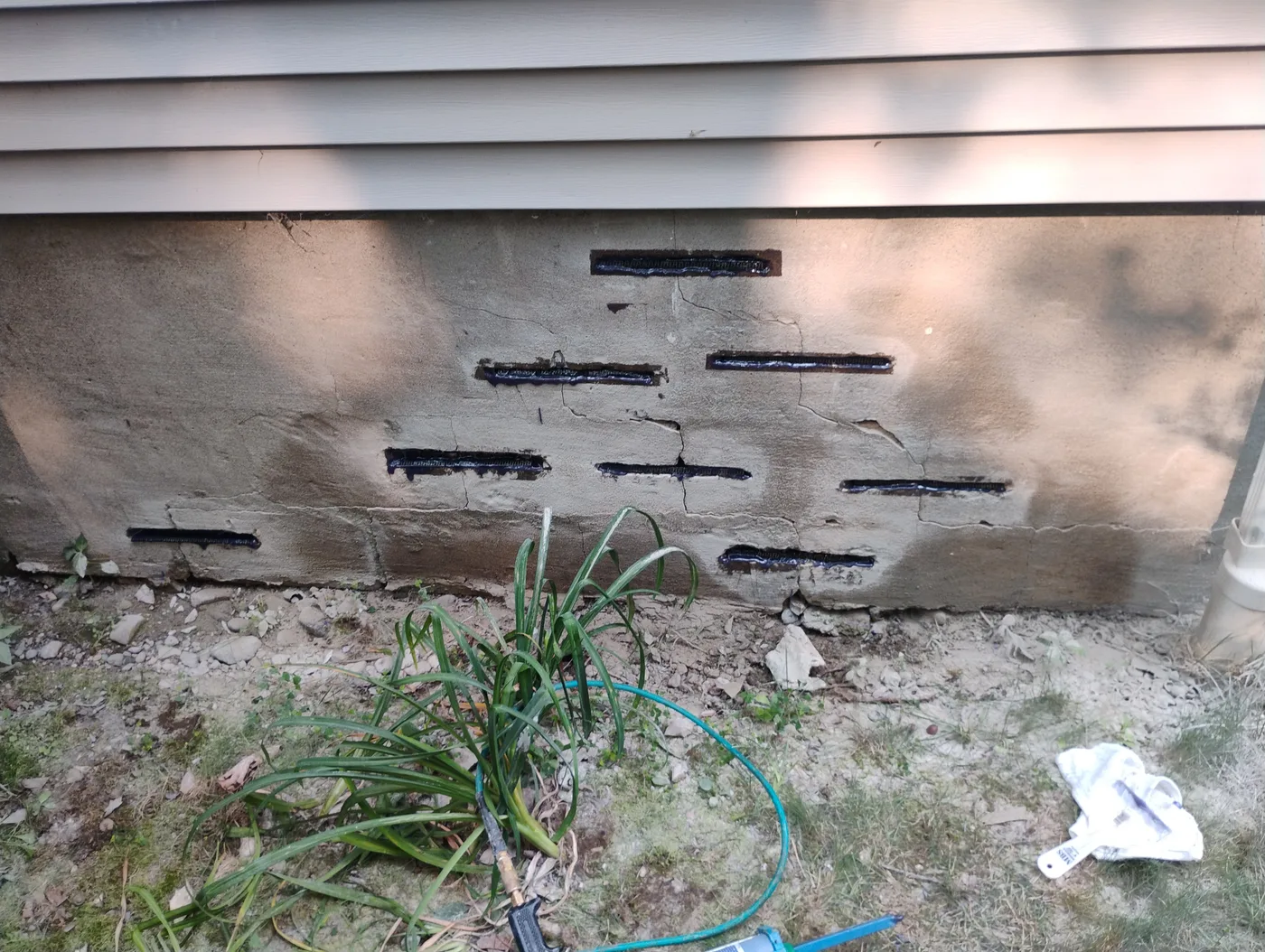
A staple (or stitch) is a piece of carbon fiber reinforcement about 12 inches long that is embedded across a crack. We carve a shallow groove into the concrete on each side of the crack, lay the carbon fiber link into the groove, and bond it with structural epoxy. The staple bridges the crack and prevents the two sides from pulling apart.
What staples do:
- Hold a crack together so it stops widening
- Prevent water from entering through the crack
- Restore structural continuity across the break
- Sit flush with the wall — paintable and nearly invisible
What staples cost: $200–$300 per staple. Most cracks need 2–5 staples depending on length. A typical single-crack repair runs $400–$1,500.
When to use staples: You have a foundation crack — vertical, diagonal, or stair-step — and the wall itself is not bowing or moving. The crack needs to be held together, not the whole wall stabilized.
Straps: A Completely Different Repair
Carbon fiber straps are full-height reinforcements that run from the footing at the bottom of the wall to the sill plate at the top. A strap is typically 12 inches wide and covers the entire vertical span of the basement wall. It is bonded to the wall surface with structural epoxy and anchored at both the top and bottom.
Where a staple bridges a single crack, a strap reinforces an entire wall against lateral soil pressure.
What straps do:
- Stabilize a wall that is bowing inward from soil pressure
- Distribute reinforcement across the full height of the wall
- Prevent further inward deflection (they do not push the wall back)
- Resist hydrostatic pressure, freeze-thaw forces, and clay expansion
What straps cost: $800–$1,500 per strap installed. A typical basement wall needs 4–6 straps spaced every 4 feet. Total cost: $3,200–$9,000 per wall.
When to use straps: Your wall has a horizontal crack and is visibly bowing inward. The wall below the crack line is deflecting into the basement. This is a structural problem — not just a crack — and it requires full-wall stabilization.
For walls with significant bowing, carbon fiber straps provide full-wall stabilization — ask us about the best approach for your situation.
The Decision Guide
| Your Situation | What You Need | Cost Range |
|---|---|---|
| Single crack, wall is straight | Staples (2–5 per crack) | $400–$1,500 |
| Multiple cracks, wall is straight | Staples at each crack | $800–$3,000 |
| Horizontal crack, wall bowing < 2” | Carbon fiber straps | $3,200–$9,000/wall |
| Wall bowing > 2” | Wall anchors or I-beams | $4,000–$15,000/wall |
| Wall buckled or separating from sill | Structural engineer first | Varies |
The key question is simple: is the wall moving, or just cracked? If the wall is straight and the crack is the only issue, staples. If the wall is bowing inward, straps.
Why Carbon Fiber for Either Repair
Whether you need staples or straps, carbon fiber is the material of choice for the same reasons:
Tensile strength. Carbon fiber has approximately 195,000 PSI tensile strength — roughly ten times stronger than steel by weight. A carbon fiber strap is about as thick as a credit card but stronger than a steel beam of equivalent cross-section in tension.
No corrosion. Steel reinforcements rust in wet basement environments. Carbon fiber does not rust, rot, or degrade. It maintains full strength indefinitely.
Low profile. Both staples and straps sit nearly flush with the wall surface. Paint over them and they are invisible. No lost basement square footage, no steel beams protruding into the room.
No excavation. Both repairs are done entirely from inside the basement. No digging up landscaping, no heavy equipment in the yard.
When Carbon Fiber Is Not Enough
Carbon fiber — whether staples or straps — has limits.
Staples cannot stabilize a bowing wall. If the wall is moving inward, staples across a crack will not stop it. You need straps or another wall stabilization method.
Straps cannot straighten a wall. If the wall has bowed more than 2 inches, straps will hold it where it is, but they will not push it back. For walls that need to be gradually straightened, wall anchors or steel I-beams are the better option.
Neither works on walls that have buckled. If the wall has broken into segments or separated from the sill plate, you need a structural engineering assessment before any reinforcement is applied.
The biggest mistake homeowners make is waiting. A crack that needs $600 in staples today can become a bowing wall that needs $6,000 in straps next year. Every freeze-thaw cycle pushes the wall a fraction of an inch further.
Get an Assessment
Not sure whether your wall needs staples or straps? Text us a photo — we can usually gauge severity from a photo. Or schedule a free foundation consultation and we will measure the deflection and tell you exactly what your wall needs. 860-573-8760 (CT) | 617-668-1677 (MA)Not sure whether your wall needs staples or straps? Text us a photo — we can usually gauge severity from a photo. Or schedule a free foundation consultation and we will measure the deflection and tell you exactly what your wall needs. 860-573-8760 (CT)Not sure whether your wall needs staples or straps? Text us a photo — we can usually gauge severity from a photo. Or schedule a free foundation consultation and we will measure the deflection and tell you exactly what your wall needs. 617-668-1677 (MA)