“How much does basement waterproofing cost?” is a question with a frustrating answer: somewhere between $800 and $30,000. That range is about as helpful as telling someone a car costs between $5,000 and $150,000. Technically true, practically useless.
The reason for that absurd range? “Basement waterproofing” covers everything from sealing a single crack to excavating your entire foundation. And in New England, where our winters actively conspire against basements, knowing which solution you actually need is the difference between spending $1,000 and spending $25,000.
Let’s break down every option, what it costs, and — most importantly — which one you probably need.
How Much Does Basement Waterproofing Cost in 2026?
| Solution | Typical Cost | Best For |
|---|---|---|
| Crack injection | $800 - $1,300 per crack | Water entering through visible cracks |
| Sump pump installation | $800 - $2,000 | Managing groundwater in low spots |
| Interior French drain | $3,000 - $8,000 | Widespread seepage along walls |
| Vapor barrier | $1,500 - $4,000 | Moisture control in crawl spaces |
| Exterior waterproofing | $10,000 - $30,000 | Severe or persistent water intrusion |
| Bulkhead sealing | $1,800 - $2,500 | Leaking basement bulkheads |
These are 2026 estimates for the New England market — Connecticut, Massachusetts, Rhode Island, New Hampshire, and Maine. Your actual costs depend on factors we will cover below.
Cost by Basement Size
The total cost of waterproofing scales with your basement’s footprint — but only for perimeter-based solutions like drainage systems and exterior waterproofing. A single crack injection costs the same whether your basement is 500 or 2,000 square feet.
| Basement Size | Typical Cost Range |
|---|---|
| 500 sq ft | $1,500 - $5,000 |
| 750 sq ft | $2,000 - $7,500 |
| 1,000 sq ft | $3,000 - $10,000 |
| 1,500 sq ft | $4,500 - $15,000 |
| 2,000 sq ft | $6,000 - $20,000 |
These ranges assume a full interior drainage system or comparable perimeter solution. A targeted repair like crack injection at $800 per crack does not change with basement size, so do not assume you need to spend based on square footage alone. Get a diagnosis first.
Signs Your Basement Needs Waterproofing
Not every damp basement needs a $10,000 drainage system — but every one of these signs means you should be paying attention:
- Water stains on walls or floor — Brown or dark lines along walls or slab edges indicate past water intrusion, even if the basement looks dry today.
- Efflorescence (white mineral deposits) — That white, chalky powder on your foundation walls is dissolved minerals left behind when water evaporates through concrete. It means water is actively moving through your walls. Our guide to efflorescence explains what it means and when to act.
- Musty smell — If your basement smells damp or earthy, moisture is present even if you cannot see it. Mold and mildew thrive in exactly these conditions. See our musty basement smell guide for diagnosis steps.
- Peeling paint or bubbling walls — Moisture behind the surface pushes paint and coatings off concrete. This is your wall telling you water is coming through.
- Condensation on walls or pipes — Sometimes confused with a leak, condensation means humid air is meeting cold foundation surfaces. A dehumidifier may help, but persistent condensation often signals deeper moisture migration.
- Standing water after rain — The most obvious sign. If water pools on your floor during or after storms, you have active water entry that needs addressing.
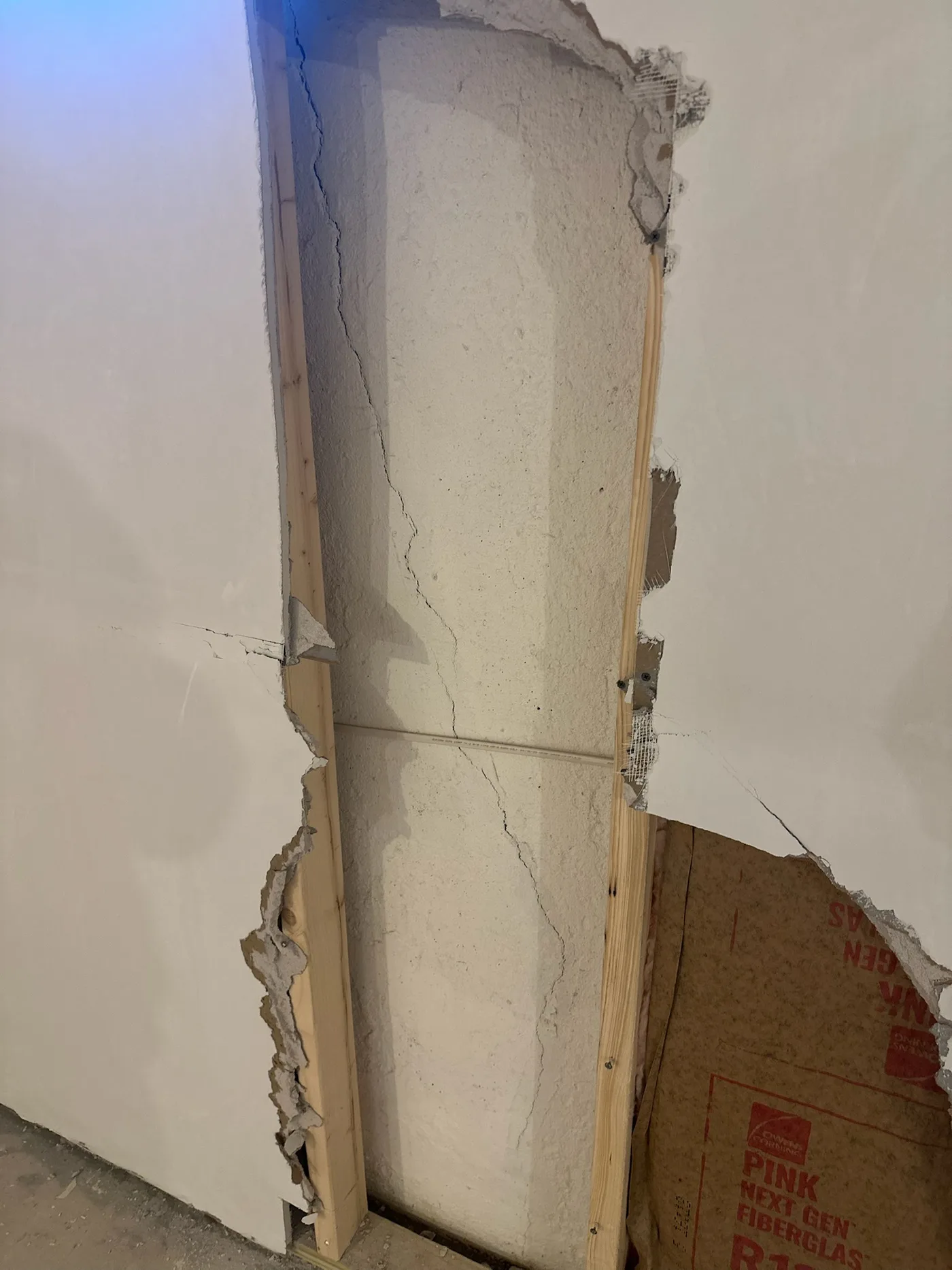
- Visible cracks with moisture — Any crack that is damp, stained, or actively dripping is a current entry point. These only get worse through New England’s freeze-thaw cycles.
If you are seeing one or two of these signs, you likely need a targeted fix. If you are checking off four or more, a more comprehensive solution may be warranted.
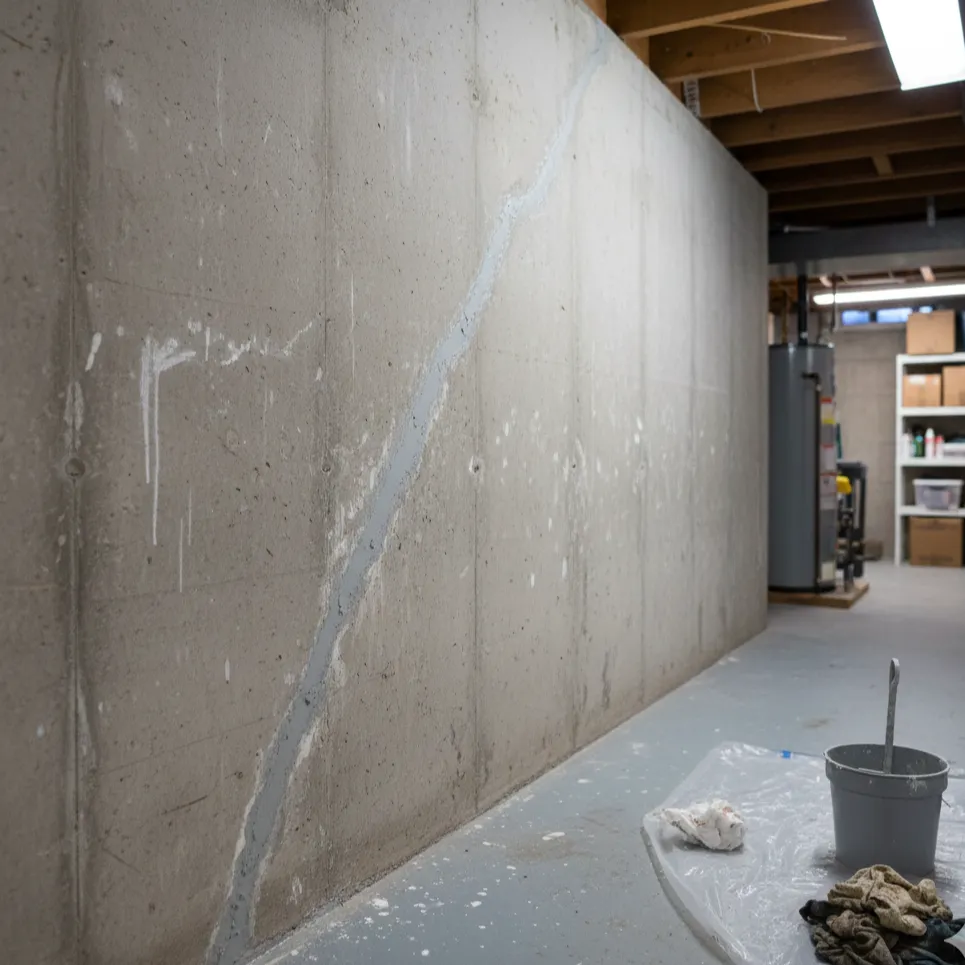
Option 1: Crack Injection ($800 - $1,300 Per Crack)
Here is a secret the waterproofing industry would prefer you not know: most basement water problems come through cracks, and cracks can be sealed individually.
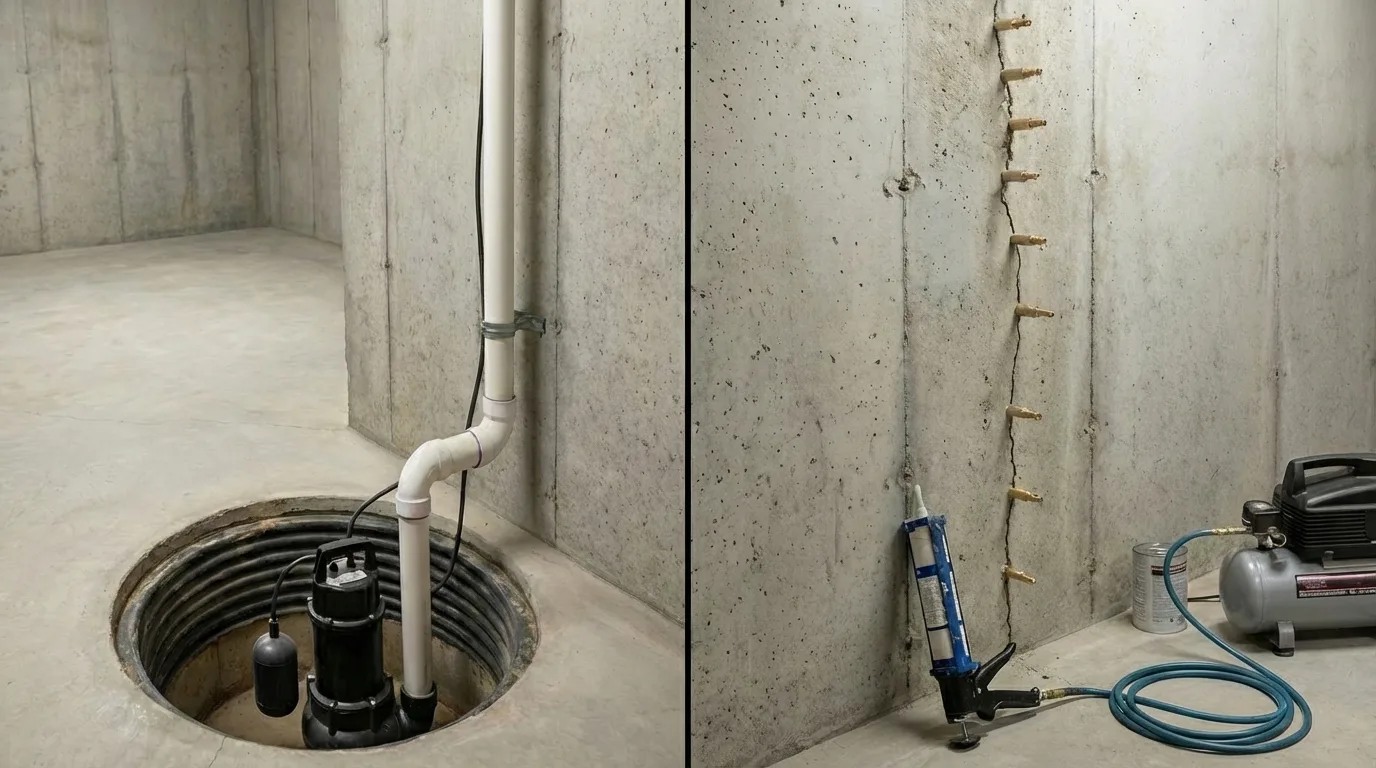
Foundation crack injection involves injecting flexible polyurethane or structural epoxy at approximately 100 PSI into the crack, filling it from the inside face of the wall all the way through to the outside — typically through 8-10 inches of concrete. The material bonds to the concrete and seals the entry point permanently.
When this is your answer (you notice water in basement after rain):
- You can see where water enters during rain
- Water appears at specific locations, not everywhere
- You have visible vertical or diagonal cracks
- The problem started after you noticed cracking
When NOT to use crack injection: If water is entering from everywhere — along the entire wall-floor joint, through the floor slab, or from multiple directions with no visible cracks — your problem is likely hydrostatic pressure, not individual cracks. Injection cannot seal what it cannot reach.
Cost factors:
- Number of cracks (multi-crack discounts are common)
- Crack length and width
- Accessibility
- Whether the crack is actively leaking during repair
For a deeper dive on this topic, our guide on basement waterproofing vs. foundation repair explains exactly when crack injection is the right call and when you need more.
Option 2: Sump Pump Installation ($800 - $2,000)
A sump pump does not stop water from entering your basement. Let’s be clear about that. It manages water that has already arrived by collecting it in a pit and pumping it away from your foundation.
Basic pedestal pump: $800 - $1,300. Gets the job done but sits above the pit, runs louder, and has a shorter lifespan.
Submersible pump: $1,200 - $2,000. Sits inside the pit, runs quieter, handles more volume, lasts longer. This is what we recommend for most New England homes.
Battery backup system: Add $500 - $1,000. In a region where nor’easters knock out power every winter, a battery backup is not optional — it is essential. The worst time for your sump pump to stop working is during the storm that is filling your basement.
When this is your answer:
- High water table pushes groundwater through the slab
- You get water in the lowest point of your basement
- Water appears even without rain (groundwater-driven)
For a comparison of these two approaches, see our piece on sump pumps vs. crack injection.
Option 3: Interior French Drain System ($3,000 - $8,000)
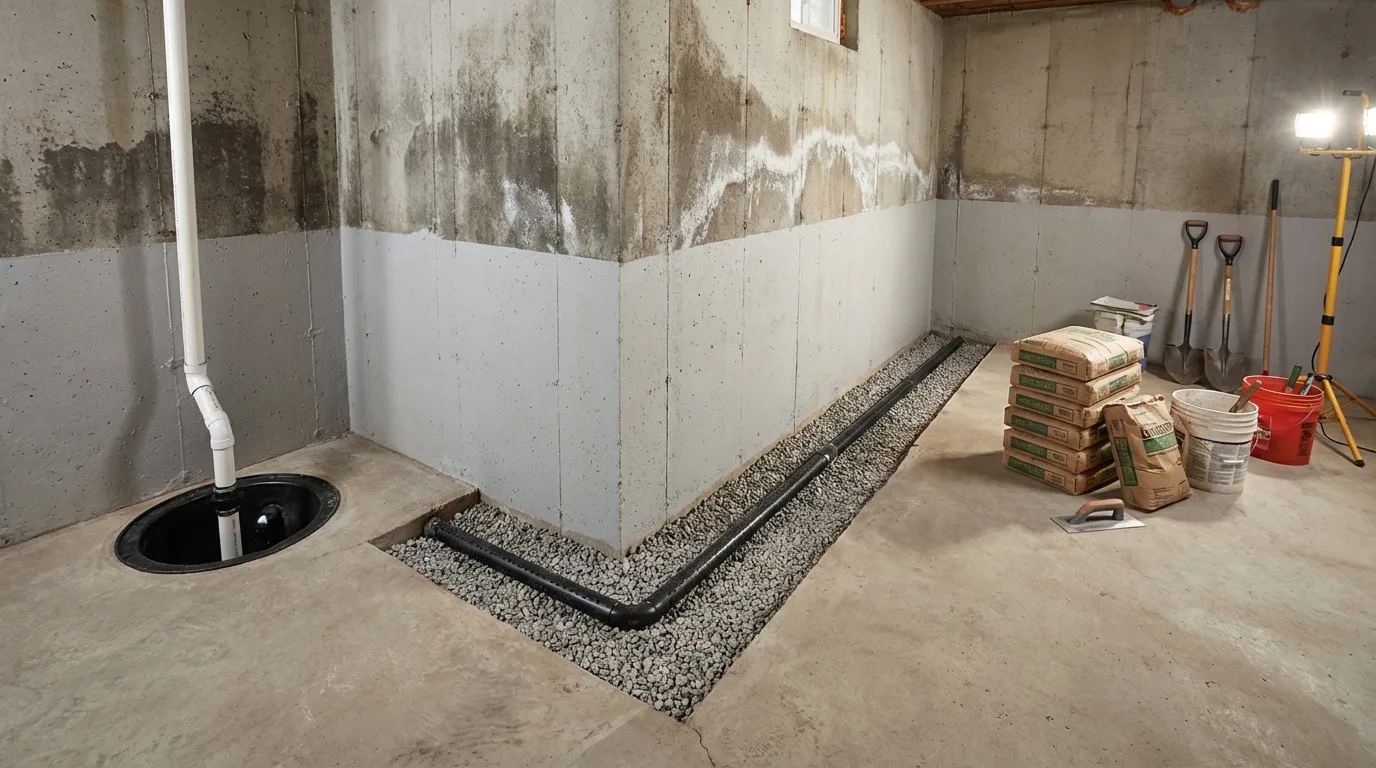
An interior French drain (also called a perimeter drain or drain tile system) involves cutting a channel along the inside perimeter of your basement floor, laying perforated pipe in gravel, and directing water to a sump pump.
What affects cost:
- Linear footage (most basements need 60-150 linear feet)
- Whether you are doing full perimeter or partial
- Sump pump inclusion
- Concrete floor condition and thickness
When this is your answer:
- Water seeps in along the wall-floor joint (the cove joint)
- Multiple areas of seepage you cannot trace to specific cracks
- Hydrostatic pressure pushes water through the slab
- Prior crack repairs have not solved the problem
Reality check: Interior French drains are a solid solution for the right problem, but they are also the most commonly oversold waterproofing product. We have seen plenty of homeowners pay $6,000 for a drain system when $1,000 in crack injection would have fixed their issue. Always get a diagnosis before agreeing to a solution.
Option 4: Vapor Barriers ($1,500 - $4,000)
Vapor barriers are heavy-duty plastic sheeting installed on basement or crawl space walls and floors to block moisture migration through concrete.
When this is your answer:
- Damp or humid basement without visible water entry
- Crawl space moisture problems
- Musty smells without active leaks
- Condensation on walls during humid months
Vapor barriers work well for moisture control but do not address active water entry. If you have water coming through cracks or joints, a vapor barrier is a bandage on a wound that needs stitches.
Option 5: Exterior Waterproofing ($10,000 - $30,000)
This is the nuclear option. Exterior waterproofing involves excavating around your foundation down to the footings, applying waterproof membrane or coating to the outside of the walls, and installing or replacing exterior drain tile.
Why it costs so much:
- Excavation requires heavy equipment
- Landscaping, walkways, and driveways may need to be removed and replaced
- The work takes multiple days to complete
- Material costs for membrane and drainage are significant
When this is your answer:
- Interior solutions have failed
- Foundation walls show deterioration on the exterior
- You are also addressing exterior grading or drainage
- Major renovation where exterior is already exposed
When it is overkill: Most of the time. Exterior waterproofing is legitimate but is also the highest-margin service for waterproofing companies. Before committing to a $20,000 exterior job, get a second opinion that includes less invasive options.
Option 6: Bulkhead Sealing and Bulkhead Sealant ($1,800 - $2,500)
New England basements love their bulkheads, and bulkheads love leaking. The joint where the bulkhead meets the foundation is a perennial weak point, and the bulkhead itself can rust, crack, or separate from the house. Proper bulkhead sealant and structural repair addresses the entire assembly — not just the visible gap.
Leaky bulkhead repair addresses the seals, joints, and connections that let water pour in during every rainstorm. For a detailed cost breakdown, check out our bulkhead repair cost guide.
What Affects Your Total Cost
Home Size and Foundation Perimeter
A 1,000-square-foot basement has roughly 130 linear feet of perimeter. A 2,500-square-foot basement has over 200. For perimeter-based solutions, more wall means more money.
Water Source and Volume
A single crack leaking during heavy rain is a very different problem from six inches of standing water after every storm. Diagnosis matters more than anything.
Accessibility
Can equipment reach your foundation? Is the work area clear, or buried under finished basement walls? Demolition and restoration of finished spaces add thousands.
Soil Conditions
New England soil ranges from sandy coastal ground on the South Shore to heavy clay-heavy glacial till in river valleys. Clay soils hold more water against foundations and create more hydrostatic pressure, often requiring more aggressive solutions. In areas with glacial till deposits — common across Connecticut, Massachusetts, and Rhode Island — the mix of clay, sand, and gravel creates unpredictable drainage patterns that vary block by block.
Foundation Type
What your foundation is made of significantly affects waterproofing approach and cost:
- Poured concrete (most homes built after the 1960s) is the most straightforward to waterproof. Cracks are predictable, injection works reliably, and the surface is uniform. This is the best-case scenario for cost.
- Cinder block / concrete block has far more potential entry points. Water can enter through mortar joints, the hollow cores of the blocks, and cracks in the blocks themselves. Sealing a block foundation often requires more extensive work than poured concrete — sometimes interior drainage rather than spot repairs.
- Fieldstone foundations (pre-1900 homes, common across New England) require specialized approaches. The irregular surfaces, lime mortar joints, and lack of a continuous barrier mean standard injection and membrane techniques do not apply. Expect fieldstone waterproofing to cost significantly more — often 2-3x the price of comparable work on poured concrete. Our fieldstone foundation repair guide covers the unique challenges.
If you are not sure what your foundation is made of, a quick look at the basement walls will tell you. Smooth and gray is poured concrete. Rectangular blocks with visible mortar lines is cinder block. Irregular natural stones of varying sizes is fieldstone.
Existing Drainage
If your home already has functional gutters, proper grading, and downspout extensions, the waterproofing solution can focus on the foundation itself. If your gutters dump water against the house and the ground slopes toward the foundation, those issues need addressing first — sometimes for free with a Saturday afternoon and a shovel.
The Smart Approach: Diagnose Before You Spend
Here is our honest recommendation after decades of foundation work across New England:
- Start by texting us a photo. We can usually identify where water enters and why without an on-site visit.
- Address the simplest solution first. Fix grading and gutters. Seal visible cracks. These low-cost steps solve the problem for a surprising number of homeowners.
- Escalate only if needed. If targeted repairs do not solve it, then consider drain systems or more invasive approaches.
- Get multiple opinions. Any company that walks into your basement and immediately recommends a $15,000 system without discussing simpler options is selling, not diagnosing.
The foundation repair cost guide covers the structural repair side of the equation if your issue goes beyond water management.
New England-Specific Considerations
Our freeze-thaw cycles are uniquely harsh on foundations. Water that enters small cracks freezes, expands, and widens the crack. Next spring, more water enters the now-larger crack. Repeat for a few decades and you understand why that “tiny crack” became a river.
This means timing matters. Fall is ideal for waterproofing work — after the summer humidity drops and before the ground freezes. Spring is the second-best window, once the frost is out and before the wet season peaks.
Frequently Asked Questions
Does homeowners insurance cover basement waterproofing?
No. Homeowners insurance considers waterproofing to be preventive maintenance, which is excluded from standard policies. Flood insurance — available through FEMA’s National Flood Insurance Program or private insurers — is a separate product entirely.
The exception: sudden, accidental water damage. If a pipe bursts and floods your basement, your homeowners policy may cover the damage and cleanup. But the waterproofing work to prevent future problems? That is always out of pocket. The good news is that most targeted waterproofing solutions cost far less than most homeowners expect.
Can I DIY basement waterproofing?
Some of it, yes. You can apply waterproof sealant paint to walls, improve exterior grading so water flows away from the foundation, clean and extend gutters and downspouts, and run a dehumidifier for moisture management. These steps are free or cheap and solve more problems than people realize.
But crack injection, interior drainage systems, and exterior waterproofing need a professional. DIY crack injection kits sold at hardware stores rarely achieve the 100 PSI pressure needed to fill a crack from inside face to soil side. Interior drainage requires cutting concrete, managing pitch and flow, and tying into a properly sized sump system. Get any of that wrong and you have spent money to move your water problem from one spot to another.
How long does basement waterproofing last?
It depends entirely on the method:
- Crack injection (polyurethane): Lifetime warranty from us. The flexible material moves with the concrete through freeze-thaw cycles without breaking the seal.
- Interior drainage systems: 20-30 years for the drain tile, though the sump pump will need replacement every 7-10 years.
- Exterior waterproofing membrane: 20+ years when properly installed and protected.
- Sealant paint: 2-5 years. This is a maintenance item, not a permanent fix.
How long does it take to waterproof a basement?
- Crack injection: A few hours per crack. You can use the basement the same day.
- Interior French drain: 2-3 days for a typical installation, including concrete cutting, pipe laying, sump pump setup, and concrete patching.
- Exterior excavation: 1-2 weeks depending on foundation size, soil conditions, access, and how much landscaping or hardscaping needs to be removed and restored.
Is basement waterproofing worth it?
Almost always, yes. An unresolved water problem can reduce your home’s sale price by 10-25%, and it kills deals entirely when buyers see active water during inspection. Appraisers and home inspectors flag water intrusion as a major deficiency.
Most targeted repairs — crack injection at $800-$1,300, a sump pump at $1,200-$2,000 — cost far less than the value they protect. Even a $5,000 interior drainage system pays for itself many times over if it preserves $30,000-$50,000 in home equity. Beyond resale, waterproofing protects stored belongings, prevents mold growth, and makes your basement a usable living space.
What is the difference between waterproofing and damp proofing?
Damp proofing resists moisture vapor only — it is a thin, asphalt-based coating applied to the exterior of foundation walls during construction. It was standard practice for decades and meets minimum building code.
Waterproofing resists liquid water under hydrostatic pressure, using thicker membranes, drainage boards, or interior drainage systems. It is a fundamentally more robust approach.
The distinction matters because many New England homes built before the 1980s only have damp proofing. That thin coating deteriorates over decades, and once it fails, your basement has no barrier against groundwater. If your older home has started leaking when it never did before, degraded damp proofing is often the root cause.
Bottom Line
Most New England homeowners with basement water issues need a solution in the $800 - $3,000 range, not the $15,000 - $30,000 range. The key is accurate diagnosis.
If water enters through identifiable cracks, crack injection at $800 - $1,300 per crack is your most cost-effective solution. If the problem is more widespread, interior drainage with a sump pump in the $3,000 - $8,000 range handles most situations.
Exterior waterproofing has its place, but it should be the last resort — not the first recommendation.
Ready to find out what your basement actually needs? Text us a photo of your basement problem for a quick assessment — we will tell you what we see, what it needs, and what it costs, even if the answer is “fix your gutters and call us if it does not improve.” After 50+ combined years of foundation work across New England, we have seen every combination of water, soil, and concrete. Your basement is not a mystery to us. 860-573-8760 (CT) | 617-668-1677 (MA)Ready to find out what your basement actually needs? Text us a photo of your basement problem for a quick assessment — we will tell you what we see, what it needs, and what it costs, even if the answer is “fix your gutters and call us if it does not improve.” After 50+ combined years of foundation work across New England, we have seen every combination of water, soil, and concrete. Your basement is not a mystery to us. 860-573-8760 (CT)Ready to find out what your basement actually needs? Text us a photo of your basement problem for a quick assessment — we will tell you what we see, what it needs, and what it costs, even if the answer is “fix your gutters and call us if it does not improve.” After 50+ combined years of foundation work across New England, we have seen every combination of water, soil, and concrete. Your basement is not a mystery to us. 617-668-1677 (MA)