Understanding Fieldstone Foundations
Fieldstone foundations are a defining feature of historic New England architecture. Built from stones gathered from farm fields—hence the name—these foundations supported homes for generations before modern concrete became standard. If your home has a fieldstone foundation, you own a piece of New England history.
What Is a Fieldstone Foundation?
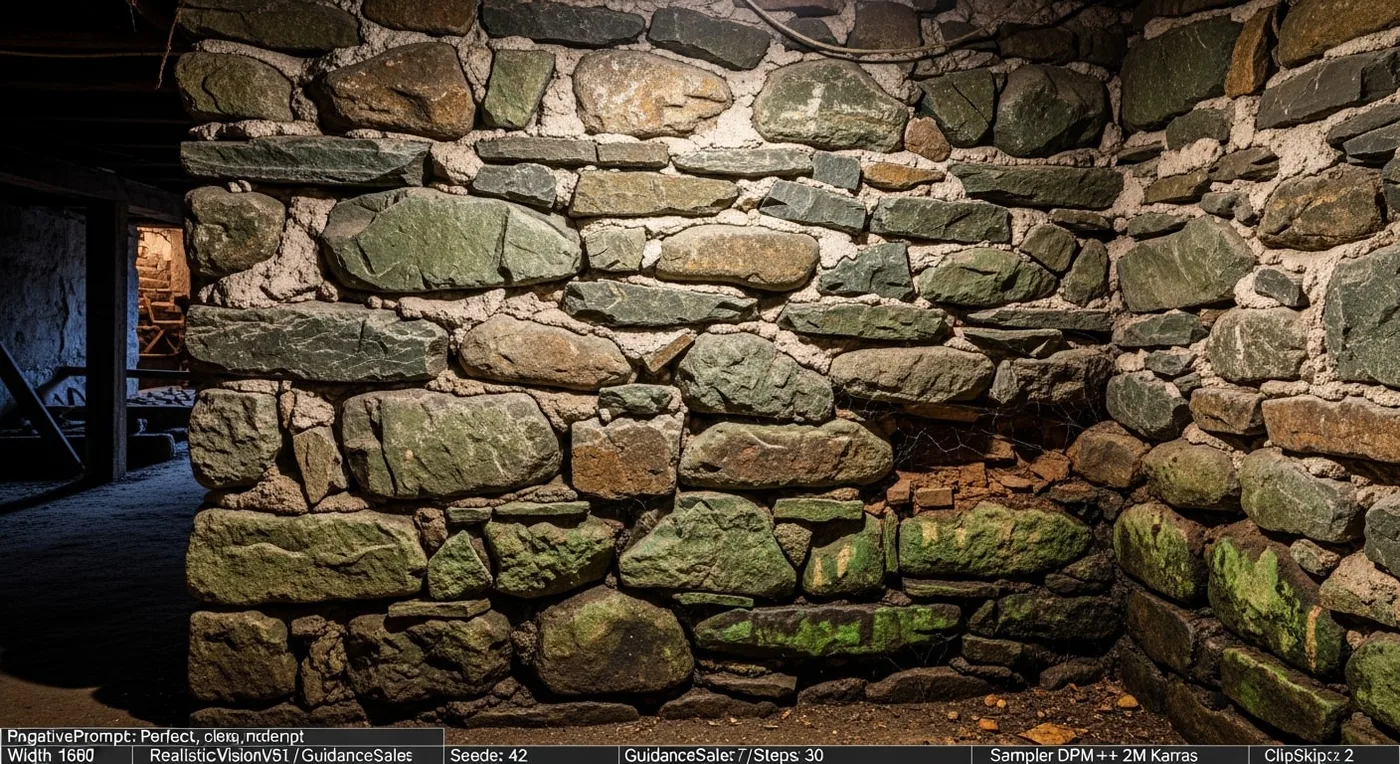
Fieldstone foundations are constructed from naturally occurring rocks, typically granite, schist, or other locally available stone. Early builders selected stones for their flat surfaces and stacked them with lime-based mortar to create basement walls. Unlike modern poured concrete, fieldstone foundations are essentially carefully assembled stone walls.
Characteristics:
- Age: Most date from 1700s-1900s
- Material: Local glacial till stones, often granite
- Mortar: Original lime-based, may have been repointed with Portland cement
- Thickness: Typically 18-24 inches
- Appearance: Irregular, textured surface with visible stones
Common Fieldstone Foundation Problems
Mortar Deterioration
The mortar between stones breaks down over time. Original lime mortar is softer than the stone, so it wears first—this is actually by design, as it’s easier to repoint mortar than replace stones. Problems arise when:
- Gaps allow water infiltration
- Stones become loose
- Previous repairs used incompatible cement (Portland cement is too hard)
Water Infiltration
Fieldstone foundations are inherently more porous than modern concrete. Water in basement after rain is extremely common with fieldstone — water enters through:
- Gaps in deteriorating mortar
- Porous stone surfaces
- The stone-to-soil interface, especially in clay-heavy soil and glacial till
- Inadequate exterior drainage and high water table conditions
Signs include white powder on basement walls (efflorescence), a persistent musty smell in your basement, and visible dampness across large wall areas.
Structural Movement
Over time, some fieldstone walls may:
- Bulge inward from lateral soil pressure and freeze-thaw cycles
- Settle unevenly
- Show displaced stones
- Develop cracks in mortar lines
Our Approach to Fieldstone Repair
Our Massachusetts branch handles limited fieldstone foundation repairs. We focus on repointing and injection — the techniques where we can deliver reliable results.
Photo-Based Assessment
Every fieldstone foundation is unique. Send us photos of your foundation and we’ll evaluate:
- Overall condition and construction type
- Previous repairs (and their quality)
- Visible moisture issues or deterioration
- Whether the problem is something we can help with
- If an on-site visit is warranted
Limited Mortar Restoration
We do limited repointing on fieldstone foundations where the scope is manageable:
- Compatible mortar mixes for historic stone
- Focused on specific deteriorated areas
- Breathable mixes that allow moisture to escape
- For extensive repointing needs, we’ll refer you to a mason who specializes in historic stone work
Water Management
For wet fieldstone basements, we can help with crack injection where applicable. However, interior drainage systems, sump pump installation, and vapor barriers are not services we provide — we’d refer you to a waterproofing contractor for those. Exterior drainage improvements are also outside our scope.
Structural Reinforcement (Limited)
For walls showing movement from freeze-thaw cycles and lateral soil pressure, we can provide:
- Carbon fiber staples (reinforcement stitches) at $200-$300 per stitch — a targeted reinforcement technique for specific crack areas
Steel I-beam supports, helical tiebacks, and targeted wall rebuilding are not services we offer — these require a structural contractor, and we’ll refer you to one if that’s what your foundation needs. See our foundation repair vs replacement guide for more context on when repairs aren’t enough.
What We Don’t Do
We believe in honest assessment. Fieldstone foundations often need work that’s outside our scope, and we’ll tell you upfront rather than take on something we can’t deliver well:
- I-beam supports and helical tiebacks — structural stabilization beyond carbon fiber stitches
- Interior drainage, sump pumps, and vapor barriers — waterproofing systems
- Major rebuilds requiring full wall replacement
- Extensive repointing beyond limited, targeted mortar work
- Historic preservation requiring museum-quality restoration
- Archaeological concerns on historically significant structures
If your fieldstone foundation needs something we don’t do, we’ll let you know and refer you to the right specialist.
Serving Massachusetts
We handle limited fieldstone foundation repairs in Massachusetts, including Greater Boston, South Shore, North Shore, and Central MA.
Many of our clients own historic homes in communities like Cambridge, Salem, Concord, Lexington, and other historic Massachusetts towns.
Get Your Fieldstone Foundation Assessed
Wondering if your fieldstone foundation needs attention? Contact us for a free assessment:
860-573-8760 (CT) | 617-668-1677 (MA)860-573-8760 (CT)617-668-1677 (MA)
Text us a photo for a preliminary assessment, or call to schedule — with 50+ years of combined experience and thousands of projects, we’ll evaluate your foundation honestly and explain your options clearly.