Most homeowners think of ice dams as a roofing problem. And they are — ice dams can tear up shingles, rot fascia boards, and send water streaming into your attic. But here is the thing nobody talks about: the water that overflows your gutters has to go somewhere, and that somewhere is straight down to your foundation.
After 50+ combined years of repairing foundations across New England, we can tell you with certainty that ice dam season and foundation crack season are not a coincidence. They are cause and effect.
How Ice Dams Form (The 60-Second Version)
If you already know this part, skip ahead. But for the uninitiated: ice dams form when heat escaping through your roof melts snow from underneath. That meltwater runs down toward the eaves, where the roof is colder (because it extends past your heated living space), and refreezes. Over time, this creates a ridge of ice along the roof edge.
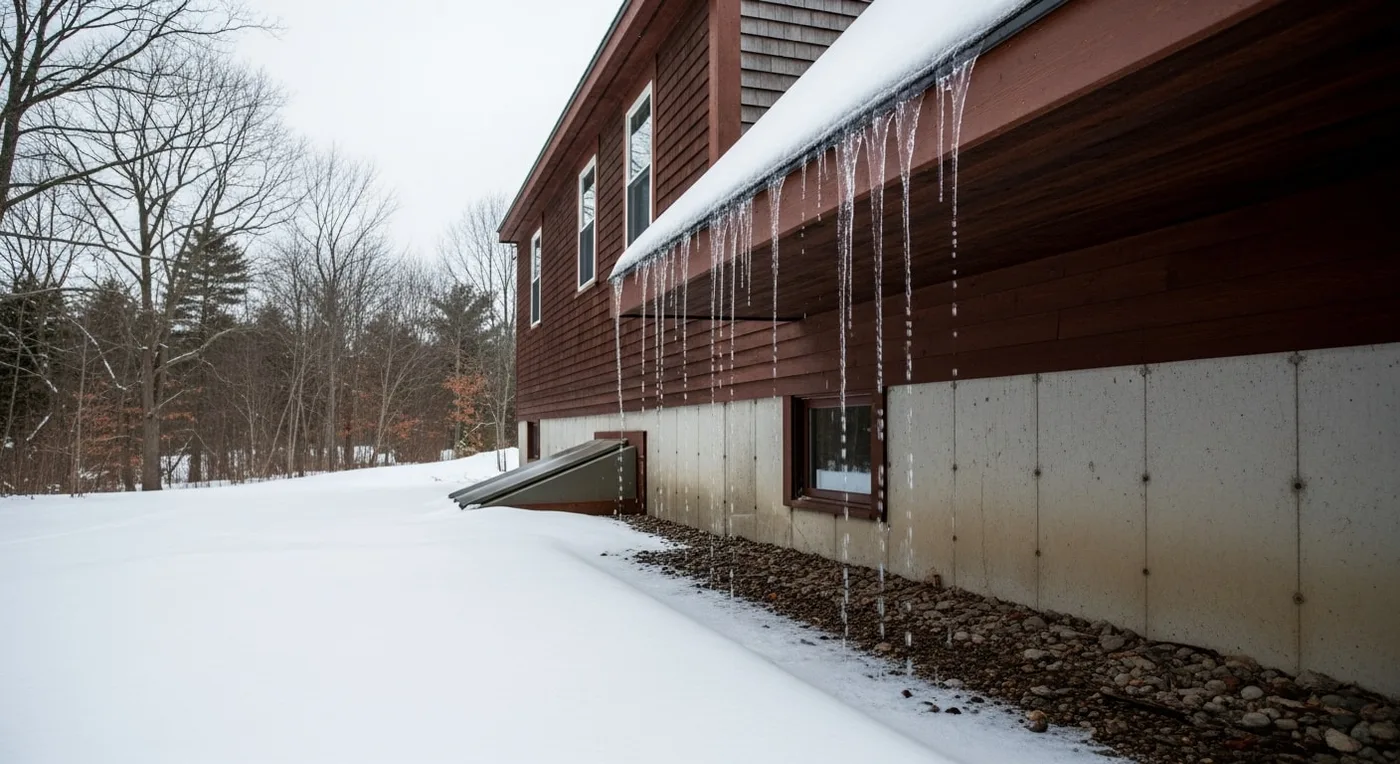
New meltwater backs up behind that ridge. It pools. It finds its way under shingles. And when the ice dam gets large enough, water cascades over the gutters in sheets.
This is where your foundation enters the story.
The Hidden Pathway: Roof to Foundation
Here is the chain of events that connects your roof to your basement, step by step:
Step 1: Gutter Overflow
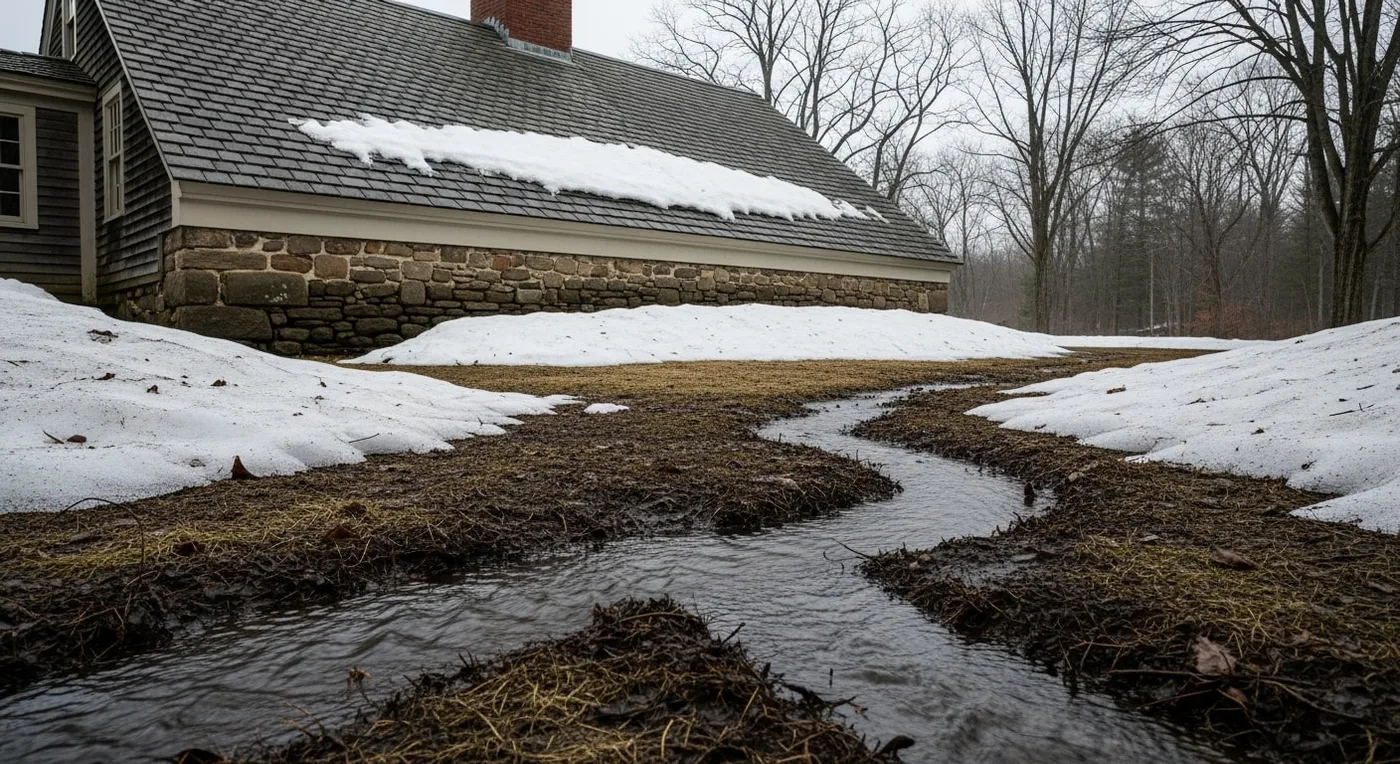
When ice dams block your gutters, meltwater pours directly off the roof edge. Instead of traveling through downspouts and away from your home, hundreds of gallons of water dump right next to your foundation wall. Every. Single. Day.
Step 2: Soil Saturation
All that water soaks into the ground immediately adjacent to your foundation. In a normal winter, your downspouts direct water 4-6 feet away from the house. With ice-dammed gutters, it is landing inches away. The soil against your foundation becomes completely saturated.
Step 3: Hydrostatic Pressure
Saturated soil is heavy soil. A cubic foot of dry soil weighs about 75 pounds. Saturated? Up to 110 pounds. Multiply that by the entire height and length of your foundation wall, and you are looking at thousands of pounds of lateral pressure pushing inward.
Step 4: Foundation Cracks
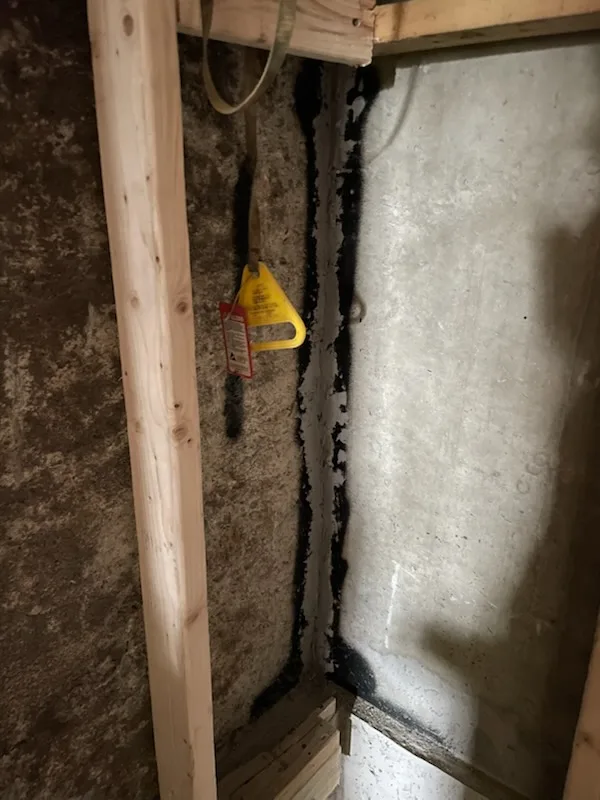
Poured concrete foundations can handle a lot of pressure, but they have limits. When hydrostatic pressure exceeds what the wall was designed for — especially at weak points like tie rod holes, cold joints, or previous repairs — cracks form. And once a crack forms, water follows.
This entire sequence can play out over a single bad winter. We have seen homeowners go from “never had water in the basement” to “active leak through a wall crack” in the span of one ice dam season.
The Freeze-Thaw Multiplier
As if hydrostatic pressure were not enough, New England adds another weapon: the freeze-thaw cycle.
Water that enters a hairline crack during the day freezes overnight when temperatures drop. When water freezes, it expands by about 9%. That expansion widens the crack ever so slightly. The next day, more water enters the now-wider crack. It freezes again. Expands again.
This process is relentless. A crack that starts thinner than a credit card in December can be letting in visible water by March. The freeze-thaw cycle is essentially a tiny hydraulic jack working against your foundation all winter long.
In a typical New England winter, we go through dozens of freeze-thaw cycles. Each one does a little more damage. By the time spring arrives, that “minor” crack may have become a genuine structural concern.
Signs of Ice Dam Foundation Damage
After an ice dam season, here is what to look for in your basement:
New cracks or wider cracks. Pay special attention to vertical cracks in poured concrete and stair-step cracks in block walls. If you marked cracks with tape or pencil last fall (smart move), check whether they have grown.
Water stains near the top of the wall. Ice dam-related water intrusion often shows up higher on the wall than you would expect, because the soil saturation is concentrated near the surface.
White powder on basement walls (efflorescence). Those chalky white streaks on your basement walls are mineral deposits left behind when water seeps through concrete and evaporates. Fresh efflorescence means recent water movement — a reliable indicator of ongoing water intrusion.
A musty smell in your basement. Your nose knows. If the basement smells different than it did in the fall, moisture is getting in somewhere — likely through cracks widened by freeze-thaw cycles.
Staining on the floor near walls. Water that enters through wall cracks often runs down to the floor joint and leaves visible marks.
If you spot any of these, do not write them off as “normal basement stuff.” Document what you find — photographs with a ruler for scale are invaluable — and keep reading.
Prevention: Breaking the Cycle at Every Level
The best foundation repair is the one you never need. Here is how to interrupt the ice dam-to-foundation pathway:
At the Roof
- Improve attic insulation. The less heat reaching your roof, the fewer ice dams. Current code for New England calls for R-49 to R-60 in attics.
- Ensure proper attic ventilation. Soffit and ridge vents keep the roof deck cold and uniform.
- Keep gutters clean. Leaves and debris make ice dams form faster and overflow sooner.
At the Ground
- Maintain proper grading. The ground around your foundation should slope away at least 6 inches over the first 10 feet. This is the single most impactful thing you can do.
- Extend downspouts. Even when gutters are working, make sure downspouts discharge at least 4-6 feet from the foundation.
- Clear snow from the foundation perimeter. When you are shoveling, push snow away from the house, not against it. Snowbanks against your foundation are slow-release water sources.
At the Foundation
- Repair existing cracks before winter. A crack that was dry all summer will not stay dry through an ice dam season. Foundation crack injection seals cracks permanently and prevents the freeze-thaw cycle from making them worse.
- Monitor known weak points. If you have had previous repairs or know where tie rod holes are, check those areas first.
When to Call a Professional
Some of this you can handle yourself. Improving grading, extending downspouts, clearing snow — those are weekend projects. But if you are seeing active water intrusion, new cracks, or cracks that have grown since fall, it is time for a professional assessment.
At Attack A Crack, we offer free foundation consultations throughout New England. We will assess the damage, explain exactly what is happening, and give you honest options — including “just monitor it” when that is genuinely the right call.
Here is our honest take after decades of foundation work: most ice dam-related foundation cracks are very fixable with crack injection or wall crack repair. The key is addressing them before another winter makes them worse. That freeze-thaw cycle does not take years off. It takes seasons.
If you have had ice dams this winter and something in the basement looks different, give us a call. We would rather tell you it is nothing than have you find a waterfall in your basement next January. 860-573-8760 (CT) | 617-668-1677 (MA)If you have had ice dams this winter and something in the basement looks different, give us a call. We would rather tell you it is nothing than have you find a waterfall in your basement next January. 860-573-8760 (CT)If you have had ice dams this winter and something in the basement looks different, give us a call. We would rather tell you it is nothing than have you find a waterfall in your basement next January. 617-668-1677 (MA)