What Is Basement Floor Crack Repair?
Basement floor crack repair is the process of grinding out cracks in a concrete basement slab and filling them with self-leveling epoxy or flexible rubber sealant. This permanently seals the crack against water seepage and radon gas infiltration while creating a smooth, durable surface that won’t re-crack.
Basement floor crack repair costs $500–$1,500 and permanently seals the pathways that let water and radon gas into your home. This Massachusetts-only service uses professional-grade self-leveling epoxy or commercial rubber — not the hardware store patches that fail within months. If you’re seeing water seep through floor cracks after rain or your radon test came back elevated, floor crack repair addresses both problems at once. Call 617-668-1677 or text us a photo for a free assessment.
Basement Floor Crack Repair in Massachusetts
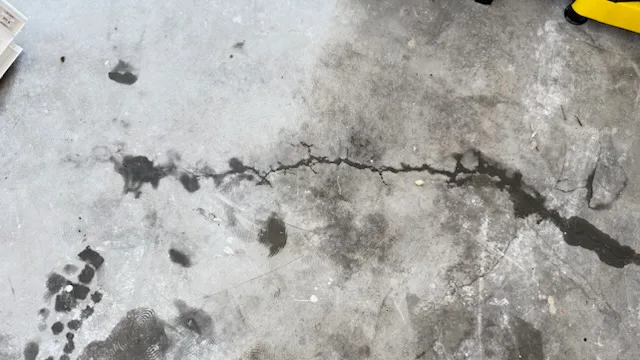
Cracks in your basement floor are more than cosmetic — they are open pathways for water and radon gas to enter your home. Whether you are seeing water seep up through the floor after rain, noticing a damp streak along a crack line, or your radon test came back high, fixing cracks in your basement floor permanently requires more than a bag of concrete patch from the hardware store.
Searching for “cement floor repair”? Cement is just one ingredient in concrete. Your basement floor is a concrete slab, and our repair process bonds directly to the existing concrete.
Why Basement Floors Crack
Every concrete slab cracks — it is a fundamental property of the material. The question is whether the crack is benign or problematic:
- Shrinkage cracks — the most common type. Concrete shrinks as it cures, and the slab cracks along natural stress points. These hairline cracks are normal but can still transmit water and radon.
- Settlement cracks — caused by soil settling unevenly beneath the slab. These are often wider and may show vertical displacement (one side higher than the other).
- Heaving cracks — caused by frost heave or expansive soil pushing the slab upward. Common in New England where frost penetration reaches 4 feet or deeper.
- Hydrostatic pressure cracks — groundwater pressure beneath the slab forces water up through cracks and the cove joint (where the floor meets the wall). This is the most common source of basement floor leaks.
- Control joint failures — builders cut control joints to direct cracking, but water and radon can enter through these joints just as easily as through random cracks.
When Floor Cracks Are Serious
Not every floor crack needs repair, but these signs indicate a problem that should be addressed:
- Water seeping through the crack during or after rain
- Damp or wet streak along the crack even without visible water
- Efflorescence (white mineral deposits) along the crack line
- Elevated radon levels — floor cracks are one of the primary entry points for radon gas
- Crack widening over time — measure and monitor with tape markers
- Vertical displacement — one side of the crack is higher than the other, indicating settlement or heaving
- Musty smell concentrated near the floor — hidden moisture feeding mold
How We Repair Basement Floor Cracks
Unlike wall cracks that we seal with injection, floor cracks require a different approach. We grind out the damaged concrete and fill with professional-grade materials that bond permanently and finish flush with your floor.
Step 1: Crack Assessment We evaluate each crack to determine its cause, depth, and whether it is actively leaking. This determines the right material and approach.
Step 2: Grinding and Preparation Using a diamond grinder, we open up the crack and remove all loose, deteriorated concrete. This creates a clean channel with fresh concrete surfaces for optimal bonding — the critical step that DIY repairs skip.
Step 3: Self-Leveling Epoxy or Rubber Seal Depending on the crack type and conditions, we apply one of two professional-grade materials:
- Self-leveling epoxy — flows into the prepared channel and bonds to the concrete on both sides, creating a rigid, waterproof seal that is stronger than the original slab. Best for stable cracks that need maximum strength and water resistance.
- Commercial-grade rubber surface seal — a flexible, durable coating that accommodates minor seasonal movement while maintaining a waterproof barrier. Best for cracks in areas subject to slight thermal expansion or where flexibility is needed.
Both materials finish flush with the surrounding floor and create a permanent seal against water and radon.
Step 4: Finishing The repair is smoothed level with the surrounding floor. The result is a clean, professional finish that is ready for foot traffic within hours.
Why DIY Patching Fails
We see the aftermath of DIY basement floor crack repair constantly. Here is why hardware store products do not work:
- No preparation — homeowners fill the surface of the crack without grinding out damaged concrete. The patch has nothing solid to bond to.
- Wrong materials — consumer-grade patching compounds are not formulated to bond to existing concrete under moisture pressure. They shrink, crack, and peel within months.
- No depth — surface patches cover the opening but do not fill the crack. Water finds its way around the patch.
- No radon seal — a surface patch does not create a gas-tight seal. Radon passes through the gap between the patch and the crack walls.
Sealing cracks in your basement floor requires grinding out the damage and filling with a material that chemically bonds to concrete. That is exactly what our process does.
Basement Floor Crack Repair Cost
Most basement floor crack repairs cost $500-$1,500, depending on the number of cracks, total length, and repair method required. Multiple cracks are common, and we offer fair pricing for multi-crack projects.
For context:
- DIY patching compound: $15-$30 per application (repeated every 6-12 months)
- Interior drainage system: $8,000-$15,000 (addresses symptoms, not the crack itself)
- Professional floor crack repair: $500-$1,500 (one-time, permanent)
Radon and Floor Cracks
Basement floor cracks are the primary entry pathway for radon gas into your home. Radon is a naturally occurring radioactive gas that rises through soil and enters through any gap in the concrete — cracks, control joints, and the cove joint where the floor meets the wall. New England has elevated radon levels: the EPA estimates that 1 in 5 homes in Connecticut and Massachusetts exceed the action level of 4 pCi/L.
Sealing floor cracks significantly reduces radon entry by eliminating the largest openings in the slab. While a dedicated radon mitigation system (sub-slab depressurization) is the gold standard for high radon levels, crack sealing is a critical complementary step — and for borderline readings, it may be enough on its own. If radon is a concern, get a radon test AND seal your cracks. The two approaches work together.
Interaction with Drainage Systems
If you have a sump pump or interior French drain, floor cracks near these systems need special attention. Water migrating through floor cracks can overwhelm your drainage system’s capacity during heavy rain events, especially during spring thaw when hydrostatic pressure peaks. Sealing floor cracks reduces the total water volume entering your basement, which in turn reduces the load on your sump pump and extends its lifespan. If your sump pump runs frequently, unsealed floor cracks may be contributing a significant portion of the water it’s handling.
After repair, maintain basement humidity below 60% to prevent condensation on the sealed surface and protect the repair. A dehumidifier is a worthwhile investment in any New England basement — it protects both the repair and your belongings.
Massachusetts Service Area
Basement floor crack repair is available throughout Massachusetts. We serve the Greater Boston area, South Shore, North Shore, MetroWest, Central MA, and Western MA.
For basement wall cracks in Connecticut, Massachusetts, or the rest of New England, see our foundation crack injection services available throughout the region.
Get Your Free Assessment
Text us a photo of your basement floor crack for a free evaluation. Most cracks can be assessed from photos alone, and we will tell you honestly whether professional repair is needed or if monitoring is sufficient.